Do this now
Follow these steps in order.
- 01
Choose the shrine program before booking transport: Kamo on October 10–11, Iwaoka on October 14–15, Isono on October 15–16 or Iizumi on October 16–17.
- 02
For Isono's October 16 river entry, use JR Iyo-Saijo Station, allow about 20 minutes to walk 1.5 km toward Isono Bridge and Bujo Park, and expect the approximate 17:15 timing to slip.
- 03
Use rail whenever possible. The official FAQ says there are no reserved viewing stands, and the city will publish the final 2026 route and traffic-control map only in early October.
- 04
Recheck the Saijo City festival page, the final traffic map and JMA warnings immediately before travel because the event has no published blanket weather policy or universal cancellation time.
What to know
Formal name, four shrine dates and what changes by district
The formal umbrella event is Saijo Festival 2026, a group of autumn rites held by Kamo, Iwaoka, Isono and Iizumi shrines in Saijo City, Ehime Prefecture. It is not one continuous parade at one venue. The official 2026 dates are October 10–11 for Kamo Shrine, October 14–15 for Iwaoka Shrine, October 15–16 for Isono Shrine and October 16–17 for Iizumi Shrine.
The official prefectural tourism listing describes six medium taikodai for Kamo, 27 danjiri and two mikoshi for Iwaoka, more than 80 danjiri and mikoshi for Isono, and 11 taikodai for Iizumi. Across Saijo and related programs, official visitor information commonly describes about 150 floats. Counts belong to different shrine programs and should not be treated as one simultaneous lineup.
Each program is a living shrine observance with early starts, neighborhood routes and its own finale. Choose one or two specific scenes instead of trying to chase every float across the city by car. Published times can slip as processions move through real streets.
What to know
Isono Shrine: departure, Goten-mae and October 16 river entry
Isono is the largest and most practical first choice for many international visitors. The official 2026 poster highlights the early-morning shrine departure on October 15 and the morning Goten-mae gathering in front of Saijo High School on October 16. Exact procession positions should be checked against the final 2026 map once the city publishes it.
The finale is kawa-iri, or river entry, near Isono Bridge and Bujo Park on October 16. Saijo City's visitor FAQ gives about 17:15 as the usual target time and warns that the procession often runs late. Treat 17:15 as an approximate ritual time, not a guaranteed show start or finish.
From JR Iyo-Saijo Station, the river-entry area is about 1.5 km away, roughly a 20-minute walk under normal conditions. Allow longer for crowds and controlled crossings, remain behind staff lines and never enter the water or float path for a photograph.
What to know
Kamo, Iwaoka and Iizumi: dates, access and scale
Kamo Shrine's program runs October 10–11. The practical rail stop is JR Ishizuchiyama Station, followed by an approximately 30-minute walk according to the city FAQ. The same official guidance says the shrine has no visitor parking, so this is not a drive-up alternative to the larger Isono program.
Iwaoka Shrine runs October 14–15. The municipal cultural guide lists a 09:00 all-float gathering on October 14, followed by local circulation. On October 15 the procession leaves before dawn and returns in the evening. JR Iyo-Himi Station is about a ten-minute walk, and parking is limited.
Iizumi Shrine runs October 16–17 with 11 taikodai. The city FAQ estimates about a 50-minute walk from JR Iyo-Saijo Station and notes limited parking. Final 2026 route times, road controls and suitable drop-off points for all three districts remain subject to the early-October traffic publication.
What to know
Tickets, reserved seats, capacity and viewing cost
General viewing from public festival areas is free. Saijo City's FAQ says there are no reserved spectator stands and asks visitors not to claim a place in advance. No general ticket, booking deadline, paid-seat inventory or sellout condition is announced for the four shrine programs.
Free and unreserved does not mean unlimited access to every street corner. Police or festival staff may close a route, bridge approach or riverbank section when it reaches a safe capacity. A particular front-row position is never guaranteed, and private land, shrine work areas and float staging areas are not public seats.
No event-wide refund policy applies to free general viewing. Separately booked hotels, tours, transport and parking use their own cancellation terms. Do not buy an unofficial viewing promise that conflicts with the city's no-reserved-stands guidance.
What to know
Getting to Saijo and moving between districts
JR Iyo-Saijo Station is the main rail gateway for the Isono district. Saijo City's official FAQ gives roughly one hour by limited-express train from Matsuyama. Confirm the current JR Shikoku timetable and seat conditions for your date, especially for the late return after the river entry.
Do not assume a taxi can cross a festival route or that one station serves every shrine. Iwaoka is better approached from Iyo-Himi, Kamo from Ishizuchiyama, and Iizumi requires a long walk or another confirmed local plan. Save the final district map and your return route offline before entering the crowd.
The city and prefectural tourism listing describe temporary parking, including approximately 1,500 free spaces near Kamogawa Bridge on October 16. That capacity is not a reservation and does not remove road-control risk. Parking varies by shrine and date; rail is the lower-risk plan for visitors unfamiliar with the area.
What to know
Crowds, closures, food and practical preparation
Saijo City says the final 2026 operation and traffic-control map is planned for early October; the current page still points to prior-year material. Do not copy an old closure hour into a 2026 itinerary. Check the new map, police instructions and any JR or bus notices immediately before departure.
Large gatherings form around shrine departures, Goten-mae and the Isono river entry. Arrive with time to walk, choose a companion meeting point away from the procession and leave wheeled luggage at your accommodation or a confirmed station facility. Temporary toilets are provided, but queues and walking distances can be substantial.
The city FAQ warns that some local restaurants close during the festival. Food stalls operate at major gathering areas, but hours, cashless payment and dietary information are not guaranteed. Carry water, enough cash for small purchases and a modest snack without blocking the route to eat.
What to know
Rain, strong wind and what remains unannounced
The reviewed official 2026 pages do not publish one rain-or-shine rule, strong-wind threshold, postponement date, cancellation decision time or unified program-change page for all four shrine festivals. A decision for one district or float group may not apply to every other program.
Check Saijo City's newest festival notice and JMA warnings on the day, then follow shrine, police and float-team instructions on site. If thunder, flooding or strong wind threatens, do not wait beside a river, under overhead equipment or inside a controlled float route for an announcement.
Because general viewing is free, there is no event-wide ticket refund. Third-party tours and travel bookings retain their own rules. Any detail still unannounced in the official 2026 material should remain unannounced here rather than being filled with a previous year's assumption.
What to know
Photography, participation and respectful viewing
Danjiri and taikodai are heavy moving ritual objects handled by trained local teams. Visitors should not touch, pull, climb or enter their operating space unless a responsible organizer gives an explicit instruction. Keep escape routes open, obey whistles and verbal commands, and never cross between a moving float and its crew.
Use a handheld camera from a staff-approved position. Do not step backward into the road, raise a monopod into a float path or use flash close to participants and horses. The reviewed event pages publish no general 2026 drone permission; absence of a rule on the page is not permission to fly over a dense crowd or controlled road.
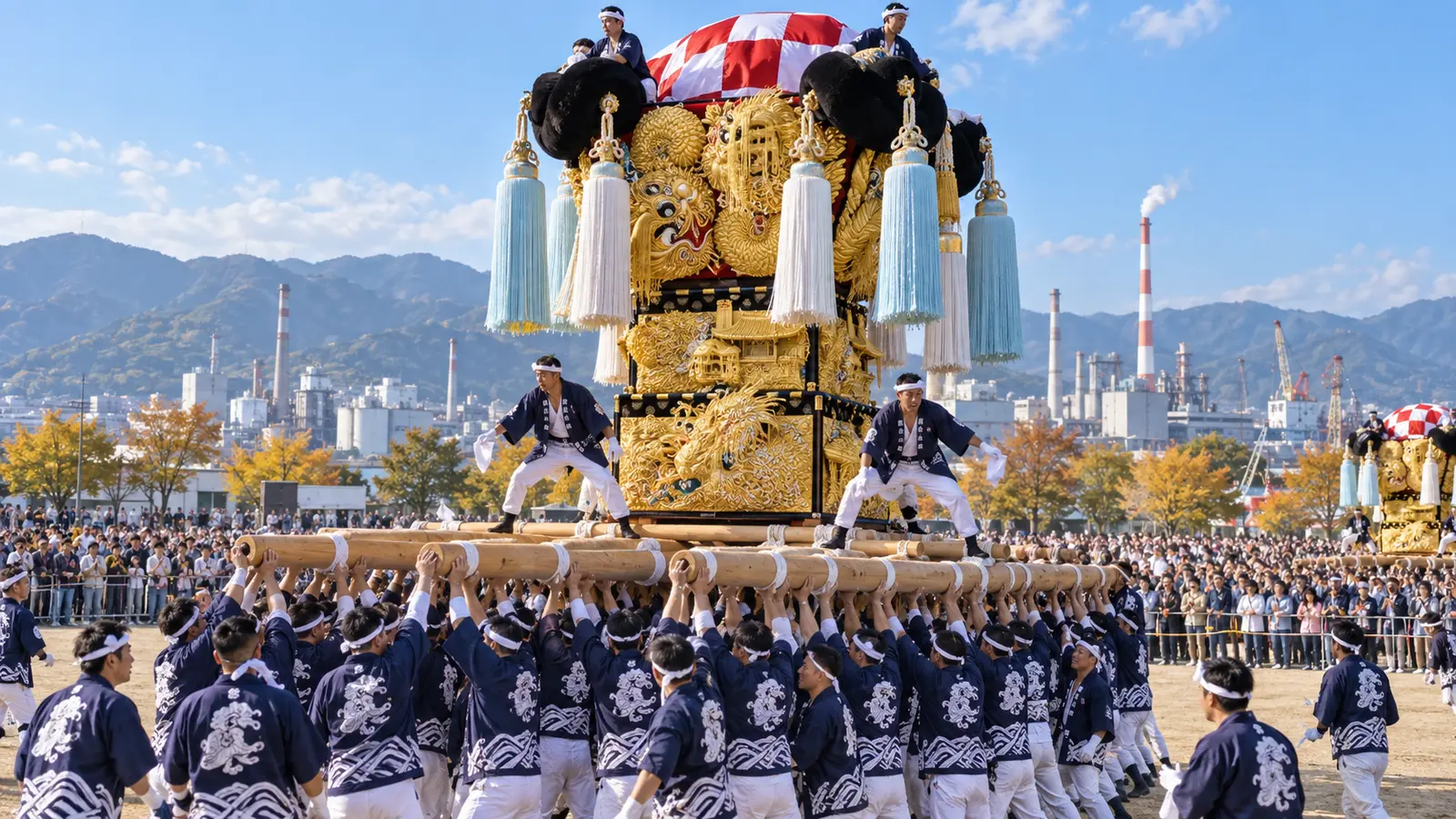
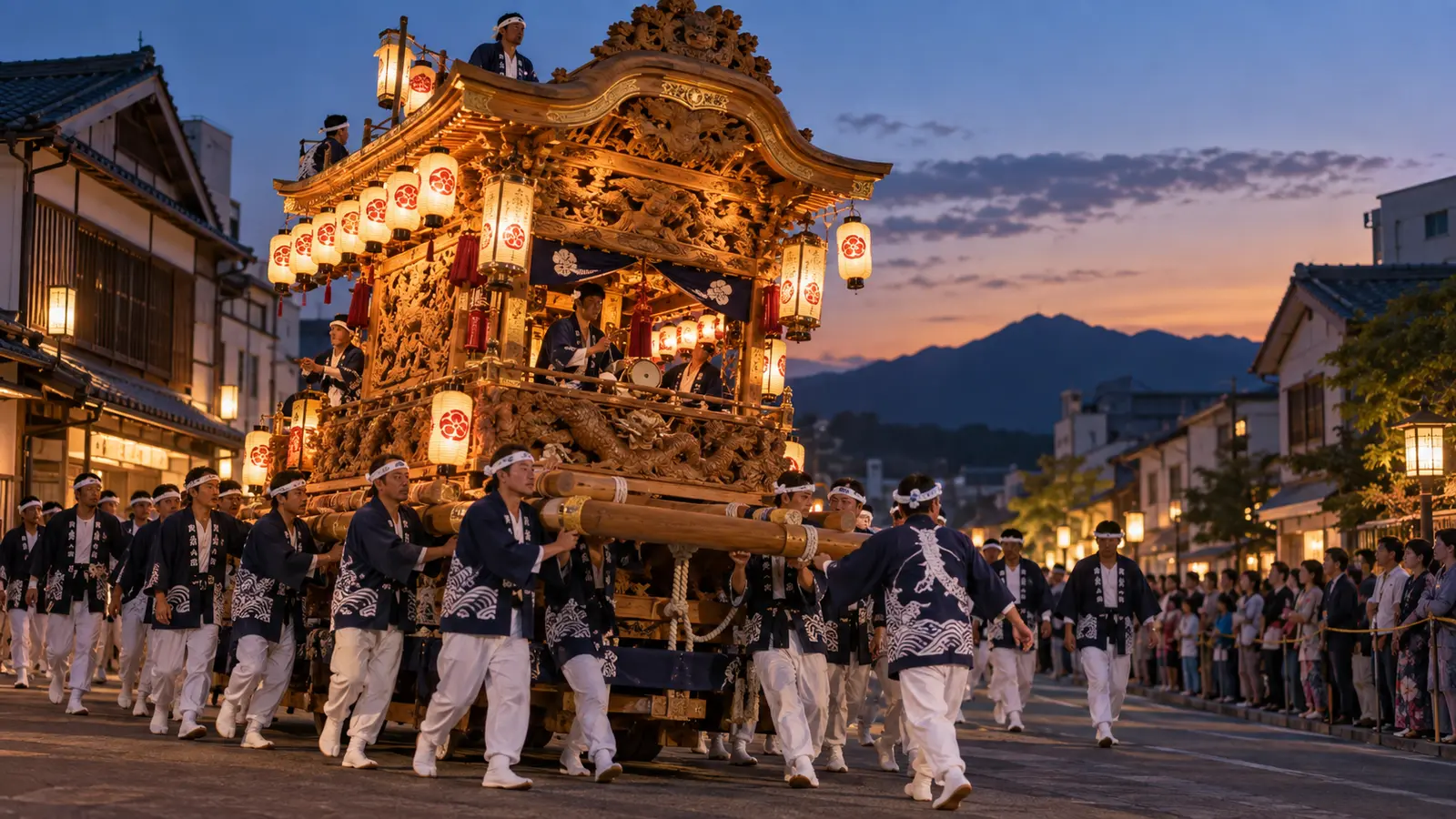
The article thumbnail is a generated editorial image intended to represent a lantern-lit Saijo float. It is not documentary photography of the October 2026 festival, and it should not be used to infer an exact float, street or crowd layout.
If that does not work
Use the fallback.
- The final traffic map changes your route: follow the newest Saijo City map and police controls rather than an old festival diagram or navigation-app shortcut.
- The river-entry area reaches safe capacity: use a staff-approved position farther back or leave; free viewing does not guarantee a riverbank sightline.
- A procession is late: protect your last train and do not enter the route to search for a float. Published ritual times are approximate.
- Rain or strong wind changes a district program: follow that shrine or city's newest notice; there is no published blanket 2026 rule for all four festivals.
- Restaurants are closed or stalls are too crowded: use your water and snack fallback and eat only where you do not obstruct the procession.
Before you need it
Save this offline.
- Chosen shrine program and its exact 2026 dates
- Final 2026 route and traffic-control map when published
- JR station, walking route and last practical return train
- Approximate 17:15 Isono river-entry plan for October 16
- Saijo City festival page, JMA warnings and meeting point
- Water, cash, closed shoes and a hands-free bag
- Hotel or station luggage plan outside the festival route
Frequently asked questions
Saijo Festival 2026: Danjiri, River Entry and Access FAQ
When is Saijo Festival in 2026?
Kamo Shrine is October 10–11, Iwaoka Shrine October 14–15, Isono Shrine October 15–16 and Iizumi Shrine October 16–17. These are separate district programs, not one continuous parade.
When is the Isono river entry?
Saijo City's FAQ gives approximately 17:15 on October 16 near Isono Bridge and Bujo Park, but warns that the procession often runs late.
Is Saijo Festival free?
Yes for general public viewing. The official guidance announces no general admission ticket or paid spectator allocation.
Are there reserved seats or a ticket sellout?
No. Saijo City's FAQ says there are no reserved viewing stands, and no general ticket deadline or sellout inventory is published. Safety controls can still restrict a crowded area.
What station should I use?
Use Iyo-Saijo for Isono and the river entry, Iyo-Himi for Iwaoka, and Ishizuchiyama for Kamo. Iizumi is about a 50-minute walk from Iyo-Saijo according to the city FAQ.
Can I park at Saijo Festival?
Temporary parking varies by district and date. The official tourism listing describes about 1,500 free spaces near Kamogawa Bridge on October 16, but spaces are not reserved and roads are controlled.
What happens if it rains?
No single 2026 rain, wind, postponement or decision-time rule is published for all four shrine programs. Check Saijo City, the relevant shrine and JMA on the day.
Is the 2026 traffic map available?
Not yet in the reviewed official guide. Saijo City says the 2026 operation and traffic-control map is scheduled for publication in early October.
Primary evidence
Official sources used
Open these pages again before travel. External links lead to the responsible Japanese authority or transport organization.