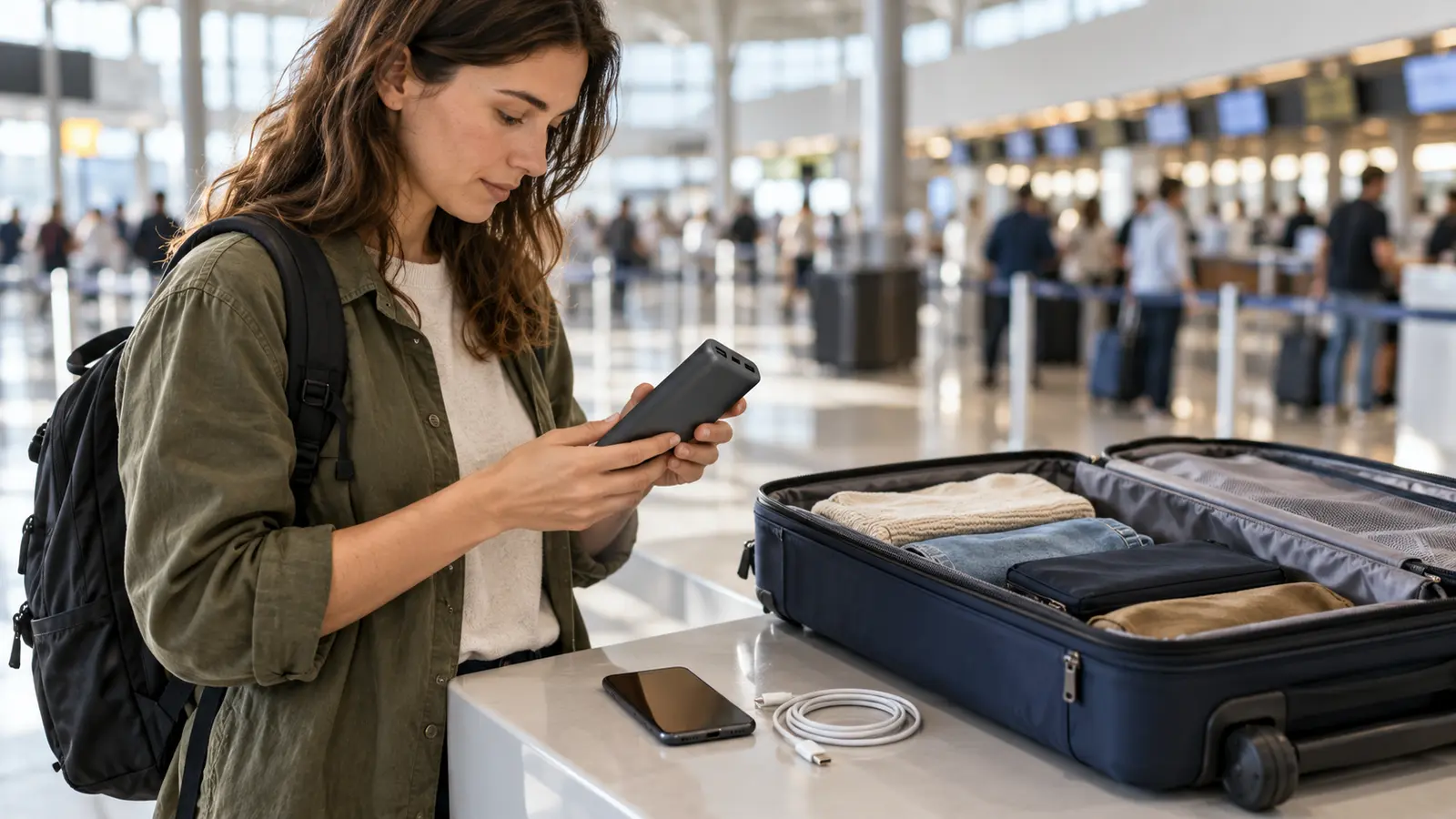
Do this now
Follow these steps in order.
- 01
Check the label on every power bank before packing. Record the printed watt-hour rating, or calculate Wh from the printed capacity and voltage: Wh = mAh × V ÷ 1,000.
- 02
Confirm the rule for the date of travel, departure airport and operating carrier of every segment, including codeshares and a domestic connection inside Japan.
- 03
Keep no more than two power banks for flights covered by Japan's April 24, 2026 rules, and keep each at 160Wh or below. For travel on or after January 1, 2027, plan for a 100Wh maximum unless the operating carrier publishes a stricter limit sooner.
- 04
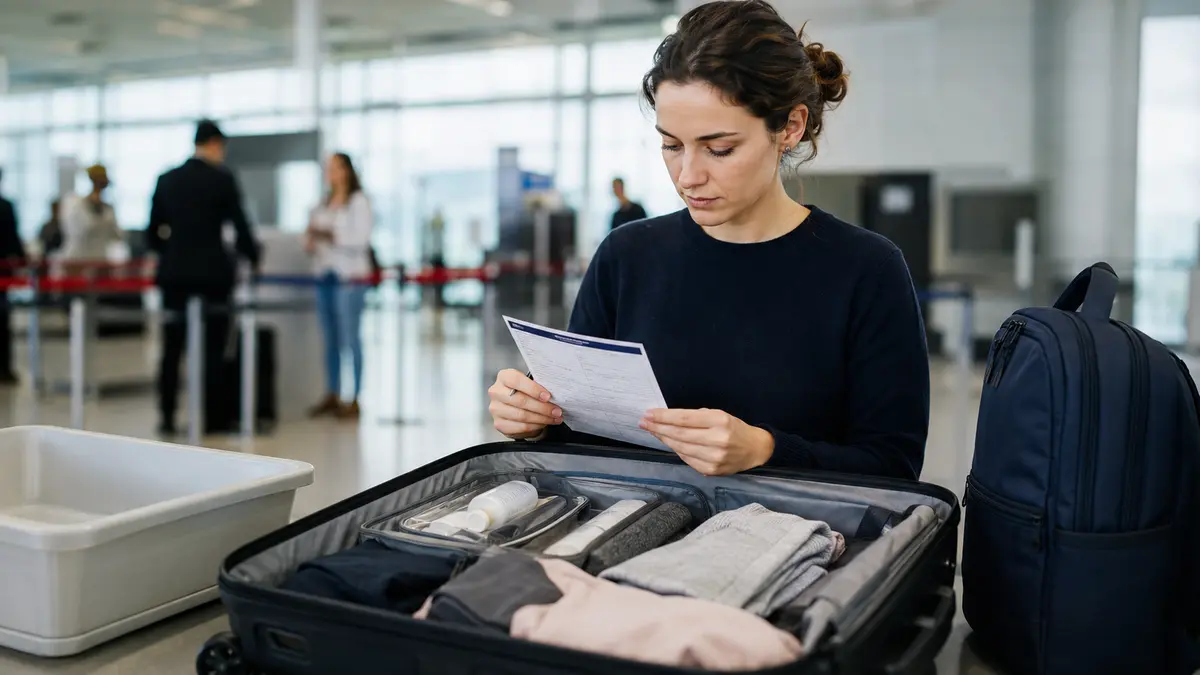
Place power banks in carry-on baggage only. Remove any power bank from a bag that will be checked at the gate.
- 05
Protect each unit separately in its retail box, a protective pouch or a separate plastic bag; cover exposed terminals with insulating tape and keep the unit away from keys and coins.
- 06
During the flight, keep each power bank where its condition can be seen rather than in an overhead locker. Do not recharge it from a seat outlet or use it to charge another device on flights applying Japan's current rule.
- 07
Tell cabin crew immediately if a battery becomes hot, swells, smells unusual, smokes or is damaged. Do not cover it, move it secretly or attempt your own onboard disposal.
What to know
Japan changed the power-bank rule on April 24, 2026
Japan's Ministry of Land, Infrastructure, Transport and Tourism revised the national standard after an emergency ICAO change. For flights applying the Japanese rule, a passenger may carry no more than two power banks, each rated at 160Wh or less. Power banks remain prohibited in checked baggage.
The same official notice requires short-circuit protection and says the units must not be placed in overhead lockers. During the flight, passengers must not charge a power bank from an aircraft outlet or USB port and must not use a power bank to charge another electronic device. JAL and ANA publish the same core restrictions for their operated flights.
These are power-bank rules, not a complete summary for every battery-powered item. A battery installed in a phone or laptop, a removable camera spare, medical equipment and mobility aids can fall under different provisions. Check the operating airline when your equipment is not an ordinary portable charger.
What to know
Read Wh, not only the marketing mAh number
Air rules use watt-hours. Use the Wh printed on the unit when it is readable. If only milliamp-hours and rated voltage are printed, Japan's official formula is Wh = mAh × V ÷ 1,000. Do not substitute the USB output voltage for the battery's rated cell voltage.
For example, a label showing 10,000mAh at 3.7V calculates to 37Wh; 20,000mAh at 3.7V calculates to 74Wh; and 30,000mAh at 3.7V calculates to 111Wh. These examples do not classify a product whose label shows a different voltage. Use the specifications on the actual unit and the manufacturer's official documentation.
JAL warns that transport may be refused when the Wh rating cannot be confirmed. A screenshot of the manufacturer's specification can help explain a label, but it does not guarantee acceptance at check-in or security. If neither the unit nor reliable manufacturer documentation establishes the rating, leave it behind.
What to know
The operating airline and departure country can be stricter
The Japanese standard is not a promise that every airline or airport will accept every compliant power bank. JAL's international baggage page tells codeshare passengers to confirm with the operating airline, and MLIT states that airlines may impose stricter rules. A flight sold under a Japanese flight number can be operated by a partner with a different limit.
Check all sectors separately: the flight to Japan, any transfer outside Japan, the domestic connection and the return flight. Use the airline shown as 'operated by' in the itinerary. When rules conflict, pack to the strictest rule or obtain written confirmation from every relevant carrier before departure.
Some departure countries add security controls or require advance approval for batteries above 100Wh. Do not rely on acceptance on an earlier sector. A battery cleared on the outbound trip may still be refused at a later airport.
What to know
2027 introduces a lower international ceiling
IATA's 68th edition rules, effective January 1, 2027, list power banks over 100Wh as forbidden for passengers and crew. IATA's current traveler guidance also says power banks must be carried in hand luggage, individually protected and checked with the airline.
JAL already warns that its present 160Wh ceiling may be reduced to 100Wh from January 2027. A 30,000mAh unit rated at 3.7V is about 111Wh, so it can sit on different sides of the rule depending on the travel date and operating carrier.
For a trip crossing the year boundary, apply the rule in force on the date of each flight. The simplest low-risk choice is a clearly labeled power bank at or below 100Wh, but even that does not override a carrier's quantity, condition or use restrictions.
What to know
Pack for short-circuit prevention and inspection
Keep every power bank individually protected. MLIT, JAL, ANA and IATA all describe practical methods: use the original retail package, cover exposed terminals with insulating tape, or place each unit in a separate plastic bag or protective pouch. Do not let metal objects or another battery bridge the terminals.
Place the units where you can remove them before a cabin bag is gate-checked. A last-minute gate check does not create an exception; take power banks and spare batteries out before handing over the bag. Keep the label visible for staff rather than wrapping the entire unit in opaque tape.
Do not fly with a swollen, leaking, punctured, crushed, overheated or recalled battery. ANA links to a separate official process for recalled lithium-battery equipment. Contact the manufacturer and the operating airline before travel; do not test a suspect unit at the airport.
What to know
Keep the power bank visible and unused onboard
On flights applying Japan's rule, do not put a power bank in the overhead locker. Keep it in an accessible place specified by the crew, such as a seat pocket or small personal-item pouch, without blocking an aisle or exit. The purpose is to notice heat, smoke or swelling early.
Do not plug the power bank into an aircraft power outlet or USB port, and do not use it to charge a phone, tablet or other device onboard. Charge essential devices before boarding and use the aircraft's built-in power directly only when the carrier and crew permit it.
If the unit becomes hot, smells unusual, swells, hisses or smokes, stop touching or charging it and alert cabin crew immediately. Crew have aircraft-specific containment and firefighting procedures; do not hide the battery in a bag, cover it with clothing or take it to a lavatory.
What to know
Smart luggage and spare batteries need a separate check
A power bank built into smart luggage is still a power bank. IATA says a smart bag with a lithium battery is acceptable only when the battery can be removed; if the bag is checked, remove the battery and carry it in the cabin under the power-bank rule. A non-removable battery can cause the bag to be refused.
A removable camera or drone battery is a spare lithium-ion battery rather than a power bank, but it is also cabin-only and must be protected against short circuits. Japan's combination limits can change when you carry both power banks and spare batteries above 100Wh, so show the exact list to the airline before travel.
Phones, tablets and laptops have batteries installed in equipment. They are not counted as power banks merely because they contain a battery, but checked-baggage shutdown and damage-protection rules can apply. Carry valuable electronics in the cabin whenever practical and follow the operating carrier's separate device rules.
If that does not work
Use the fallback.
- If the Wh marking is missing or unreadable, use only the actual unit's rated capacity and voltage plus official manufacturer documentation. If staff still cannot verify it, leave the unit behind; do not guess.
- If a battery is above the carrier's limit, do not transfer it to checked baggage. Ask the airline about an approved dangerous-goods shipment well before travel, or leave it with someone who can lawfully retain it.
- If staff refuse a battery at the airport, ask about a lawful landside return, storage or disposal option. MLIT warns that ordinary parcel delivery may also reject air transport, so declare the battery to the carrier and follow its instructions.
- If a cabin bag must be checked at the gate, remove every power bank and spare battery before surrendering the bag and carry them within the permitted cabin allowance.
- If two operating airlines publish different limits, follow the stricter rule for the full itinerary or split the itinerary only after receiving carrier-specific confirmation.
- If you need phone power on arrival, fully charge the phone before boarding, enable low-power mode, keep essential confirmations offline and use an airport outlet only where permitted after landing.
- If a battery shows damage, heat, swelling or odor before departure, isolate it from use and follow manufacturer or local hazardous-waste instructions. Do not take it to the aircraft to ask for an exception.
Before you need it
Save this offline.
- Photo of each power bank label showing Wh, mAh and rated voltage
- Official manufacturer specification page or manual for the exact model
- Operating-airline baggage rule for every flight and codeshare segment
- Any carrier approval or written answer required for unusual battery equipment
- A small protective pouch or separate plastic bag for each unit and insulating tape for exposed terminals
- Offline boarding passes, hotel address and arrival transport plan in case the phone battery is low
Frequently asked questions
Power Banks on Flights to Japan: Carry-on, Wh Limits and 2026 Rules FAQ
Can I put a power bank in checked luggage for Japan?
No. Japan's current rule and IATA guidance treat power banks as spare batteries and prohibit them in checked baggage. Carry them in the cabin within the operating airline's capacity, quantity and condition limits.
How many power banks can I bring on a Japanese airline in 2026?
From April 24, 2026, Japan limits passengers to two power banks, each 160Wh or less, unless the airline applies a stricter rule. Check the operating carrier and every departure country.
Can I use a power bank to charge my phone during the flight?
Not on flights applying Japan's current rule. Charging a power bank from aircraft power and using a power bank to charge another device onboard are prohibited. Follow crew instructions and use built-in aircraft power only when permitted.
Is a 20,000mAh power bank allowed on a flight to Japan?
It depends on the rated voltage and airline. At 3.7V, 20,000mAh calculates to 74Wh, below both 100Wh and 160Wh thresholds. Use the actual label and manufacturer specifications; do not assume every 20,000mAh model has the same rating.
Is a 30,000mAh power bank allowed?
At 3.7V it calculates to about 111Wh. That is within Japan's present 160Wh ceiling but can trigger stricter airline or airport rules, and IATA rules from January 1, 2027 prohibit passenger power banks over 100Wh. Confirm every operating carrier before travel.
What if my power bank has no Wh label?
Calculate only from the printed rated capacity and voltage and keep official manufacturer documentation for the exact model. JAL says transport may be refused when the Wh rating cannot be confirmed, so leave it behind if the rating is not reliably verifiable.
Can a power bank stay inside smart luggage?
Only if it can be removed and the airline accepts the bag. Remove the battery before checking the luggage and carry it in the cabin under the power-bank rule. A bag with a non-removable lithium battery may be refused.
Do the same rules apply to a laptop or phone battery?
Not exactly. A battery installed in a device is treated differently from a power bank or spare battery. Separate limits and shutdown or damage-protection requirements can apply, so check the operating airline's portable-electronic-device rules.
Primary evidence
Official sources used
Open these pages again before travel. External links lead to the responsible Japanese authority or transport organization.