Do this now
Follow these steps in order.
- 01
Arrive at JR Onomichi Station before sunset, leave large luggage elsewhere and choose a compact route instead of trying to visit every temple in 150 minutes.
- 02
Use the station-front green area and lower town for an easy first section, then add one hillside cluster such as Jikoji–Komyoji–Hodoji or the Senkoji area if stairs and darkness suit your group.
- 03
If using the ropeway, confirm the operator's October 17 notice and last boarding on the day. The planned 21:15 close can change and is not a guaranteed connection after a queue.
- 04
Treat the festival-wide ticket, road-control map, event parking, program times and ordinary-rain handling as unannounced until the organizer publishes them.
- 05
Check the official festival site, ropeway notice, JMA warnings and return train shortly before departure; severe weather cancels the event.
What to know
Formal name, date, time and scale
The formal event is the 21st Onomichi Lantern Festival, or Dai 21-kai Onomichi Akari Matsuri. It is scheduled for Saturday, October 17, 2026 from 18:00 to 20:30. The event spreads across the old central city rather than using one gated venue, connecting temple approaches, courtyards, waterfront spaces, the station area and shopping streets.
The festival reimagines the lights that historically guided boats through the Onomichi Channel toward the city's temples. Schools and community groups create the paper lanterns, and the organizer describes roughly 25,000 lights across the city. The result is a walking night, not a single stage show with one best seat.
Two and a half hours is short for a hillside city. A visitor trying to reach every listed temple will spend much of the evening climbing and navigating. Choose one lower-town loop and one hillside priority, then protect enough time to return to the station or ropeway before service ends.
What to know
The 14 temples and how to choose a route
The official 2026 venue list names 14 temples: Saihoji, Jikoji, Kaifukuji, Komyoji, Hodoji, Senkoji, Tenneiji, Myosenji, Shoju-in, Taisanji, Saikokuji, Saigoji, Jodoji and Kairyuji. They are distributed along several slopes and old neighborhoods; they are not one continuous level path.
Other listed venues include Shimanami Koryu-kan, Onomichi Station Higashigosho Green Area, Hacci, Rengazaka Slope, Mukaishima's Kaneyoshi area, Onomichi City Museum of Art, Happy Kubo, Hondori Shopping District, Soraiken Garden, Onomichi Central Pier, the municipal central library and the Senkoji Mountain Ropeway summit station.
For the least complicated visit, begin outside JR Onomichi Station, walk through the lower shopping-street and waterfront venues, and add nearby lower temple approaches only if the group is comfortable. For a higher viewpoint, choose the Senkoji cluster and plan the ascent or ropeway separately. Do not use the event thumbnail as a route map; save the organizer's current map and follow signs on site.
What to know
Admission, reservations, programs and sellouts
The reviewed official event pages do not list a festival-wide admission charge, visitor reservation, booking deadline, reserved viewing product or overall sellout system. Public streets and approaches remain subject to normal access and staff control, so the absence of a general ticket does not guarantee entry to every small courtyard at every moment.
Individual facilities can use their own admission. The ropeway is paid, museum entry can be separate, and a temple treasure display, workshop, performance, food stall or limited activity may set a fee or capacity. The final 2026 program for those individual activities, including exact performance times and any reservation instructions, is not fully published on the reviewed pages.
Do not buy an unofficial 'festival ticket' that is not linked by the organizer. If an individual activity later opens reservations, check its operator, date, venue, cancellation terms and capacity directly. A free citywide festival can still have a paid attraction or a small program that fills.
What to know
JR Onomichi Station and access from the Shinkansen
JR Onomichi Station is the nearest and most useful gateway. The station-front Higashigosho Green Area is itself an official venue, and the lower-town shopping streets and waterfront are reachable on foot. This makes JR rail the simplest default when the final road-control and parking plan is not yet published.
The Sanyo Shinkansen stops at Shin-Onomichi Station, not JR Onomichi Station. Onomichi's official tourism guidance directs visitors onward by local bus or taxi; a normal bus trip to the central station area takes about 15 minutes, but event traffic and waiting can extend it. From Fukuyama, a local JR train to Onomichi takes roughly 20 minutes under the published tourism estimate. Confirm the live timetable and the final return before travel.
There is no festival-wide luggage counter announced. Leave suitcases at accommodation or a confirmed station facility before climbing narrow stairs. Protect an onward Shinkansen with extra time because a hillside descent, ropeway queue or crowded local train can make a short map distance slow.
What to know
Senkoji Mountain Ropeway hours, fares and last-service risk
The ropeway operator plans extended service from 09:00 to 21:15 on October 17 so visitors can use the summit station during the festival. It expressly says the plan may change depending on conditions. Treat 21:15 as the scheduled operating end, not a promise that a visitor joining a long queue at 21:14 will board.
The current official fare page lists adults and junior-high-school-age visitors at ¥500 one way or ¥700 return. Children of elementary-school age and younger are ¥250 one way or ¥350 return; one preschool child accompanied by one adult rides free under the stated rule. Discounts have their own eligibility and must be shown before purchase.
The ropeway links the lower Sanroku Station and the summit in about three minutes, but the approach to the lower station and the descent from the hill still require planning. Check the final boarding procedure, queue and any suspension before relying on it. If it stops, the fallback is a steep walking route or a changed itinerary—not an assumed replacement bus.
What to know
Weather, traffic controls and crowd movement
The organizer states that the festival is cancelled in severe weather. The reviewed 2026 page does not publish a postponement date, a decision deadline or a precise rule for ordinary rain. Check the official site and JMA warnings on October 17 rather than applying a previous year's rain decision.
The final 2026 traffic-control map, event parking plan, shuttle service and bus diversions are not published in the reviewed sources. Do not assume a previous-year closure or parking area remains valid. Rail is the lower-risk plan; if driving is necessary, wait for the current official map and never use temple, shop or residential access as overflow parking.
Lantern routes use narrow stone stairs, sloped lanes and temple approaches that can bottleneck. Keep tactile paving, doorways and emergency paths open. Move to a different venue when staff pauses entry, and agree on a meeting point in the lower town because members of a group can become separated on dark stairways.
What to know
Footing, accessibility and photography
Wear closed shoes with grip and carry a small light for unlit transitions, using it downward without washing out lantern displays or shining into faces. Visitors who avoid stairs should prioritize the station-front, shopping-street, pier and other lower venues, then verify accessibility with the specific facility. The citywide event page does not publish one step-free route connecting every venue.
No universal 2026 rule for tripods, drones, commercial filming or close portrait photography is published on the reviewed visitor pages. A public street can still have a temporary restriction, while temples, the museum and the ropeway can apply their own rules. Keep equipment out of stairs and paths, ask before identifiable close portraits and obey every local sign.
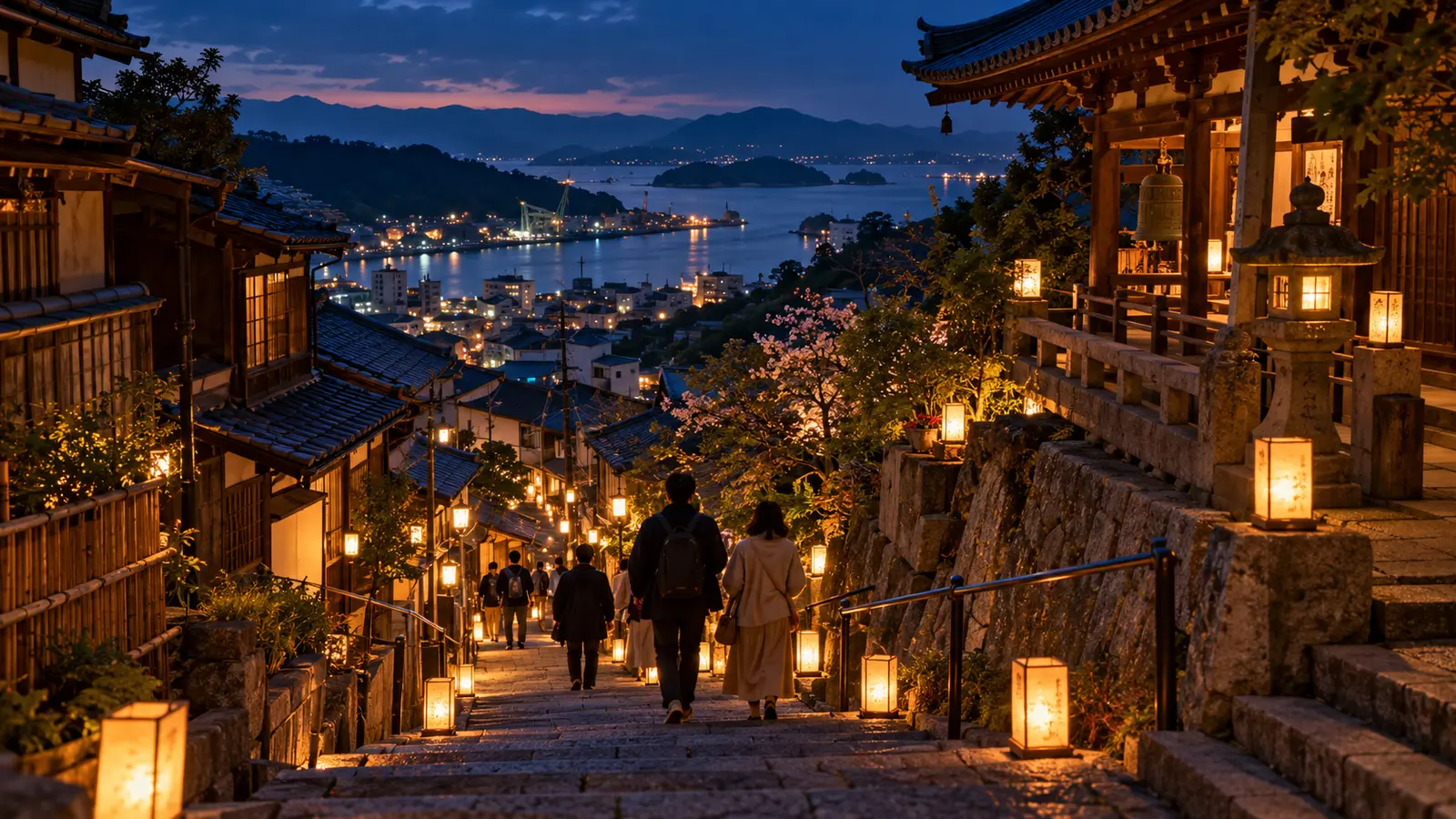
The thumbnail on this page is a generated editorial image illustrating a lantern-lit Onomichi hillside. It is not documentary photography of the 2026 festival, an exact participating temple, lantern layout, crowd level or view.
What to know
What to verify before leaving
Open the official festival page for the final map, participating venues, program updates and weather decision. Then check the ropeway's October 17 notice, current JR and bus times, JMA warnings and the last practical return service. Save the map and station route offline before entering the hills.
Details that remain unpublished at this review include the full 2026 performance timetable, individual treasure-display conditions, final road restrictions, event parking, ordinary-rain operation and a festival-wide photography policy. Treat them as unannounced, not as permission or an invitation to reuse a previous-year plan.
If that does not work
Use the fallback.
- A temple approach is full: move to another official lower-town or hillside venue and return only when staff reopens access.
- The ropeway queue threatens the last service: leave the line and use a safe walking or changed-route plan; do not assume boarding after the scheduled close.
- Severe weather cancels the event: there is no published postponement date; follow the organizer and do not enter closed hillside paths.
- An individual program is full or paid: enjoy the public lantern route and check that facility's own fee and next-entry conditions.
- The return train is at risk: shorten the route and descend early, using the live operator timetable rather than the normal walking estimate.
Before you need it
Save this offline.
- October 17 date and 18:00–20:30 festival hours
- Official venue map and a short chosen route
- JR Onomichi Station or Shin-Onomichi onward connection
- Ropeway 09:00–21:15 planned service and current fare if using it
- Return train, bus or taxi plan
- JMA warnings, compact rainwear, grippy shoes and small light
- Portable battery and a lower-town meeting point
Frequently asked questions
Onomichi Lantern Festival 2026: Temples, Ropeway and Access FAQ
When is Onomichi Lantern Festival 2026?
Saturday, October 17 from 18:00 to 20:30. The organizer says the event is cancelled in severe weather.
Where is the festival?
Across 14 central Onomichi temples plus station-front, shopping-street, waterfront, museum, library, Mukaishima and Senkoji ropeway summit venues.
Do I need a ticket or reservation?
No festival-wide admission ticket, visitor reservation, booking deadline or overall sellout system is published. Individual attractions or limited programs can charge separately or use capacity limits.
What is the nearest station?
JR Onomichi Station. Its station-front green area is an official venue and the lower festival area is walkable from the station.
Does the ropeway run late?
The operator plans 09:00–21:15 service on October 17, subject to change. Confirm the last boarding and queue on the day.
How much is the ropeway?
The published normal fare is ¥500 adult one way or ¥700 return, and ¥250 child one way or ¥350 return, with separate discount and preschool rules.
What happens if it rains?
Severe weather cancels the event. The reviewed 2026 page does not publish a specific ordinary-rain rule, postponement date or decision time.
Are 2026 traffic controls and parking published?
No final event traffic map, parking plan, shuttle or bus-diversion plan was published in the reviewed sources. Use rail where possible and recheck the organizer.
Primary evidence
Official sources used
Open these pages again before travel. External links lead to the responsible Japanese authority or transport organization.