Do this now
Follow these steps in order.
- 01
Treat October 11 and every listed time as planned rather than final; save the organizer page and check it again on the evening before and morning of the event.
- 02
Use Yui Rail to Kencho-mae Station for Kumoji Intersection and the west end of Kokusai-dori. Do not plan to park at the event because the official visitor listing says parking is unavailable.
- 03
Choose whether to watch the 10:25 Hatagashira parade, join or view the 13:30 main tug program, or do both with a break away from the road-closure crowd.
- 04
Before joining, secure loose bags, keep children outside the densest pulling line, follow staff commands and leave the central rope joint and operational lanes clear.
What to know
Formal name, date and tentative status
The formal event is the 56th Naha Great Tug-of-War, organized by the Naha Great Tug-of-War Preservation Society. It is a large public tug built around two parts of central Naha: a flag procession on Kokusai-dori and the giant rope on National Route 58 at Kumoji Intersection.
The organizer currently lists Sunday, October 11, 2026, but marks the date and detailed times as planned. That wording matters when booking a flight, hotel or day trip: the event is officially announced, yet the final operating notice can still change. This guide was checked on September 14 and will not treat the provisional timetable as guaranteed.
What to know
Planned 2026 schedule and venues
The Hatagashira parade is planned for 10:25–12:55 on Kokusai-dori. Tall community standards move along the shopping street before the main tug. This is a procession rather than the tug itself, so do not wait on Route 58 in the morning expecting the rope action to have started.
The main Naha Great Tug-of-War program is planned for 13:30–16:10 on National Route 58 at Kumoji Intersection. This published window includes ceremony and event operations; it is not a promise that the physical pull lasts for the full period. Arrive before the road becomes fully crowded and follow announcements about when public participants may approach the hand ropes.
A final 2026 program, detailed route and crowd-entry map were not published on the reviewed official pages. Do not infer an exact rope-pull minute, finish time, accessible viewing zone or exit gate from a previous year's map.
What to know
Why the rope is extraordinary
The official Okinawa travel guide describes a rope approximately 200 metres long and 43 tonnes in weight, with about 280 smaller hand ropes extending to the crowd. Naha's modern revival dates to 1971, while the tradition is traced to the Ryukyu Kingdom era. The scale and open participation make the event more than a conventional parade.
Visitors may be invited to pull alongside local participants, subject to that day's crowd and safety controls. The official visitor guide also describes taking a small piece of rope after the event as a good-luck custom, but do not cut, pull apart or collect any part until staff explicitly permits it. A past Guinness recognition is part of the event's history; it should not be read as a new 2026 record claim.
What to know
Admission, tickets, reservations and sellout conditions
The official Okinawa visitor listing states that the event is free. The organizer and tourism pages reviewed September 14 publish no general spectator ticket, paid grandstand, participation reservation, application deadline or advance allocation for joining the hand ropes.
There is therefore no published ticket sellout condition for general viewing or participation. Free access does not guarantee entry to the densest section: police and staff can stop movement, close a viewing position or restrict access when the road reaches safe capacity. Private tours, food, transport and nearby facilities can charge separately and are not official event admission.
What to know
Nearest station and access from Naha Airport
Kencho-mae Station on Yui Rail is the practical stop for Kumoji Intersection and the west end of Kokusai-dori. From Naha Airport Station, take the monorail toward Tedako-Uranishi and confirm the current fare and timetable on the official Yui Rail site. The normal station route is step-free where lifts operate, but event barriers and crowd controls can change the easiest street-level exit.
Miebashi Station can be useful for the central and eastern side of Kokusai-dori, while Makishi Station serves the street's eastern end. For the main tug, do not choose a station solely by straight-line distance: police closures may determine which approach is open. Save the return timetable and allow extra platform time after the event.
The official 2026 event pages do not publish a special Yui Rail timetable, station-entry control or shuttle service. Leave suitcases at your hotel or a confirmed locker before entering the crowd; the event is not one controlled venue with a general cloakroom.
What to know
Traffic restrictions, parking and crowd strategy
National Route 58 must be controlled for the giant rope, and Kokusai-dori is used by the morning procession. The official visitor listing says event parking is not available. Do not drive toward Kumoji or depend on a taxi reaching the intersection, even if a map app still shows an ordinary road route.
The final 2026 closure hours, bus diversions, taxi drop-off points and pedestrian gates are unannounced. Check Naha City, the organizer, Yui Rail and your bus operator shortly before departure. If you need an accessible route, contact the organizer rather than assuming the nearest road opening will have a low-density viewing area.
For both programs, choose a meeting point away from the rope and a major crossing. Mobile service can slow in a dense crowd. Keep water and a compact battery with you, and plan a shaded break between the parade and main tug instead of remaining on the street continuously.
What to know
How to participate without creating a safety risk
Join only when staff opens the relevant area and use a smaller hand rope rather than touching the enormous central rope or its joined section. Keep both feet clear of loops, do not wrap rope around a hand or body, and release it if you lose balance. Closed shoes and a hands-free bag are safer than sandals, wheeled luggage or loose shoulder straps.
Children, anyone with limited balance and visitors who do not understand the safety commands should watch from a staff-approved area outside the densest pulling line. Do not push forward for a souvenir or photograph as the rope settles. Emergency access and the work of local teams take priority over a visitor's view.
Photography is welcome only where it does not block participants, crossings or staff. No event-specific 2026 drone rule is published in the reviewed pages; that is not permission to fly above a crowd or controlled public road. Leave the drone packed and use a handheld camera from a safe position.
What to know
Rain, typhoon risk and unannounced decisions
The reviewed 2026 pages do not publish a single rain-or-shine rule, typhoon cancellation threshold, postponement date, decision time or refund policy. Because the event uses a massive straw rope, tall standards and major public roads, do not assume it will proceed in rain or strong wind based on an ordinary street festival.
Check the Preservation Society and official Okinawa event page, then JMA warnings and Yui Rail status immediately before travel. If a tropical cyclone or severe-weather warning threatens Naha, protect your flight and hotel plan rather than waiting inside a closed-road zone. There is no ticket refund issue for general free access, but third-party bookings follow their own terms.
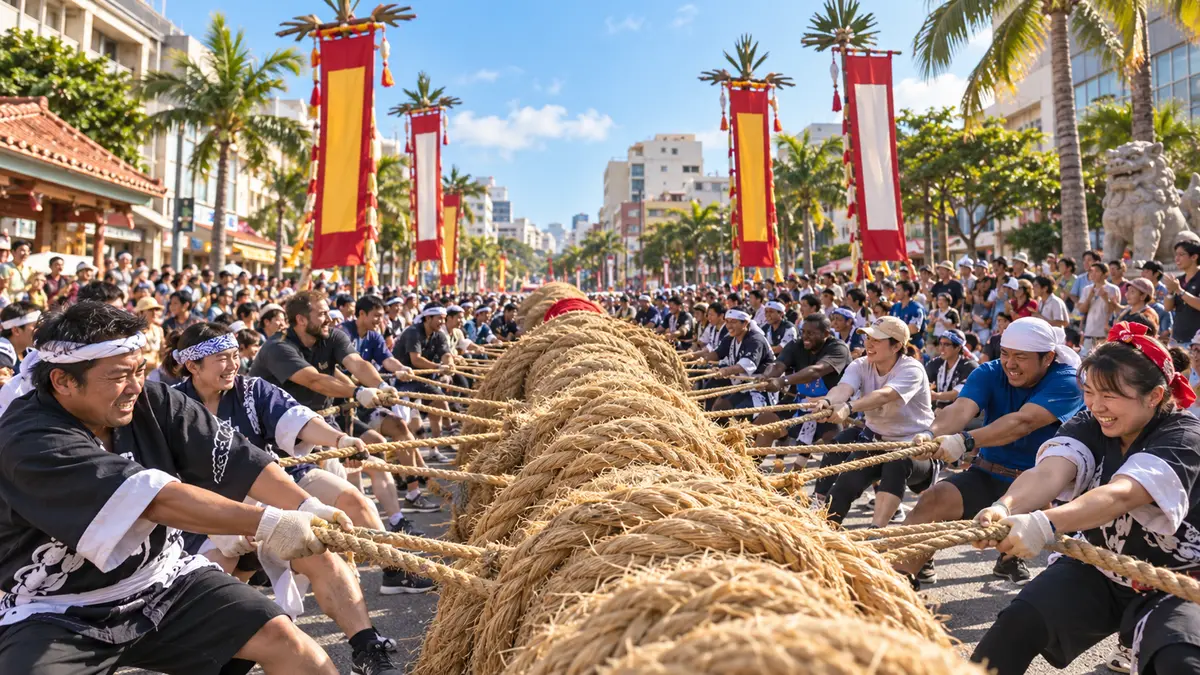
The article thumbnail is a generated editorial image representing the event's rope, crowd and subtropical setting. It is not documentary photography of the October 11, 2026 event.
If that does not work
Use the fallback.
- The date or times change: follow the newest Preservation Society notice; every time in this guide is currently labeled planned.
- Kumoji reaches safe capacity: use a staff-approved viewing area farther back or leave; free participation does not guarantee access to a hand rope.
- A monorail station entrance is controlled: follow Yui Rail staff to an open entrance or use another confirmed station instead of crossing a closed road.
- Rain, strong wind or a typhoon affects the program: use official organizer and JMA updates; no 2026 substitute date or decision time is published.
- You cannot safely join the pull: watch from behind the managed line and keep the operational area clear rather than forcing participation.
Before you need it
Save this offline.
- Organizer page showing the planned October 11 date and times
- Kencho-mae Station map, current Yui Rail timetable and hotel route
- Final 2026 traffic map and pedestrian entry points when published
- 10:25 Kokusai-dori parade and 13:30 Kumoji program plan
- JMA warning page, organizer contact and companion meeting point
- Water, closed shoes, compact rainwear and a hands-free bag
- Return transport plan with extra time after 16:10
Frequently asked questions
Naha Great Tug-of-War 2026: Schedule, Access and Participation Guide FAQ
When is Naha Great Tug-of-War in 2026?
The organizer currently plans the 56th event for Sunday, October 11, 2026. The date and times are still labeled planned, so check again before travel.
What time is the parade and main tug?
The Hatagashira parade is planned for 10:25–12:55 on Kokusai-dori. The main Route 58 program at Kumoji Intersection is planned for 13:30–16:10; the exact physical pull minute is not separately published.
Is Naha Great Tug-of-War free?
Yes. The official Okinawa visitor listing says admission is free, and no general spectator ticket or participation reservation is published.
Can tickets sell out?
No general ticket inventory is published, but staff may restrict a crowded road section or access to the hand ropes for safety. Free entry does not guarantee a particular position.
What is the nearest station?
Kencho-mae Station on Yui Rail is the practical stop for Kumoji Intersection and the west end of Kokusai-dori. Confirm event-day exits and station controls.
Can visitors join the tug?
The official visitor guide describes public participation using the smaller hand ropes. Join only when staff permits it and keep clear of the central rope joint and operational lanes.
Can I park at the event?
No visitor parking is available according to the official event listing. Use Yui Rail or another confirmed public-transport route and expect road restrictions.
What happens in rain or a typhoon?
A 2026 rain rule, typhoon threshold, postponement date and decision time were not published in the reviewed official pages. Check the organizer, JMA and Yui Rail immediately before travel.
Primary evidence
Official sources used
Open these pages again before travel. External links lead to the responsible Japanese authority or transport organization.