What Is Danjiri? Japan’s Float Festivals, History & Highlights
Discover what danjiri means, why communities pull festival floats, and how Kishiwada, Sakai, Kobe and Saijo differ—with highlights and viewing tips.
What is danjiri?
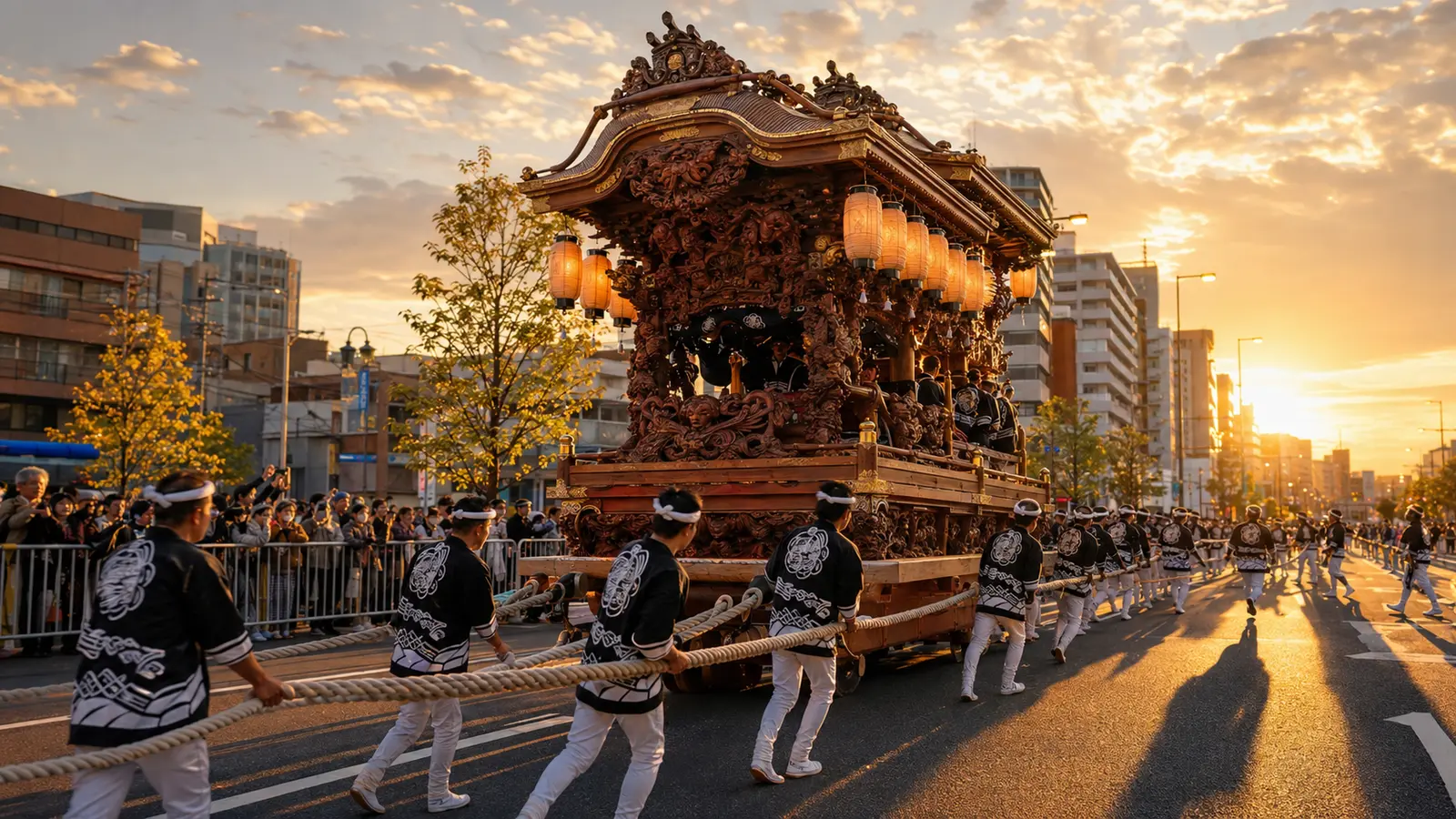
A danjiri is a festival float: an elaborate wooden structure brought through a town by a local team during a matsuri, or festival. The word is often written 地車. For many visitors, the first image is a carved float sweeping around a street corner in Kishiwada, Osaka, with a performer on its roof and a long line of people pulling ahead.
That image captures one famous tradition. Danjiri also belong to other communities, where the design, movement, season and ritual can look very different. Think of the word as a starting point for exploring local festival culture rather than the name of one nationwide event.
This feature explains the culture. It is not a live festival schedule. The header uses an existing generated editorial illustration representing Kishiwada-style danjiri; it is not documentary photography or a depiction of every regional style.
In this guide
- History and meaning
- Why communities do this
- Regional differences
- What to watch
- Planning and etiquette
- Frequently asked questions
- Official sources
History and meaning
Kishiwada: a harvest prayer with a long local history
Kishiwada City traces its festival to an Inari observance traditionally dated to 1703. Lord Okabe Nagayasu invited the deity of Kyoto’s Fushimi Inari into the castle’s third enclosure and prayed for an abundant grain harvest. The city’s account describes early festivities involving performances and shrine visits. Read the city’s history.
This is the origin tradition of Kishiwada’s festival. It should not be used as the founding date of every danjiri festival in Japan, or as proof that today’s fast turns existed in their present form in 1703.
A danjiri is not simply a portable shrine
In ordinary travel usage, a mikoshi is a portable shrine associated with a deity’s procession, while a danjiri is a festival float. Dashi is a broader term visitors will encounter for festival floats. Local names and forms overlap; identifying the specific community matters more than forcing every object into one nationwide category.
In Saijo, for example, the city describes danjiri, mikoshi and taikodai together as types of festival yatai. The same English word “float” can conceal important local distinctions. Saijo’s official overview is a useful introduction.
Why communities do this
Prayer and gratitude
The religious purpose depends on the shrine and community. Kishiwada’s origin account emphasizes harvest prayers; Kobe’s official visitor guide describes prayers for health and abundant harvests. Saijo explicitly presents its autumn festivals as thanksgiving to the deities for the harvest.
A procession therefore belongs within a relationship between a neighborhood and its shrine. At Kishiwada, miyairi is the visit to the community’s tutelary shrine. Watching the shrine approach helps explain the destination and meaning behind the movement through the streets. Kishiwada’s festival glossary explains the ritual terms.
A neighborhood working together
Osaka’s official tourism bureau describes Kishiwada’s festival as an organization in which different generations have defined responsibilities. The visible pullers are only part of that collective effort. The bureau’s overview explains this intergenerational structure.
For a visitor, this changes what is interesting: look for who gives instructions, how the crew responds and how a neighborhood identifies itself. The spectacle becomes easier to understand when you watch the relationships around the float as well as the float itself.
Why the speed, turning and roof performance?
Kishiwada’s signature yarimawashi is a fast turn around a right-angle corner. The city explains that the front levers provide braking and the rear lever steers; timing between the teams is critical. The daikugata performs on the roof. These are specialist local roles, not activities for spectators to imitate.
The religious purpose of the festival and the skilled performance within it are related aspects of the event. It would be misleading to claim that every danjiri must run fast, or that dangerous movement has one universal religious explanation.
Regional differences at a glance
These are four introductions, not an exhaustive list of Japan’s danjiri traditions. Even nearby neighborhoods can have different customs.
| Place | Typical season | What makes it distinctive | What to look for |
|---|---|---|---|
| Kishiwada, Osaka | September and October, in different districts | Carved wheeled floats; famous coordinated turns | Yarimawashi, roof performers, neighborhood crews and lantern-lit evening pulling |
| Sakai, Osaka | Mainly autumn; dates depend on the shrine | Numerous local danjiri festivals across the city | Compare neighborhood processions and check the specific shrine’s program |
| Nada and Higashinada, Kobe | Spring, including Golden Week programs | District-specific decorated floats, bells, drums and spirited calls | Listen to the music and compare decoration between teams |
| Saijo, Ehime, Shikoku | October; several shrine festivals | Danjiri within a wider culture of ritual yatai; Isono Shrine’s river-entry finale | Carvings, lanterns, Ise Ondo singing and the relationship between floats and shrine procession |
Kishiwada: understand the day and the district
Kishiwada has separate September and October festival districts. Evening lantern displays offer another way to appreciate the floats alongside the daytime action. Use the city’s festival hub to identify the area and route before choosing a station or viewing point.
Sakai: a network of neighborhood festivals
Sakai’s official tourism association maintains a shrine-by-shrine danjiri directory. It is a better planning tool than treating “Sakai Danjiri” as one event at one venue. Sakai also has futon daiko traditions; those should not automatically be labelled danjiri.
Kobe: a spring alternative
Kobe’s official visitor guide highlights floats decorated differently by district in Nada and Higashinada. Its 2026 listing covered May 3–5 and is now marked ended. That is a past edition, not a confirmed future schedule. Start with the official Kobe listing and check the year before planning a visit.
Saijo: the river-entry tradition
Saijo’s festival culture deserves its own itinerary rather than an Osaka day-trip assumption. At Isono Shrine’s October 16 kawairi, danjiri gather beside the Kamo River as the mikoshi returns toward the shrine; a subset enters the river around it. Not every float enters the water. See the city’s Isono festival explanation.
What to watch at a danjiri festival
- Look at the wood before the movement. When a float is stationary and viewing is permitted, compare the carved panels and roof details. Kishiwada’s city website introduces individual neighborhoods’ carvings, so you can choose one float to learn about before visiting.
- Follow one team through a complete passage. Instead of moving constantly, notice the instructions, pulling rhythm and steering work from one permitted viewing area.
- Listen as well as film. Give yourself a few minutes without a screen to hear the calls and instruments. In Saijo, listen for Ise Ondo singing alongside the drums and gongs.
- Include a shrine moment. A permitted view of a shrine approach adds context that a short clip of a dramatic turn cannot provide.
- Compare daylight with lantern time where the program includes it. Woodwork and coordinated movement are easier to inspect by day; lanterns change how the structure and streets appear after dark.
How to plan your first visit
Choose a region first, then confirm the shrine, district, date and procession map. A search for “danjiri festival Osaka” is useful for discovery but too broad for a reliable day plan. Save the current route and your return journey before leaving your accommodation.
As of this article’s October 15, 2026 review, Kishiwada’s main September 19–20 and October 10–11 programs have already finished. These dates do not establish the next edition. For Saijo and other festivals, consult the current official program and operating notices rather than assuming an old guide remains valid.
For your first viewing session, choose a clearly permitted space with room to leave. Follow stewards immediately, keep intersections and ropes clear, and never step into the route for a photograph. A float can occupy more space while turning than it appears to need while moving straight.
Visitors should watch unless an organizer explicitly authorizes participation. Do not grab ropes, touch carvings, climb a float or enter the river. Ask before taking close portraits, avoid blocking residents’ entrances and keep any tripod within permitted space. If dense crowds are unsuitable for your group, ask organizers about accessible viewing arrangements before travelling.
Visiting outside festival season
The Kishiwada Danjiri Kaikan introduces the tradition through floats, exhibits and audiovisual experiences. It is a useful alternative for understanding construction and culture without timing a trip around a procession. Check its official opening information before visiting.
Frequently asked questions
What does danjiri mean?
It is a regional name for a festival float, often written 地車. Kishiwada’s carved wheeled floats are a famous example, but the word also appears in other regional traditions.
Why do people pull danjiri?
The procession belongs to a local shrine festival and can express harvest prayers, gratitude and hopes for health. It also passes neighborhood responsibilities and traditions between generations.
Is danjiri the same as mikoshi?
Usually no. A mikoshi is a portable shrine associated with a deity’s procession; a danjiri is a festival float. Check local terminology, particularly outside Osaka.
Are all danjiri festivals fast or dangerous?
No. Kishiwada’s fast turns are one local highlight. Movement and ritual vary, but spectators everywhere should respect heavy moving floats, crowd controls and staff instructions.
Can tourists join a danjiri team?
Do not assume so. Ask the responsible organizer about any visitor program and watch from authorized areas unless you receive explicit permission to participate.
Official sources
- Kishiwada City: festival history — the local 1703 origin tradition.
- Kishiwada City: festival glossary — miyairi, yarimawashi, daikugata and lantern pulling.
- Kishiwada City: festival hub — district information, float introductions and dated schedules.
- Osaka Convention & Tourism Bureau — district differences and intergenerational organization.
- Sakai Tourism & Convention Bureau — local shrine directory.
- Sakai City: traditional festivals — autumn danjiri and futon daiko context.
- VISIT KOBE: Danjiri Festival — Kobe’s regional spring tradition.
- Saijo City: festival overview — thanksgiving, yatai types, carvings and music.
- Saijo City: Isono Shrine festival — kawairi river-entry tradition.
- Kishiwada City: Danjiri Kaikan — exhibitions outside festival dates.
Related guides
Continue with festival etiquette in Japan, photography etiquette, or the archived Kishiwada September 2026 viewing guide. Use newly dated official information for a future festival visit.