Do this now
Follow these steps in order.
- 01
Choose one district before traveling: use the official Kishiwada map with Kishiwada Station, or the separate Haruki map with Haruki Station.
- 02
Choose a session: September 18 trial pulling, the September 19 early-morning pull-out and parade atmosphere, or the September 20 Honmiya program. September 6 is an earlier trial-pull date.
- 03
If you want a seat, open the current viewing-seat organizer page and linked sales route before payment; stock is limited and purchases cannot be refunded or exchanged for customer reasons.
- 04
Save the official traffic map, Nankai return timetable, heat information and same-day city notices. Do not drive into the controlled area or rely on a previous year's route.
What to know
Why this festival is different from a stationary float display
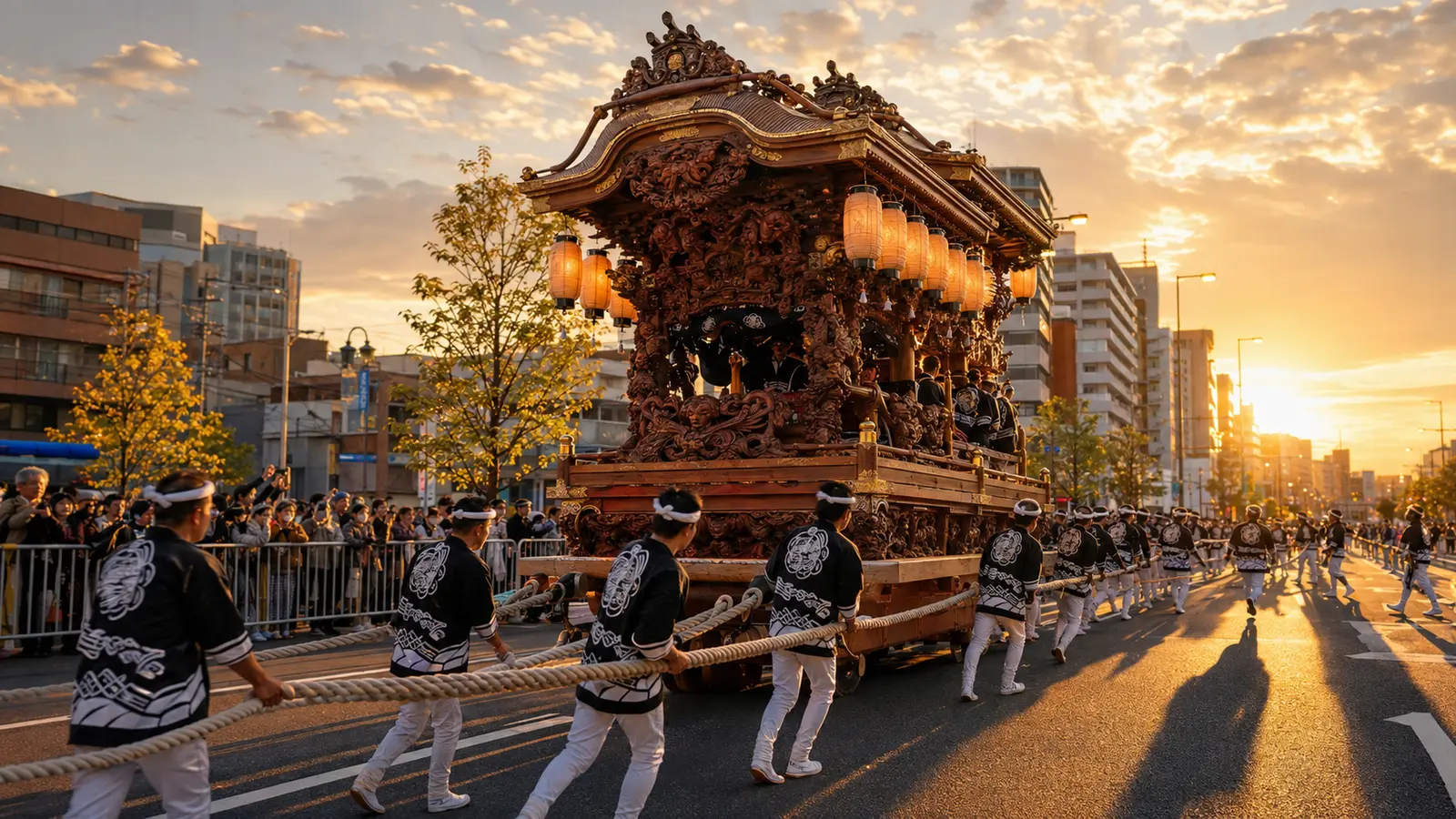
Kishiwada City traces the festival back more than 300 years to a harvest-prayer observance in the middle Edo period. The carved wooden danjiri belong to individual neighborhoods and move through active streets rather than remaining in one fenced venue. The signature sight is yarimawashi: a coordinated, fast turn at an intersection.
Daytime pulling emphasizes speed, teamwork and the carved floats. At night the danjiri are decorated with lanterns and move at a different pace. Treat the street as an operating festival route: stay behind barriers and staff lines, keep intersections open and never step forward for a photograph when a float is approaching.
What to know
Official September 2026 dates and operating hours
Kishiwada City's 2026 schedule lists trial pulling from 14:00 to 16:00 on Sunday, September 6 and Friday, September 18. Yoimiya runs from 06:00 to 22:00 on Saturday, September 19. Honmiya runs from 09:00 to 22:00 on Sunday, September 20.
Those broad hours do not mean every float passes every corner continuously. The municipality has published separate illustrated maps for the Kishiwada and Haruki districts, but the 2026 parade and shrine-entry order was still not posted on the city's order page as of August 27. Choose a district and save its current map instead of copying a 2025 timetable.
What to know
Kishiwada district or Haruki district
The September festival covers two distinct areas. Kishiwada Station is the practical rail gateway for the central Kishiwada district, including the station-front streets and routes toward the castle-town and Kankan areas. Haruki Station is the gateway for the separate Haruki district. Do not arrive at one station expecting a short walk to every float in both districts.
For a first visit focused on the best-known central streets, start with the Kishiwada district map. Choose Haruki deliberately if its neighborhood route is your priority. Set a meeting point away from a turning intersection and share the station name in Japanese because dense crowds can make a last-minute district change slow.
What to know
Access from Osaka and Kansai Airport
From central Osaka, use the Nankai Main Line south from Namba and search the event-date timetable for Kishiwada or Haruki. From Kansai Airport, use the Nankai line toward Osaka and confirm the necessary transfer or stopping pattern in the official route search. Not every limited express stops at both festival gateways, and a ticket for a reserved-seat train can require a separate seat charge.
Nankai had not published a dedicated 2026 festival service plan in the official sources reviewed on August 27. Check live operator information before leaving and allow extra time for managed station entry and queues after the evening program. Large luggage belongs at your accommodation or a confirmed locker outside the busiest period, not in an active viewing lane.
What to know
General viewing, reserved seats and sellout conditions
Kishiwada City's festival and map pages do not list a general admission charge, advance reservation or universal ticket for entering public festival viewing areas. That does not guarantee an unrestricted view: police controls, barriers, private property, resident access and staff instructions determine where spectators may stand.
TryHard Japan separately operates reserved viewing seats in the Kankan area for September 18–20. Sales opened July 3 at 10:00 through the announced ticket route, and direct cash sales were also scheduled at Namikiri Shrine. The organizer states that sales end when the planned quantity is reached and that customer-requested refunds or exchanges are not accepted. Exact session prices and live availability must be checked on the organizer's current ticket page; the accessible official text does not provide one stable price table.
Reserved seating is optional, not a festival admission requirement. Buy only for the exact date, time and side of the viewing area you want. A ticket does not override severe-weather decisions, controlled walking routes or instructions at the venue.
What to know
Traffic restrictions and crowd strategy
Kishiwada City confirms traffic restrictions for September 6, 18, 19 and 20 and links a current police traffic-control PDF. The controlled zones and times differ across the Kishiwada and Haruki maps. Public transport is the reliable default; a navigation app may route a car toward a street that is closed by the time you arrive.
Arrive before the session you care about, but do not reserve space by blocking a shop, home, emergency route or tactile paving. Keep children close, agree on a fallback meeting point and expect the heaviest pressure around famous turns, the station approach and the end of evening pulling. Follow police and festival staff even when a crowd appears to be moving another way.
What to know
Rain, heat and final checks before leaving
As of August 27, Kishiwada City had not published one festival-wide 2026 rule explaining whether rain, strong wind or a typhoon cancels, shortens or changes every district. Do not infer a decision from an ordinary rain forecast. Recheck the city festival page, viewing-seat organizer if applicable, Nankai service information and JMA warnings on the day.
September can still be dangerously hot in Osaka, especially in open streets and long stationary crowds. Check the Ministry of the Environment's WBGT and Heat Stroke Alert, carry water and use a compact raincoat rather than opening a large umbrella beside a dense route. Leave early if heat symptoms begin; a paid seat or long journey is not a reason to remain in unsafe conditions.
The article thumbnail is an editorial image created to represent danjiri culture and is not documentary photography of the 2026 festival.
If that does not work
Use the fallback.
- Reserved seats are sold out: use only an officially permitted public viewing area shown on the current district map; avoid unverified resale listings.
- Your chosen station is under crowd control: follow Nankai staff and use the next managed service rather than crossing tracks, entering a closed gate or forcing a different exit.
- Rain or wind changes the program: wait for the responsible organizer's same-day notice and confirm any ticket treatment before changing districts.
- The parade or shrine-entry order is still unpublished: plan around the confirmed district and operating window, not an old neighborhood sequence.
- Heat or crowd density becomes unsafe: move away from the route, cool down and shorten the visit; call 119 for a medical emergency.
Before you need it
Save this offline.
- September 6 and 18 trial-pull times, September 19 Yoimiya and September 20 Honmiya hours
- Official 2026 Kishiwada or Haruki illustrated map
- Current police traffic-control PDF
- Kishiwada or Haruki Station route and Nankai return timetable
- Reserved-seat ticket, session, side, entry instructions and organizer contact if purchased
- Osaka WBGT, JMA warnings and same-day city notice
- Water, compact rain protection, portable battery and a meeting point away from the route
Frequently asked questions
Kishiwada Danjiri Festival 2026: Dates, Access and Viewing Guide FAQ
When is the Kishiwada Danjiri Festival in September 2026?
Trial pulling is 14:00–16:00 on September 6 and 18. Yoimiya is 06:00–22:00 on September 19, and Honmiya is 09:00–22:00 on September 20.
What is the nearest station?
Use Kishiwada Station for the central Kishiwada district or Haruki Station for the separate Haruki district. Both are on the Nankai Main Line.
Do I need a ticket?
Kishiwada City lists no general admission ticket or reservation for public festival viewing areas. Optional reserved viewing seats in the Kankan area are sold separately.
When do reserved viewing seats sell out?
The organizer says sales end when the planned allocation is reached. Check the current ticket page for the exact session and live availability.
Can I drive to the festival?
Traffic restrictions apply on September 6, 18, 19 and 20. Use public transport and consult the official 2026 police map rather than relying on normal navigation.
What happens if it rains?
A single festival-wide 2026 rain or typhoon rule was not published as of August 27. Check Kishiwada City, the viewing-seat organizer if relevant, Nankai and JMA on the day.
Is the 2026 parade order available?
The city had not published the 2026 parade and shrine-entry order on its official order page as of August 27. Use only a newly dated 2026 notice when it appears.
Primary evidence
Official sources used
Open these pages again before travel. External links lead to the responsible Japanese authority or transport organization.