Do this now
Follow these steps in order.
- 01
Before travel, enable overseas ATM use with your card issuer, confirm your cash-withdrawal PIN and daily limit, and save the issuer's international contact details.
- 02
Find an ATM through the official Seven Bank, Japan Post Bank or E-net locator and confirm that the machine—not only the store—shows your card network.
- 03
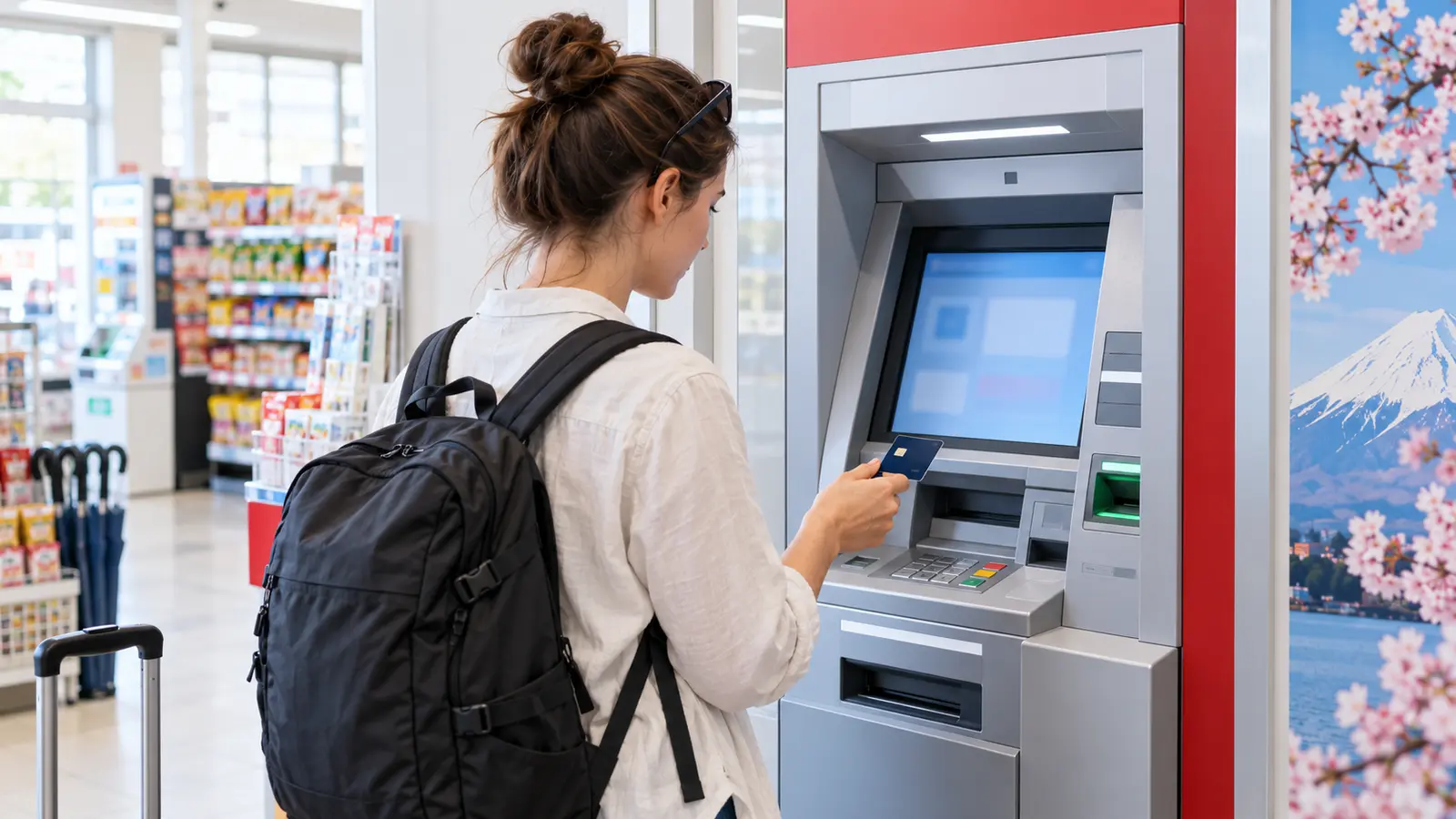
Insert the card, select English and Withdrawal, choose the account requested by your issuer, enter the PIN privately and request Japanese yen.
- 04
Read the operator fee, withdrawal amount and any currency-choice screen before confirming; cancel if the terms are unclear.
- 05
Take the card, cash and receipt, count the cash discreetly and verify the pending transaction in your banking app when connectivity is available.
What to know
Prepare the card before relying on it in Japan
A network logo is only the first compatibility check. Seven Bank and E-net both warn that some cards carrying a listed logo may still be unusable. Approval also depends on the issuing bank, the card's overseas-cash setting, available balance or credit, PIN status and the issuer's daily limit. Confirm those conditions before departure rather than treating a Japanese ATM locator as a guarantee.
Use a debit or cash card if that matches your account plan. With a credit card, a cash withdrawal may be treated as a cash advance under your issuer's interest and fee rules. Japan's ATM operator cannot explain or remove the issuer's charges. Carry a second card from a different account or network and a small amount of yen separately so one decline does not stop the trip.
What to know
Choose an ATM whose official page lists your network
Seven Bank lists Visa and PLUS, Mastercard, Maestro and Cirrus, UnionPay, American Express, JCB, Discover and Diners Club. It operates ATMs at 7-Eleven stores and other locations, but says that some cards with those marks may not be accepted. Visa and Mastercard services are listed as 24 hours; the published daily service windows for several other networks have short overnight gaps.
Japan Post Bank lists Visa, PLUS, Mastercard, Maestro, Cirrus, JCB, UnionPay and Discover for overseas-issued cards. Its ATMs are found at post offices and other locations, including compact units in some FamilyMart stores. Service hours vary by machine, location and holiday schedule, so use its current information rather than assuming the host store's hours are the ATM's hours.
E-net lists overseas Visa, Mastercard, UnionPay and JCB cards at compatible ATMs in select FamilyMart, Don Quijote and other retail locations. Its international page advertises 24-hour service, while also warning that the same logo does not guarantee compatibility and that not every store has an eligible E-net ATM.
What to know
Know the ATM ceiling and your issuer's separate limit
Seven Bank currently sets a ¥100,000 ceiling for each overseas-card withdrawal and a ¥30,000 ceiling for a magnetic-stripe transaction. Japan Post Bank currently sets a ¥50,000 ceiling for each withdrawal. These are per-transaction operator ceilings, not a promise that your card can withdraw that amount.
Your issuer may apply a lower per-transaction or daily overseas limit, and available funds, cash-advance limits or fraud controls may reduce it further. If the amount is declined, Seven Bank's official guidance says to reduce the requested amount and try the transaction again. Avoid splitting a large withdrawal into repeated transactions without checking fees, because an operator or issuer fee can apply each time.
What to know
Separate operator fees, issuer fees and exchange rates
There is no single nationwide foreign-card ATM fee. Seven Bank says fees vary by card brand. Japan Post Bank says a ¥220 ATM usage fee may apply to certain cards issued abroad, and that the issuing institution may charge an additional fee. E-net says handling fees vary by the bank of withdrawal and that the card issuer may add fees.
Review the confirmation screen before authorizing the withdrawal, then keep the receipt. Also check the issuer's foreign-exchange markup, overseas ATM fee and cash-advance terms. The amount shown by the Japanese ATM does not necessarily include every issuer charge that will appear later.
What to know
Understand the yen-versus-home-currency screen
Seven Bank explains that its Dynamic Currency Conversion service may offer a choice between the cardholder's home currency and Japanese yen for supported Visa and Mastercard transactions. Selecting the home currency fixes that billing amount at the ATM. Selecting Japanese yen settles the ATM transaction in yen, and the home-currency amount is determined later when the issuer bills it.
The two choices use different conversion paths. Do not press a button only because one number looks familiar: read the displayed rate and fees, compare them with your issuer's terms, and cancel if you cannot understand the choice. Seven Bank says its DCC option is not available for JCB, Discover, UnionPay, American Express or Diners Club.
What to know
Complete the withdrawal without losing the card or receipt
Seven Bank's official sequence is: insert the card, choose a language, select Withdrawal, choose the account, enter the PIN, choose a yen amount, review the currency choice when offered, then collect the cash, card and receipt. The exact order can vary at other machines, so follow the screen in front of you and shield the keypad.
Do not walk away as soon as the cash appears. Confirm that the card has been returned, take the receipt and record the ATM location and time. Check the amount in a secure place. A receipt and the ATM's identifying details are useful if the account is debited incorrectly or the machine retains the card.
What to know
Respond safely to a decline, PIN error or retained card
A decline does not prove that every Japanese ATM will reject the card. First verify the network logo, overseas-cash setting, balance and issuer limit. Try one smaller amount or another officially compatible operator. If the screen reports an incorrect PIN, stop guessing: Seven Bank directs cardholders to contact the card issuer. Repeated guesses can lock the card under issuer rules.
If the ATM retains the card, use the contact number shown on the machine or ask the host facility for help immediately. Record the operator, ATM location, time and any error code. The Japanese operator controls the machine, while the overseas issuer controls the card account; you may need both organizations. Do not accept help from an unknown bystander who asks for the PIN.
What to know
If the account is debited but no cash arrives
Do not repeat the same withdrawal immediately. Keep the receipt, photograph only the ATM identification and location—not your PIN or full card number—and note the exact time, requested amount and message. Check whether the entry is pending or completed, then contact the ATM operator using its official details and the card issuer using the number on the card or issuer app.
A pending entry may be handled differently from a completed charge, and resolution timing belongs to the operator and issuer. Do not state that cash was received if it was not, and do not discard the receipt until the case is closed. Use another card or a staffed exchange option for immediate cash rather than multiplying disputed transactions.
If that does not work
Use the fallback.
- If one supported ATM declines the card, check the issuer app and try one lower amount before moving to a different official operator; repeated PIN guesses can lock the card.
- If the issuer has blocked overseas cash withdrawals, contact it through the official international number or secure app and ask what must be changed.
- If no card works, use a second card, a staffed airport or authorized currency-exchange counter, or a trusted travel companion's agreed payment while you resolve the issue.
- If the card is retained or cash is missing, record the ATM details and contact both the operator and issuer; keep the receipt and avoid another identical transaction.
Before you need it
Save this offline.
- Card issuer's international support number and overseas ATM instructions
- Official Seven Bank, Japan Post Bank and E-net ATM locators
- Your issuer's cash-withdrawal limit, fees and cash-advance terms
- A second card and emergency yen stored separately from the primary wallet
Frequently asked questions
Japan ATM Guide for Foreign Cards: Fees, Limits and Fallbacks FAQ
Can every foreign Visa or Mastercard withdraw cash in Japan?
No. A listed network logo means the ATM supports that network, but Seven Bank and E-net both warn that some cards with the same logo may still be incompatible. The issuer can also block overseas cash withdrawals or set a lower limit.
What is the withdrawal limit at a Japanese ATM?
It depends on the operator and issuer. As checked October 20, 2026, Seven Bank lists ¥100,000 per overseas-card withdrawal, or ¥30,000 for a magnetic-stripe transaction, while Japan Post Bank lists ¥50,000 per transaction. Your issuer may allow less.
How much is the ATM fee?
There is no universal fee. Japan Post Bank says ¥220 may apply to certain overseas cards; Seven Bank says its fee varies by card brand; E-net says handling fees vary. Your issuer may add an overseas ATM fee, foreign-exchange markup or credit-card cash-advance cost.
Should I choose Japanese yen or my home currency?
Read the displayed rate and your issuer's terms before deciding. On a supported Seven Bank DCC transaction, home currency fixes the converted amount at the ATM; choosing yen leaves the home-currency amount to be determined later by the issuer. Cancel if the choice or charges are unclear.
What should I do after an incorrect PIN message?
Stop guessing and contact the card issuer. Seven Bank specifically directs users to the issuing company after an incorrect-PIN error, and repeated attempts may lock the card under issuer rules.
What if my account is charged but the ATM gives no cash?
Do not immediately repeat the withdrawal. Keep the receipt, note the ATM operator, machine location, time, amount and error, check the transaction status, and contact both the ATM operator and your card issuer through official channels.
Primary evidence
Official sources used
Open these pages again before travel. External links lead to the responsible Japanese authority or transport organization.