Do this now
Follow these steps in order.
- 01
Choose a day by priority: September 15 for the main ceremony and procession, or September 16 for yabusame. September 14 is quieter and centers on the evening Yoimiya-sai.
- 02
Use JR Kamakura Station East Exit and allow about ten minutes to walk to Tsurugaoka Hachimangu. Avoid planning a car arrival in the historic center.
- 03
Treat yabusame sightlines as limited rather than guaranteed. Arrive with time to follow staff directions, and keep a second Kamakura stop ready if the track area is full.
- 04
On the morning of your visit, recheck the official festival page, JMA warnings, the Ministry of the Environment heat alert and Kamakura's crowd map.
What to know
What the Reitaisai is—and why travelers choose it
The formal event is Tsurugaoka Hachimangu Reitaisai, the shrine's most important annual festival. The Kamakura City Tourist Association traces the Reitaisai to 1187, when Minamoto no Yoritomo conducted a release-of-living-creatures rite and yabusame at the shrine. The three-day program combines Shinto ceremonies, a public procession, courtly music and dance, and mounted archery.
For an international visitor, the decision is not simply whether to visit the shrine: each date has a different purpose. September 15 provides the central religious ceremony and street procession. September 16 provides the most visually dramatic program, yabusame, but also the greatest risk of restricted sightlines and dense stationary crowds.
What to know
Official 2026 dates and times
Monday, September 14: the Yoimiya-sai eve ceremony begins at 18:00. The official program also lists a tea dedication from 10:00 to 15:00, a boys' and girls' chorus at 16:00 and Japanese drums at 19:00.
Tuesday, September 15: the Reitaisai ceremony begins at 10:00. The Shinko-sai procession begins at 13:00 and travels along Wakamiya Oji toward the second torii gate. A dance dedication is listed at 18:00.
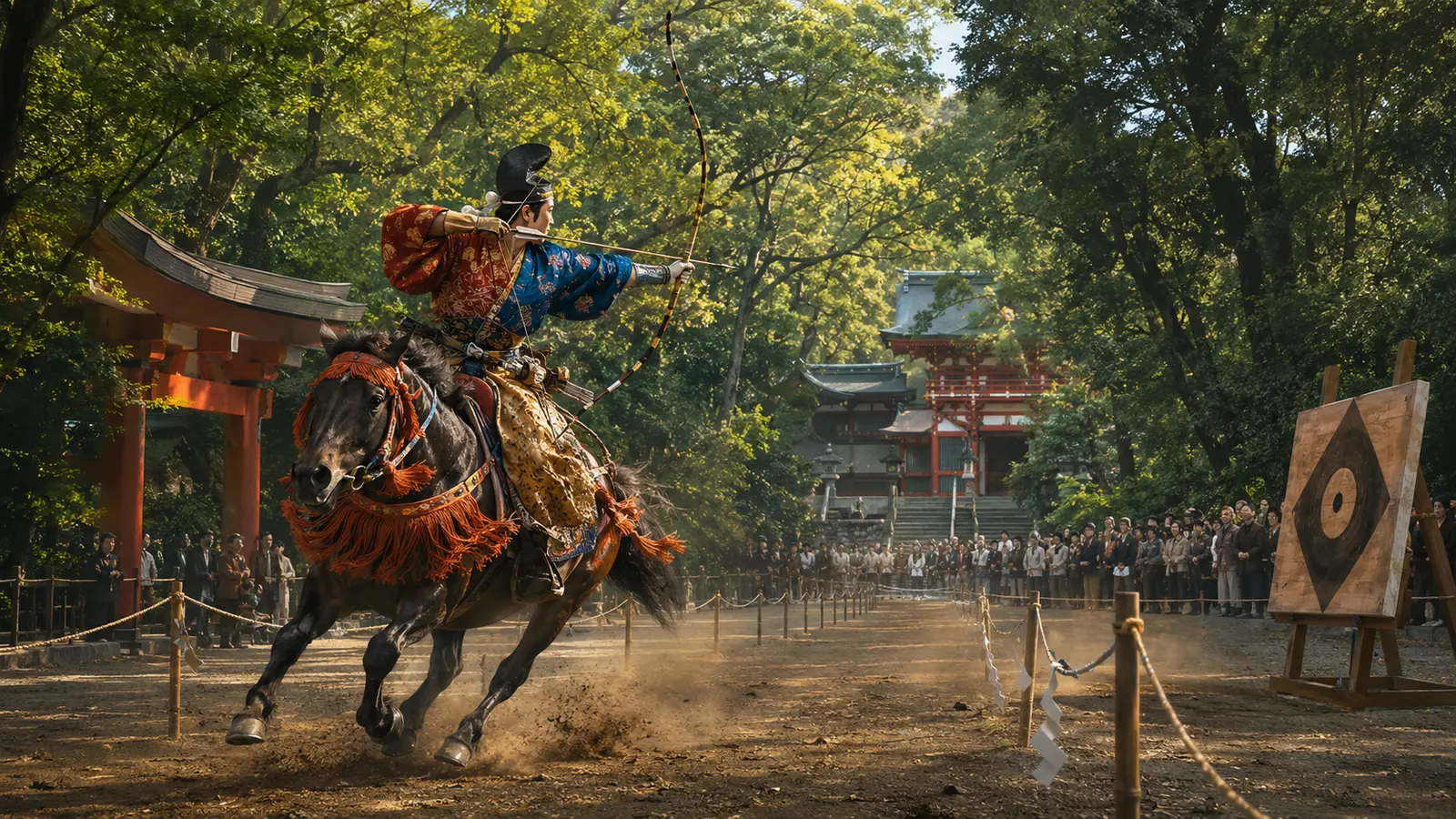
Wednesday, September 16: yabusame begins at 13:00 on the shrine's straight riding track. Mounted archers in traditional dress gallop past three targets. The Suzumushi Hojoe begins at 17:00, with other cultural dedications scheduled during the day.
These are published start times, not promises about duration, finishing time or an uninterrupted view. Keep the official event page open because individual programs can be adjusted.
What to know
How to choose between the procession and yabusame
Choose September 15 if you want the religious center of the festival and a moving procession rather than one fixed viewing point. The Shinko-sai route uses Wakamiya Oji from the shrine toward the second torii, so follow managed crossings and do not step into the route for photographs.
Choose September 16 if horseback archery is the reason for the trip. Yabusame is a fast ritual: each mounted run passes in seconds, and spectators line a straight track rather than a stadium bowl. The responsible pages do not promise a view from every position, publish a 2026 seat allocation or recommend a precise arrival time. Arriving early improves planning flexibility but does not guarantee admission to a particular area.
Travelers who want less crowd pressure can use September 14 for the eve ceremony and dedications, then visit other central Kamakura sites before the evening program. Do not assume all three days have the same atmosphere or schedule.
What to know
Venue, nearest station and access
The venue is Tsurugaoka Hachimangu, 2-1-31 Yukinoshita, Kamakura, Kanagawa. The official English visitor page gives JR Kamakura Station East Exit as the practical gateway and estimates a ten-minute walk. The central approach uses Komachi-dori or Wakamiya Oji; Wakamiya Oji is also part of the September 15 procession area.
From Tokyo or Yokohama, use rail to Kamakura and check the current operator route before departure. No dedicated 2026 special-train plan is published on the event sources reviewed on August 29. Allow extra time for the station, pedestrian approach and possible managed crossings rather than depending on a normal ten-minute transfer at festival peak.
A dedicated 2026 event traffic-control plan was not published in the reviewed sources. Driving is a poor default because central Kamakura streets are narrow, parking is limited and the procession uses a major approach. If a vehicle is essential, check Kamakura City and Kanagawa Prefectural Police notices immediately before travel.
What to know
Admission, tickets, reservations and sellout conditions
The shrine grounds normally have no general entry charge. Separate fees apply to facilities such as the shrine museum or Treasure Hall, but those are not festival viewing tickets.
As of August 29, the official 2026 festival page does not publish a general spectator ticket, reservation requirement, application deadline, reserved viewing allocation or sellout condition for the procession or yabusame. That means travelers should not promise themselves a paid or guaranteed position based on an old blog, resale listing or previous-year arrangement.
If the shrine later announces controlled, sponsor or priority viewing, use only a newly dated official notice and check eligibility, entry time and refund terms before paying. Public access may still be limited by capacity and safety even when no general ticket is listed.
What to know
Crowds, photography and respectful viewing
Use Kamakura's official crowd map before leaving, then follow shrine staff, police and barriers on site. Keep station gates, the horse track, tactile paving, shop entrances and residential access clear. Set a meeting point away from the shrine approach because mobile service can slow in a dense crowd.
Photograph only from an allowed position. Do not use flash near horses, lean across barriers, extend equipment into the riding line or step into a procession for a centered shot. Keep tripods and long lenses out of other spectators' space, and stop recording if staff prohibit it in a ritual area.
Respect Kamakura asks visitors to take trash with them, avoid eating while walking where it obstructs others, use designated smoking areas and protect residents' daily access. Treat the event as an active religious festival, not a staged performance arranged around cameras.
What to know
Rain, heat and final checks before you go
The official 2026 event page reviewed on August 29 does not publish a single rain, strong-wind or horse-safety cancellation rule, a decision time, a postponement date or ticket-refund policy. Do not infer that yabusame will run in rain. Check Tsurugaoka Hachimangu and the Kamakura City Tourist Association on the day, especially if JMA issues a warning.
Mid-September can still be dangerously hot. Check the Ministry of the Environment's WBGT and Heat Stroke Alert, carry water, use sun protection and leave a packed viewing line if symptoms begin. A compact raincoat is safer than opening a large umbrella beside horses or a dense procession route.
Before departure, confirm the chosen ceremony time, current crowd conditions, rail service, weather warnings, photography restrictions and any newly announced traffic or viewing controls. The article thumbnail is an editorial illustration created to represent yabusame and is not documentary photography of the 2026 festival.
If that does not work
Use the fallback.
- The yabusame track area is full or your view is blocked: follow staff instructions and switch to the wider shrine grounds or a separate Kamakura visit; never cross a barrier to recover a sightline.
- Rain, wind or heat changes the program: wait for the shrine or official tourism notice and do not rely on a previous year's cancellation pattern.
- Kamakura Station is under crowd control: stay with the managed pedestrian flow and take the next safe train rather than forcing a gate or platform transfer.
- A new ticket or controlled-viewing notice appears: verify that it is dated 2026, issued or linked by the shrine, and clear about entry and refund terms before paying.
- The procession blocks your planned crossing: use the route directed by police or event staff and allow it to pass; do not enter the route between groups.
Before you need it
Save this offline.
- September 14–16 schedule and the exact ceremony you chose
- Tsurugaoka Hachimangu address and JR Kamakura Station East Exit walking route
- Official event and shrine festival pages
- Kamakura crowd map, JMA warnings and heat-alert page
- Return train route and a meeting point away from the shrine approach
- Water, sun protection, compact rain gear and portable battery
- A backup Kamakura stop if the viewing area is full or weather changes the ritual
Frequently asked questions
Tsurugaoka Hachimangu Reitaisai 2026: Yabusame, Schedule and Access FAQ
When is Tsurugaoka Hachimangu Reitaisai in 2026?
The festival runs September 14–16, 2026. The Yoimiya-sai is at 18:00 on September 14, the main Reitaisai at 10:00 and Shinko-sai procession at 13:00 on September 15, and yabusame at 13:00 on September 16.
What time is yabusame in Kamakura in 2026?
The official 2026 schedule lists yabusame at Tsurugaoka Hachimangu from 13:00 on Wednesday, September 16.
What is the nearest station?
JR Kamakura Station is the nearest practical rail gateway. Tsurugaoka Hachimangu is about a ten-minute walk from the East Exit under normal conditions.
Do I need a ticket or reservation?
The official 2026 event page did not publish a general spectator ticket, reservation deadline, guaranteed viewing area or sellout condition as of August 29. Check again before travel because safety controls can still limit access.
Is the Reitaisai free?
The shrine grounds normally have no general entry charge, and the official festival page lists no general spectator fee. Separate museum or Treasure Hall charges are not festival viewing tickets.
What happens if it rains or is windy?
A 2026 rain, strong-wind or horse-safety rule was not published on the reviewed official event page as of August 29. Check the shrine, official Kamakura tourism page and JMA on the day.
Is there a 2026 traffic-control plan?
A dedicated 2026 event traffic-control plan was not published in the reviewed sources as of August 29. The September 15 procession uses Wakamiya Oji, so use rail and follow same-day police and staff directions.
Primary evidence
Official sources used
Open these pages again before travel. External links lead to the responsible Japanese authority or transport organization.