Do this now
Follow these steps in order.
- 01
Choose Saturday evening for lantern-lit stationary floats and music, or Sunday for the full 13-float procession and karakuri demonstrations.
- 02
If you need a chair and fixed viewing window, check the official linked booking page now; seats are unassigned within each reserved area and live inventory can change.
- 03
Use JR Otsu Station, Keihan Biwako-hamaotsu or Shimanoseki, and plan to walk between festival areas instead of driving into the controlled city centre.
- 04
Download the final 2026 route and traffic notice when released, then recheck weather, JR service and the organizer before departure.
What to know
Why Otsu Festival is an easy cultural trip from Kyoto
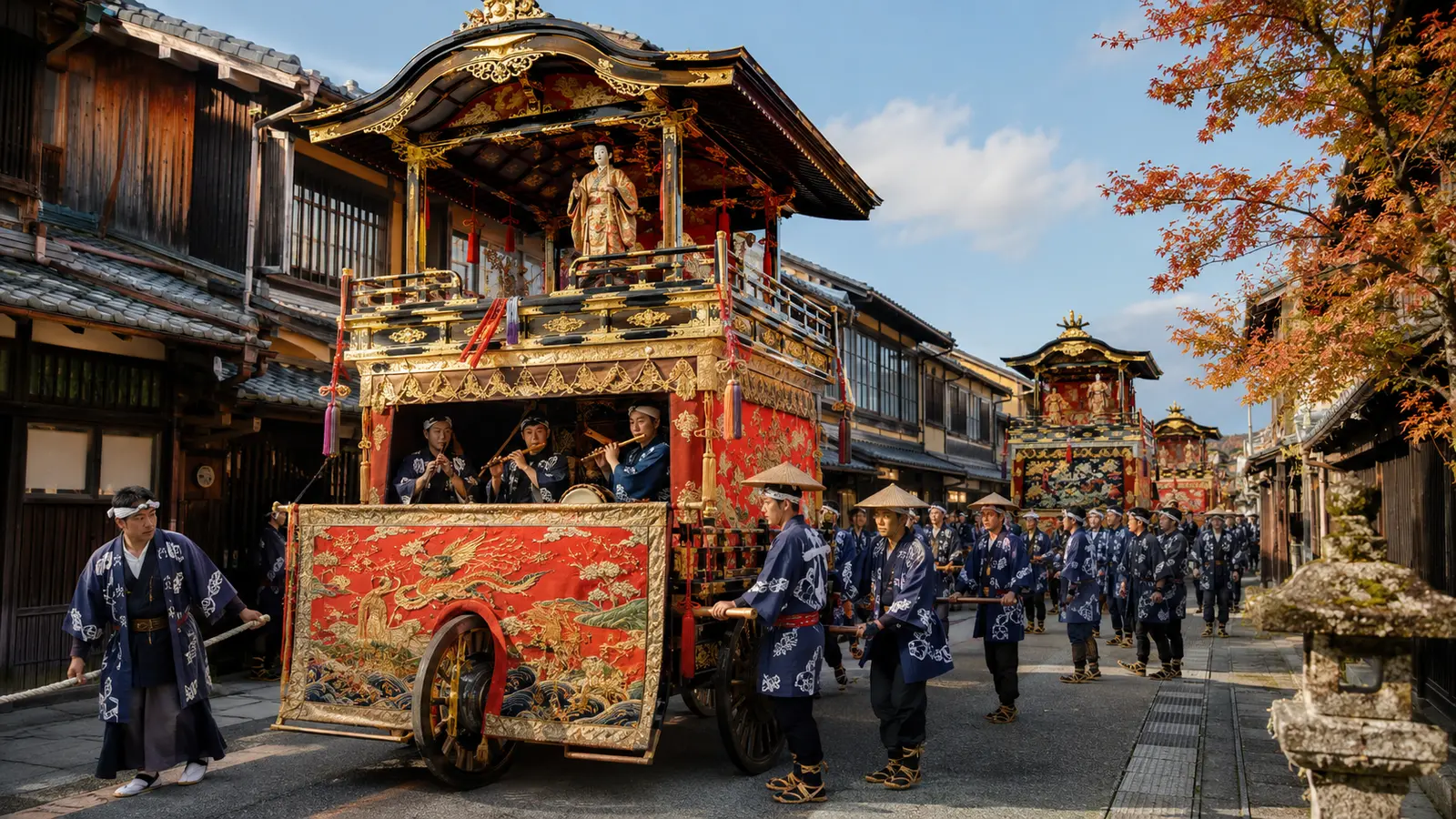
Otsu Festival is the annual festival of Tenson Shrine and one of Shiga's major float festivals. The official tourism association describes 13 ornate hikiyama floats, each carrying a different mechanical karakuri performance based on subjects including noh theatre and historical stories. The float ritual is a National Important Intangible Folk Cultural Property and was added to UNESCO's Intangible Cultural Heritage list in December 2025.
The practical advantage is access. Official local guidance puts Kyoto Station to JR Otsu Station at about ten minutes on the Biwako Line, so a traveler can experience an important regional festival without changing hotels. Otsu is still a living city rather than an enclosed venue: the floats, neighborhood display spaces and spectators share streets that once formed the Otsu-juku post town.
What to know
Confirmed 2026 dates, hours and venues
Float assembly, called yamatate, is scheduled for Sunday, October 4 from 08:30 to 15:00. The visitor-facing festival weekend begins with Yomiya on Saturday, October 10 from evening until about 21:00. Floats are decorated during the morning, a daytime pull is planned, and lantern-lit floats and festival music fill the neighborhoods after dark.
The main festival procession runs Sunday, October 11 from about 09:00 to 17:30. All 13 floats assemble in front of Tenson Shrine, then travel through central Otsu and perform karakuri at designated shomo points. The event area includes JR Otsu Station, Chuo-odori, the old Tokaido streets and Tenson Shrine rather than one entrance or arena.
The reviewed official pages do not yet provide one English minute-by-minute route table for every float or the final 2026 traffic-control map. Treat the published overall hours as planning boundaries and use the organizer's newly dated route notice closer to the weekend.
What to know
Free viewing and the three paid-seat choices
General street viewing is free and requires no festival-wide reservation. A paid seat is optional: it provides a chair and a defined viewing period, not entry to the whole festival. Free sightlines depend on the procession, crossings, staff controls and how early a public section fills.
The new morning seats cost ¥2,000 and cover approximately 09:30–10:45 on the old Tokaido beside the north parking area of NHK Otsu. Entry is planned from 09:00. These seats show the floats soon after departure, but they do not include a karakuri demonstration or commemorative gift.
Afternoon seats cost ¥5,000 and include an anti-evil chimaki and official program. The Otsu-ekimae avenue block is scheduled for about 13:30–14:45, with entry from 12:30; the old Tokaido block is about 14:30–15:45, with entry from 13:30. Both afternoon areas include karakuri. A ¥11,000 option adds the official fully stamped Yomiya goshuin book to either afternoon seat.
What to know
Booking deadline, sellouts and seat conditions
Online reservations opened at 09:00 JST on Saturday, August 22 through the booking page linked by the official tourism association. The reviewed notice does not publish one final purchase deadline, total public-seat allocation or guaranteed same-day sales policy. Buy while your preferred area is shown as available rather than assuming the booking window stays open until October 11.
Seats are not individually selectable, and adjoining seats may not be available even in one order. The booking confirmation is exchanged for the festival ticket at the viewing-area entrance. Read the live product conditions before payment because optional tours and ordinary viewing seats are separate products.
The organizer warns that inventory can move as tour allocations are adjusted: an area shown sold out may receive later availability. That is not a waitlist or guarantee. Use only the official linked booking flow, recheck the exact area and time, and do not buy an undated or unofficial resale listing.
What to know
Nearest stations and the Kyoto day-trip plan
JR Otsu Station is the simplest gateway for the station avenue and central festival district. From Kyoto Station, the official access guide gives about ten minutes on the JR Biwako Line. Confirm that the train stops at Otsu and keep enough margin for platform crowding on the return.
Keihan Biwako-hamaotsu and Shimanoseki stations approach different parts of the wider festival area. The official access guide also lists a through journey from Sanjo Keihan to Biwako-hamaotsu in about 25 minutes via the subway Tozai Line and Keihan railway under ordinary conditions. Choose the station by the viewing block, not only by whichever map pin says Otsu Festival.
The event covers public streets and will bring traffic restrictions. The final 2026 closure boundaries, bus diversions, temporary parking rules and bicycle controls were not published on the official pages reviewed September 4. Rail and walking are the more predictable default; follow barriers and staff instead of trying to cross with a float.
What to know
Rain, cancellation and refund rules
The paid-seat guidance says the procession is planned to proceed in rain. Umbrellas and parasols are prohibited in the reserved areas because they obstruct views and create a safety risk, so bring a full raincoat and a waterproof bag cover. A weather forecast is not a cancellation decision; check the organizer on the morning of the event.
Paid-seat charges are not refundable unless severe weather or another operational reason causes the hikiyama procession itself to be cancelled. The public guidance does not state a fixed rainfall, wind or lightning threshold, a postponement date, a decision time or how partial interruption would affect every ticket. Review the terms shown for your product and keep transport cancellation rules separate from the festival ticket.
What to know
Crowds, karakuri viewing and final checks
Sunday's karakuri demonstrations are performed only at designated shomo points, so the ¥2,000 morning block is not a lower-price version of the afternoon experience. If karakuri is the priority, choose an announced afternoon seat or a legal public position near an official performance point after the final route is published.
Keep station exits, tactile paving, doorways and float turning space clear. Do not reach toward the float, chase distributed chimaki into the road or step through a controlled crossing for a photograph. The reviewed 2026 visitor page does not publish one blanket photography or tripod policy for every public street, so obey on-site signs and keep all equipment inside your lawful viewing space.
Before leaving, recheck the 2026 procession route, paid-seat availability, ticket exchange point, weather decision, road and bus restrictions, and return railway status. The article thumbnail is an editorial illustration created to evoke the festival and is not documentary photography of the 2026 event or evidence of its exact floats, participants, weather or crowd level.
If that does not work
Use the fallback.
- The preferred reserved block is sold out: recheck later only because tour allocations can change, or plan free street viewing without claiming a guaranteed karakuri sightline.
- Rain is forecast: bring a raincoat because umbrellas are prohibited in paid seating, and wait for the organizer's actual operating decision.
- The procession is cancelled: follow the original booking channel's refund procedure and confirm separately whether your train, hotel or tour is refundable.
- A public viewing section is full: move to a wider lawful area or later route point; never enter a road, doorway, paid block or float turning zone.
- A bus or road route is restricted: use the nearest practical rail station and follow the current operator notice rather than an ordinary-day route result.
Before you need it
Save this offline.
- October 10 Yomiya and October 11 main-festival hours
- Final 2026 procession route and traffic-control notice when released
- Paid-seat confirmation, viewing area, entry time and ticket-exchange instructions
- Walking route from JR Otsu, Biwako-hamaotsu or Shimanoseki
- JR or Keihan return timetable and live operator status
- Organizer weather update and purchase-channel refund terms
- Raincoat, water, portable battery and a compact bag
Frequently asked questions
Otsu Festival 2026: Floats, Tickets and Access FAQ
When is Otsu Festival in 2026?
Yomiya is Saturday, October 10 from evening to about 21:00. The main 13-float procession is Sunday, October 11 from about 09:00 to 17:30.
Where is Otsu Festival held?
It spreads across central Otsu around Tenson Shrine, JR Otsu Station, Chuo-odori and the old Tokaido streets.
Is Otsu Festival free?
General street viewing is free. Optional reserved seats cost ¥2,000, ¥5,000 or ¥11,000 depending on time, viewing area and included items.
Do I need to reserve a seat?
No for general public-street viewing. Yes if you want one of the official chair areas; online reservations opened August 22 and current inventory must be checked live.
Can Otsu Festival seats sell out?
Yes. No total public allocation or final sales deadline is published. Inventory can occasionally reappear after tour adjustments, but that is not guaranteed.
How do I reach Otsu Festival from Kyoto?
Official local guidance gives about ten minutes from Kyoto Station to JR Otsu Station on the Biwako Line. Keihan Biwako-hamaotsu and Shimanoseki serve other parts of the festival area.
What happens if it rains?
The event is planned to proceed in rain. Umbrellas and parasols are prohibited in paid seating; bring a raincoat. Paid seats are refunded only if the float procession is cancelled.
Which paid seat includes karakuri?
The ¥5,000 afternoon areas and ¥11,000 goshuin-book option include a karakuri viewing point. The ¥2,000 morning seat does not.
Are the final road restrictions published?
The detailed 2026 closure, bus-diversion and parking plan was not published on the reviewed official pages as of September 4. Recheck before travel.
Primary evidence
Official sources used
Open these pages again before travel. External links lead to the responsible Japanese authority or transport organization.