Do this now
Follow these steps in order.
- 01
Choose Saturday evening if seeing all seven illuminated floats together is the priority; use Sunday or Monday for a less concentrated three-day itinerary.
- 02
Travel by the JR Tohoku Main Line to Nihonmatsu Station and collect the latest route map at the station tourist information desk before entering the crowd.
- 03
Do not copy the 2025 timetable, parking list or road controls into a 2026 plan; wait for the dated 2026 organizer map.
- 04
Recheck the official tourism page, JR East status and weather on the event day because the float route and operating decision can change.
What to know
Formal name, confirmed dates and what makes it special
The formal event is the Nihonmatsu Shrine Grand Festival, or Nihonmatsu Jinja Reitaisai; it is widely known as Nihonmatsu no Chochin Matsuri, the Nihonmatsu Lantern Festival. The Nihonmatsu Tourism Federation identifies it as a Fukushima Important Intangible Folk Cultural Property and says the festival is held on the first Saturday, Sunday and Monday of October. Its official 2026 calendar lists October 3–5.
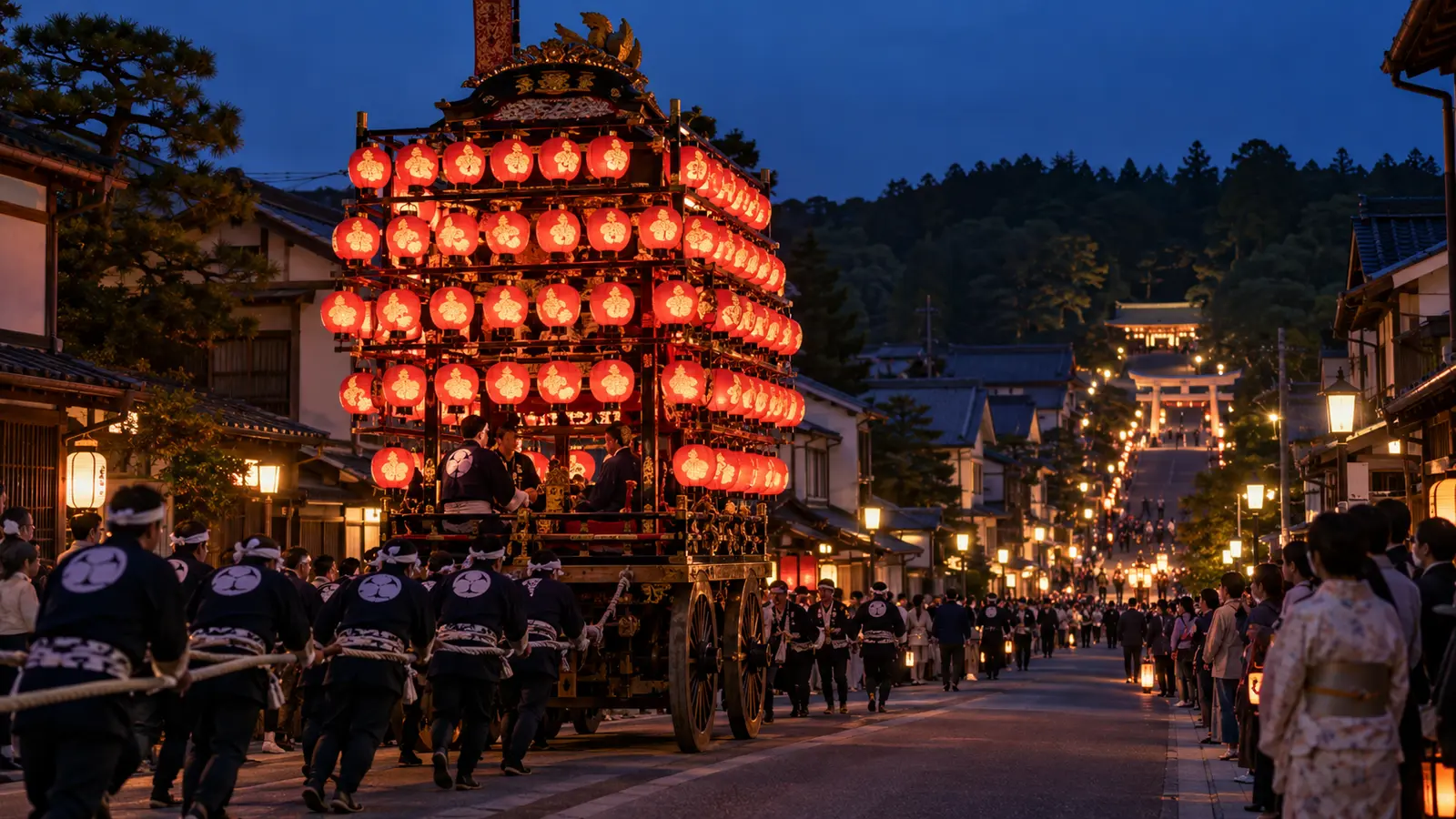
Seven neighborhood taikodai floats carry rows of locally made red paper lanterns. The prefectural English guide says each float uses about 300 lanterns with real candles, while the local guide describes roughly 3,000 lanterns across the first-night spectacle. This is a moving religious festival, not a stationary illumination: stay outside the pull ropes, turning space and candle-handling work area.
What to know
Three-day schedule and the best night to choose
Saturday, October 3 is the yoimatsuri and the only night when all seven illuminated floats run together. The floats receive sacred fire at Nihonmatsu Shrine, move through the city with separate musical rhythms and chants, and finish their joint route near Nihonmatsu Station. Choose this night for the fullest visual experience and expect the largest concentration of spectators.
Sunday, October 4 is the main festival day. The standing official guide places the joint daytime float run from about 08:30 to 15:00, followed by the mikoshi's return to the shrine and separate illuminated neighborhood runs at night. Monday, October 5 is the after-festival: daytime neighborhood runs are followed by evening joint processions split into a four-float group and a three-float group.
Those broad Sunday times and the sequence describe the established festival format, but the final 2026 departure times, meeting points, stop times and finish times were not published when checked September 6. Treat an older route PDF as historical reference only and replace it with the 2026 map before travel.
What to know
Venue, nearest station and access from Tokyo or Sendai
The festival spreads across central Nihonmatsu around Nihonmatsu Shrine, the historic neighborhood streets and JR Nihonmatsu Station. There is no single arena entrance. The prefectural visitor guide says the festival area begins immediately outside Nihonmatsu Station, which makes rail the clearest default for an international visitor.
Nihonmatsu Station is on the JR Tohoku Main Line between Fukushima and Koriyama. The city tourism federation gives an indicative journey of about 1 hour 50 minutes from Tokyo Station by Tohoku Shinkansen with a change at Koriyama, about one hour from Sendai by Shinkansen connection, and about two hours from Sendai using local trains. These are planning estimates, not guaranteed connections; check the current JR timetable for the exact date.
The station tourist information desk distributes local maps and can help with current visitor information. Save two return options because the first-night finish can be late, mobile networks may slow and ordinary walking routes can be interrupted by moving floats or police controls.
What to know
Admission, tickets, reservations and sellout conditions
The reviewed official pages do not announce a festival-wide admission gate, general spectator ticket or reservation requirement for the street processions. No official 2026 reserved-seat sale, price, application deadline, capacity, same-day allocation or resale channel was published as of September 6.
Because no public official seat inventory is announced, there is no verified sellout condition to report. A hotel, transport package or locally arranged viewing product is separate from general festival access: confirm exactly what it includes, who operates it and its cancellation terms before payment.
Free public street viewing does not guarantee a front-row position, chair, shelter or unobstructed view. Do not reserve space with tape, luggage or unattended sheets, and never stand inside a controlled road, shrine ritual zone, resident entrance or float maneuvering area.
What to know
Rain, fire safety and severe-weather decisions
A uniform 2026 rule for rain, wind, lightning, postponement, cancellation, decision time and refunds was not published in the official sources reviewed September 6. Paper lanterns contain real candles, so weather can affect each float and part of the program differently. Wait for a newly dated organizer or city notice rather than assuming the entire three-day event will run unchanged.
Use a compact raincoat instead of opening a large umbrella beside pull ropes or a dense procession. Keep hair, sleeves, bags and camera straps away from the lantern framework and candle crew; do not touch a float or try to help with a lantern. Follow police, fire and festival staff immediately if a route is cleared.
A festival change does not automatically cancel or refund a train, hotel or commercial tour. Check each booking's terms separately, and use JMA warnings plus JR East operating information when deciding whether the journey itself remains safe.
What to know
Crowds, traffic controls, parking and photography
The Saturday-night gathering of all seven floats is the highest-demand period. Arrive before dusk, identify an exit route while streets are still readable and watch from behind barriers or the line set by staff. Steep streets, heavy moving floats, pull ropes and sudden changes of direction make the front edge unsuitable for small children or anyone who cannot move quickly in a compressed crowd.
The official festival page still shows a prior-year route and parking arrangement, but the final 2026 road closures, pedestrian directions, bus changes, temporary parking sites and capacity rules were not published when checked. Use rail where practical and do not drive into central Nihonmatsu based on an old map. The tourism federation warns that part of the Kannon Kyuryo walking trail may close from the day before through the day after the festival for fall prevention; check whether the same restriction is posted for 2026.
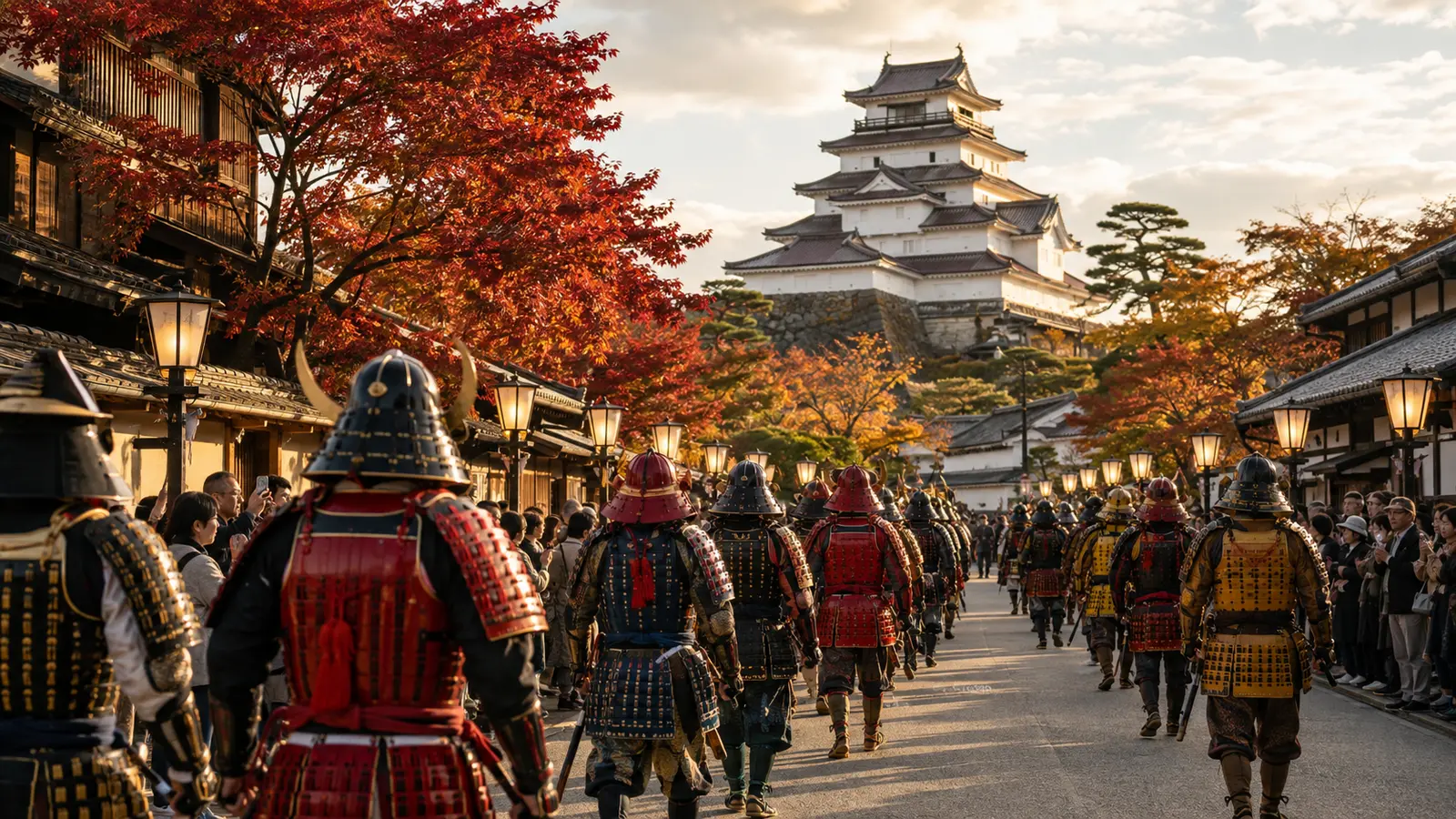
No blanket 2026 public rule for tripods, flash, livestreaming or drones was found. Keep equipment close to your body, do not block a resident, performer, emergency route or lantern crew, and never fly a drone over the procession. The article thumbnail is an editorial image created to evoke the event; it is not documentary photography of the 2026 festival or evidence of exact floats, participants, lighting, weather or crowd levels.
What to know
What to confirm before leaving your accommodation
Within 48 hours, look for the dated 2026 route and timetable, traffic-control map, any temporary parking notice, the organizer's weather decision and JR East service. Save the Japanese name 二本松の提灯祭り and the official page offline so station or hotel staff can identify the correct event.
Bring water, a charged phone, compact rainwear and only a small bag that stays inside your body line. Wear shoes suitable for hills and long standing. If the current official instruction conflicts with this guide, follow the newer on-site or operator notice.
If that does not work
Use the fallback.
- The Saturday route is full: move to a wider lawful section or choose Sunday or Monday rather than pushing toward the seven-float gathering.
- The 2026 route map is still unavailable: collect current information at Nihonmatsu Station and do not follow a prior-year road closure or parking plan.
- Rain, wind or lightning affects the lanterns: wait for the organizer's specific decision and switch to an indoor Nihonmatsu plan if the procession is unsafe.
- The last practical train is crowded or missed: use only a confirmed licensed taxi or pre-booked accommodation plan; do not assume an overnight service exists.
- A viewing line blocks your route: follow police or staff around the controlled section instead of stepping under a rope or between floats.
Before you need it
Save this offline.
- October 3, 4 or 5 plan and the final 2026 operating timetable
- JR route to Nihonmatsu Station plus two return departures
- Current float route, traffic-control and station-area maps
- Organizer weather notice, JMA warnings and JR East status
- Accommodation address or licensed taxi contact if staying after the last train
- Water, compact rainwear, portable battery and walking shoes
Frequently asked questions
Nihonmatsu Lantern Festival 2026: Dates, Access and Night Guide FAQ
When is the Nihonmatsu Lantern Festival in 2026?
It is scheduled for Saturday, October 3 through Monday, October 5, 2026.
Which night should I choose?
Saturday, October 3 is the only night when all seven illuminated taikodai floats run together. It is the signature experience and likely the busiest.
What is the nearest station?
JR Nihonmatsu Station on the Tohoku Main Line. The festival area begins outside the station and extends through central streets to Nihonmatsu Shrine.
How long does it take from Tokyo?
The official city tourism guide gives about 1 hour 50 minutes from Tokyo Station using the Tohoku Shinkansen and changing at Koriyama. Confirm the actual connection for your date.
Do I need a ticket or reservation?
No festival-wide gate or general spectator reservation is announced. No official 2026 reserved-seat product, price or deadline was published as of September 6.
Can official seats sell out?
No public official 2026 seat inventory or sellout rule was announced. Commercial tours and accommodation packages have their own capacity and terms.
What happens if it rains?
The final 2026 rain, wind, postponement and decision rules were unannounced as of September 6. Check the dated organizer notice because real-candle paper lanterns can make operating decisions program-specific.
Are the 2026 traffic restrictions published?
The final road closures, pedestrian plan, bus changes and temporary parking details were not published in the reviewed official sources as of September 6.
Are all seven floats together every day?
No. All seven run together on Saturday evening; Sunday combines a daytime joint run with separate neighborhood night runs, and Monday evening divides them into groups of four and three.
Primary evidence
Official sources used
Open these pages again before travel. External links lead to the responsible Japanese authority or transport organization.