Do this now
Follow these steps in order.
- 01
Do not travel for the 2026 program: it ended on September 16. Wait for a dated future announcement from Morioka Hachimangu, Morioka Tourism or Morioka City.
- 02
Open the official 2026 leaflet and save the correct route map; individual floats also circulate through the city and are not confined to one fenced venue.
- 03
From Morioka Station, use the central-city loop bus to Morioka Bus Center for the shrine district, then follow event-day staff instructions and keep well outside the horseback-archery lane.
- 04
Check the organizer, JR East and JMA before leaving because Kitakami Line disruption continues and no unified 2026 rain-decision time has been published.
What to know
Formal event name and completed 2026 dates
The event is Morioka Autumn Festival, centered on the Morioka Hachimangu Grand Festival and its prefecturally designated float tradition. The shrine program runs through September 16, while the main city float operation is officially scheduled for September 14–16 from about 09:00 to 20:00. Some participating groups also operate on September 13.
The festival-eve shrine program was held on September 13, Hachiman-kudari on September 14, the Grand Float Parade on September 15 and yabusame with remaining individual-float operations on September 16. All of those 2026 programs have ended. Future editions remain religious and community observances rather than a single fenced street show.
What to know
The three best public moments
On Monday, September 14, all eight floats assemble for Hachiman-kudari. The parade departs the front of Morioka Hachimangu at 13:00 and moves along Hachimancho. The shrine's mikoshi procession also starts at 13:00, while the official program lists a float welcome show near the Morioka History and Culture Museum from 16:00 to 17:00 and a night shrine approach from about 18:00.
On Tuesday, September 15, the Grand Float Parade begins at 18:00 after a 17:20 departure ceremony near the Morioka History and Culture Museum. All eight illuminated floats travel through Odori toward the Odori 3-chome area. This is the most compact choice for seeing the full 2026 lineup, but it also concentrates the crowd and traffic controls.
On Wednesday, September 16, yabusame is scheduled for 13:00 at the horseback-archery ground inside Morioka Hachimangu. The official pages reviewed September 13 do not publish a reserved-seat plan, capacity, queue-opening time or guaranteed sightline. Treat space as first-come and obey barriers around horses and the running lane.
What to know
Eight floats and how to read them
Morioka Tourism lists eight 2026 floats. Each has a dramatic omote front tableau and a different miokuri rear scene, drawing on kabuki, legend, dance and local performing arts. The official leaflet identifies the groups and both subjects, making it useful even if you cannot read the labels on the moving floats.
The tradition dates its origin to 1709, when town districts celebrated completion of the castle town by presenting their emblems to the shrine. Today a float can involve about 200 pullers, drummers and singers. Stay outside the ropes, do not step between a float and its team for a photograph, and leave room for turns and staff commands.
What to know
Admission, tickets, reservations and sellout conditions
The 2026 city, tourism and festival-leaflet pages list no general admission charge, spectator ticket, advance reservation, booking deadline or paid viewing inventory for the two float parades or yabusame. Public-route viewing is therefore planned as free and walk-in, subject to safety controls and available space.
No official 2026 sellout mechanism is published for general spectators. That does not guarantee a front-row position: staff can close or redirect a crowded viewing area, and shrine ceremonies can have access limits that are not expressed as tickets. Food, transport, parking, museum admission outside free areas and private services can cost separately.
What to know
Access from Morioka Station
For Morioka Hachimangu, the official leaflet recommends the Dendenmushi central-city loop bus from Morioka Station stop 16 to Morioka Bus Center, then a roughly ten-minute walk. Its printed visitor estimate is about 13 minutes on the bus and ¥150, but confirm the current fare and event-day service before boarding because the route leaflet and normal operator tables use different date contexts. A normal Iwate Kotsu fare table separately lists ¥250 from Morioka Station to Hachimangu-mae.
For the September 15 parade start near the Morioka History and Culture Museum, the leaflet gives the same station stop and a roughly ten-minute loop-bus trip to Kencho-Shiyakusho-mae, followed by a four-minute walk. Walking from Morioka Station is estimated at about 25 minutes to the museum and 40 minutes to the shrine. These are planning estimates, not crowd-day guarantees.
Do not carry a suitcase into the parade route. Leave large luggage at your hotel or a confirmed station locker, save the return timetable and keep enough margin if connecting through the disrupted Kitakami Line. Recheck JR East because other Tohoku lines also have same-day rain, fallen-tree and maintenance disruptions.
What to know
Road closures, parking and public transport
On September 14, vehicle access is restricted around the shrine and Hachimancho for Hachiman-kudari from 11:00 to 14:00. The night shrine route from the Sakanacho area toward Morioka Hachimangu is also closed from 18:00; the official page did not state one confirmed finish time. Individual float operations elsewhere can cause temporary congestion even without a complete road closure.
On September 15, the central Grand Float Parade route is closed from 18:00 to 20:00 between the museum area, Odori and the Odori 3-chome side. Morioka City says the Morioka Castle Park underground car park will be completely unavailable for entry or exit from 16:00 to 19:30. Use rail and bus, then expect diversions and walk the final blocks rather than driving toward a closed route.
What to know
Rain, severe weather and what is unannounced
The official 2026 pages reviewed on September 13 do not publish one festival-wide rain-or-shine rule, postponement date, cancellation threshold, refund policy or decision time. Do not infer that floats or horseback archery will proceed because a shrine rite continues indoors. Check the tourism association and shrine immediately before departure, together with JMA warnings.
Use compact rainwear rather than an umbrella near moving floats or a dense viewing line. Wet roads change braking and turning space for large wheeled floats, while severe weather can also affect JR and local bus operations. Follow police and staff even if an online route map still shows the original plan.
What to know
Crowd, horse and photography safety
For the best chance of an unobstructed view, reach the route well before the published departure, choose a fixed meeting point away from corners and crossings, and keep children away from ropes and wheels. September 15 evening is the obvious full-lineup choice and therefore likely to concentrate spectators; no official 2026 crowd cap or live-capacity tool is published.
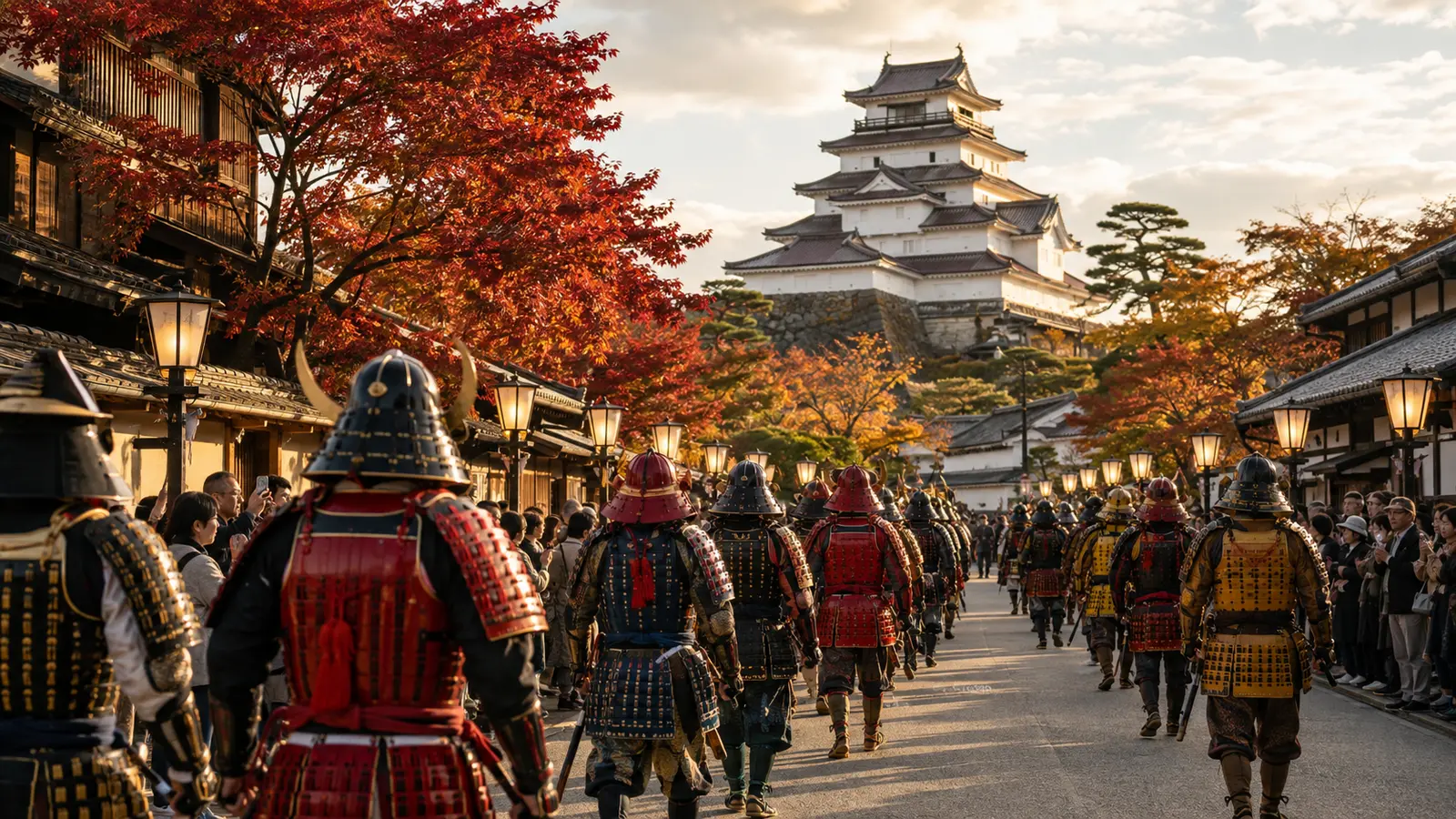
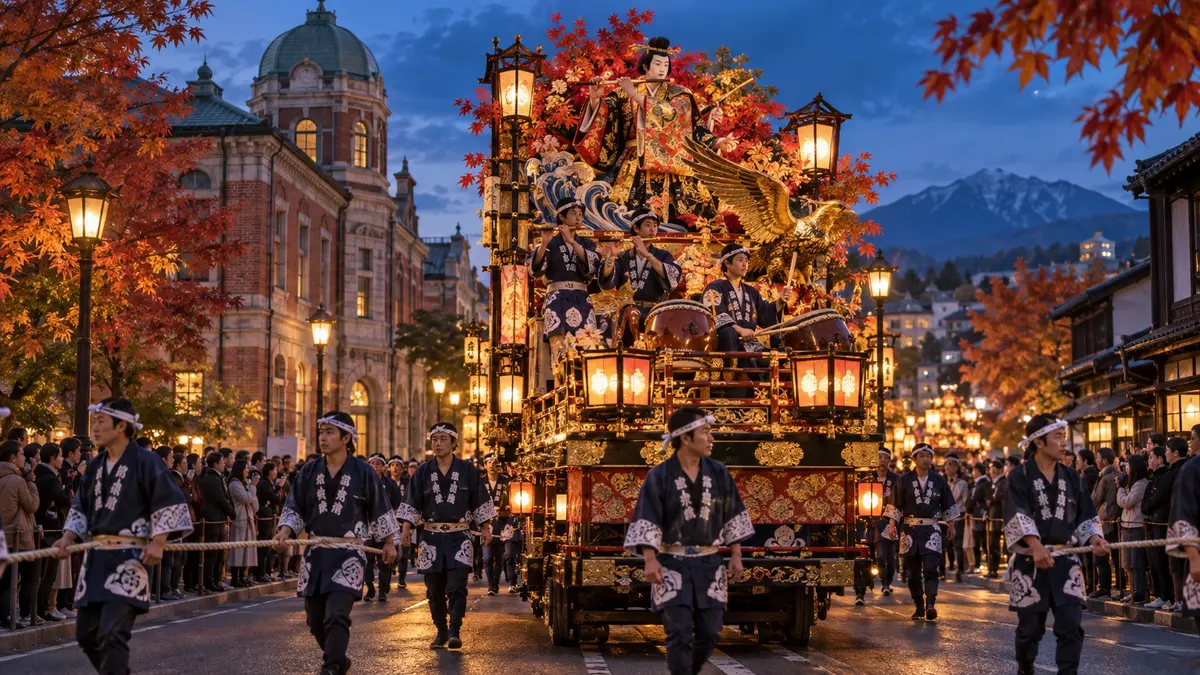
During yabusame, remain behind every barrier, silence sudden sounds and never use flash toward a horse or rider. For street photographs, do not block a pull team, kneel in the road or make close portraits without permission. The article thumbnail is a generated editorial image representing the festival theme; it is not documentary photography of the 2026 event.
If that does not work
Use the fallback.
- A parade route becomes full: move to a staff-approved later section or choose another day's event instead of standing in a crossing or float turning area.
- Rain or wind changes the program: follow the newest organizer and shrine notice; no blanket 2026 weather rule or substitute date is published.
- A normal bus stop is diverted: use the operator's live information and walk from a confirmed open stop rather than waiting on a closed road.
- Yabusame viewing space is unavailable: remain outside the horse lane and use another shrine or float program; do not cross a barrier for a sightline.
- Rail disruption threatens the return: shorten the visit and protect the confirmed train rather than relying on a tight connection through an affected line.
Before you need it
Save this offline.
- Official 2026 16-page festival leaflet and chosen parade map
- September 15 at 18:00 or September 16 at 13:00 plan
- Morioka Bus Center, Kencho-Shiyakusho-mae and hotel route
- Event-day Iwate Kotsu and JR East status
- Morioka City parking closure and road-control hours
- Organizer update, JMA warnings and a companion meeting point
- Compact rainwear, water, portable battery and transit cash
Frequently asked questions
Morioka Autumn Festival 2026: Float Parades, Yabusame and Access FAQ
When is Morioka Autumn Festival in 2026?
The festival-eve shrine program is on September 13. The main float operation runs September 14–16, generally between about 09:00 and 20:00.
When are all eight floats together?
All eight appear in Hachiman-kudari from Morioka Hachimangu at 13:00 on September 14 and in the Grand Float Parade from the museum area at 18:00 on September 15.
When is yabusame?
Horseback archery is scheduled for 13:00 on Wednesday, September 16 at Morioka Hachimangu.
Do I need a ticket or reservation?
No general spectator fee, reservation, deadline or paid viewing allocation is published for the parades or yabusame. Space is not guaranteed and safety controls apply.
How do I get there from Morioka Station?
Use the Dendenmushi loop bus toward Morioka Bus Center for the shrine district or Kencho-Shiyakusho-mae for the museum area, then walk. Confirm event-day diversions and the current fare.
Are roads closed?
Yes. The shrine district is restricted September 14, and the central Grand Float Parade route is closed 18:00–20:00 September 15. The castle-park underground car park also closes 16:00–19:30 on September 15.
What happens if it rains?
A unified 2026 rain, severe-weather or postponement rule was not published in the reviewed official pages. Check the organizer, shrine and JMA immediately before travel.
Primary evidence
Official sources used
Open these pages again before travel. External links lead to the responsible Japanese authority or transport organization.