Do this now
Follow these steps in order.
- 01
Choose November 2 for the lantern-lit night procession, November 3 for the Nishinohama sand-ground climax, or November 4 for the final town circuit and float return.
- 02
Use JR Karatsu Station and walk into the festival area; do not build the day around a car park or shuttle until the 2026 traffic notice is published.
- 03
Stay outside the roadway, float ropes and turning space, especially at corners; selfie sticks and drones are prohibited by the official visitor guidance.
- 04
Recheck the dated 2026 route, weather decision, transport status and final operating times immediately before travel.
What to know
Why Karatsu Kunchi is worth a Kyushu detour
Karatsu Kunchi is the autumn grand festival of Karatsu Shrine. Fourteen individually shaped hikiyama—lions, helmets, a sea bream, a dragon and other enormous forms—are built from layers of paper and fabric finished with lacquer and metal leaf. Karatsu City identifies the float procession as an Important Intangible Folk Cultural Property and part of the UNESCO-listed Yama, Hoko, Yatai float-festival tradition.
This is not one repeated parade. The first night is a lantern-lit assembly, the second day accompanies the shrine mikoshi to the Otabisho at Nishinohama, and the third makes a final old-town circuit before the floats return to the exhibition hall. Travelers should choose by experience and crowd tolerance rather than assuming any one-hour visit covers the festival.
What to know
Confirmed 2026 dates and the published three-day schedule
The Saga Prefecture Tourism Federation confirms Monday, November 2 through Wednesday, November 4, 2026. Karatsu City's standing festival page lists Yoiyama on November 2 from 19:30 to 22:10: six floats begin around Oteguchi, the others join from their neighborhoods, and all fourteen proceed toward the float exhibition area beside Karatsu Shrine.
On Tuesday, November 3—Japan's Culture Day public holiday—Otabisho Shinko is listed from 09:30 to 16:15. A lion dance is offered at Karatsu Shrine around 05:00, the floats and mikoshi depart after 09:30, the Nishinohama sand-ground pull-in begins at noon and the pull-out at 15:00. The sand section is the signature spectacle and the most compressed viewing decision.
On Wednesday, November 4, Yokujitsusai is listed from 10:00 to 16:40. The floats pause together on Komeyamachi Street around noon, depart again around 14:30 and return to the exhibition hall after the final circuit. The city notes that published points refer to the lead Red Lion float and that all fourteen can take about 50 minutes to pass, so a single clock time is not a promise for every float.
What to know
Venue, nearest station and access from Fukuoka
The operating area includes Karatsu Shrine, Nishinohama, Oteguchi, Komeyamachi Street and roads across the former castle town. The prefectural event listing gives 3-13 Minamijonai, Karatsu, and places the shrine about ten minutes on foot from JR Karatsu Station; the tourism association's shrine page uses an approximately 15-minute normal walk. Expect festival controls to lengthen either estimate.
From Fukuoka, the usual rail approach is the through Fukuoka City Subway/JR Chikuhi Line to Karatsu. Official tourism material gives roughly 70 minutes from Hakata or central Fukuoka as planning context, but direct patterns and transfers vary by departure. Confirm the current timetable and whether the train terminates before Karatsu; do not assume every subway train continues onto the JR section.
Save at least two return options and your accommodation address. November 2 ends late, November 3 is a national holiday, and platforms and trains can be much busier than on an ordinary timetable day. The station tourist information desk is the appropriate place to ask for the current route map when open.
What to know
Admission, tickets, reservations and sellout conditions
The reviewed city, prefectural and tourism-association pages describe viewing along the public procession route and do not announce a festival-wide admission gate, general spectator ticket or mandatory reservation. They also do not publish a 2026 official reserved-seat sale, price, application deadline, capacity, same-day allocation or public sellout condition as of September 7.
Do not interpret the absence of a gate as a guaranteed viewing position. Police and float staff can close a road edge, clear a corner or redirect spectators when space becomes unsafe. A hotel plan, private tour or hospitality invitation is separate from public festival access and has its own price, inventory and cancellation terms.
Karatsu households traditionally host relatives and invited acquaintances for festival meals, but this is not an open restaurant system. Do not enter a home, photograph a private meal or expect an invitation because you are attending the festival. Use operating restaurants or the station-area market and confirm opening hours because the official English guide warns that many businesses close during Kunchi.
What to know
Rain, wind and what remains unannounced for 2026
The official sources reviewed September 7 do not publish a final 2026 rule for rain, strong wind, lightning, postponement, cancellation, decision time or schedule recovery. They also do not promise that a change to one procession automatically changes the other days. Wait for a dated Karatsu City, shrine or tourism-association notice rather than applying an older year's decision.
Use compact rainwear instead of an umbrella beside ropes, moving floats or a dense curb. A festival change does not automatically refund rail, hotel or commercial-tour costs, so check each booking separately. JMA warnings and current rail status should decide whether the journey remains safe even when the organizer has not yet changed the program.
What to know
Crowds, road controls, parking and the dangerous corners
The prefectural page warns that roads and parking become extremely crowded and recommends public transport. It confirms that temporary and paid parking normally exists, but the final 2026 sites, dates, hours, fees, shuttle arrangements, accessible spaces and traffic-control map were not published in the reviewed sources. A 2025 parking list is historical reference only and must not be reused as a current plan.
Large floats can weigh two to three tonnes and need space to turn. The tourism association tells visitors to stay away from floats and ropes, remain out of the roadway, never cross the ropes and treat corners as especially dangerous. Do not walk immediately behind a float, lean into its path for a photo or put a child at the route edge.
Arrive before the procession reaches your chosen section, identify a wider exit and follow staff even if that costs the preferred shot. November 3 around Nishinohama is the highest-pressure viewing period; travelers who need lower crowd density should consider a broader part of the November 4 route rather than forcing a position at the sand-ground entrance.
What to know
Photography, drones, accessibility and luggage
The official English guide prohibits selfie sticks and drone flights, and the tourism association separately warns about collisions caused by spectators leaning toward the route while filming. Keep a handheld camera inside your body line, turn off flash if staff request it and never step under a rope or backward into the road while watching a screen.
No final 2026 accessible viewing platform, wheelchair route, temporary toilet plan, stroller policy or mobility assistance procedure was published in the reviewed event sources. Contact the Karatsu Station Tourist Information Center before travel if step-free access or a controlled viewing position is essential, and choose a wide station-side area over the narrowest old-town corners.
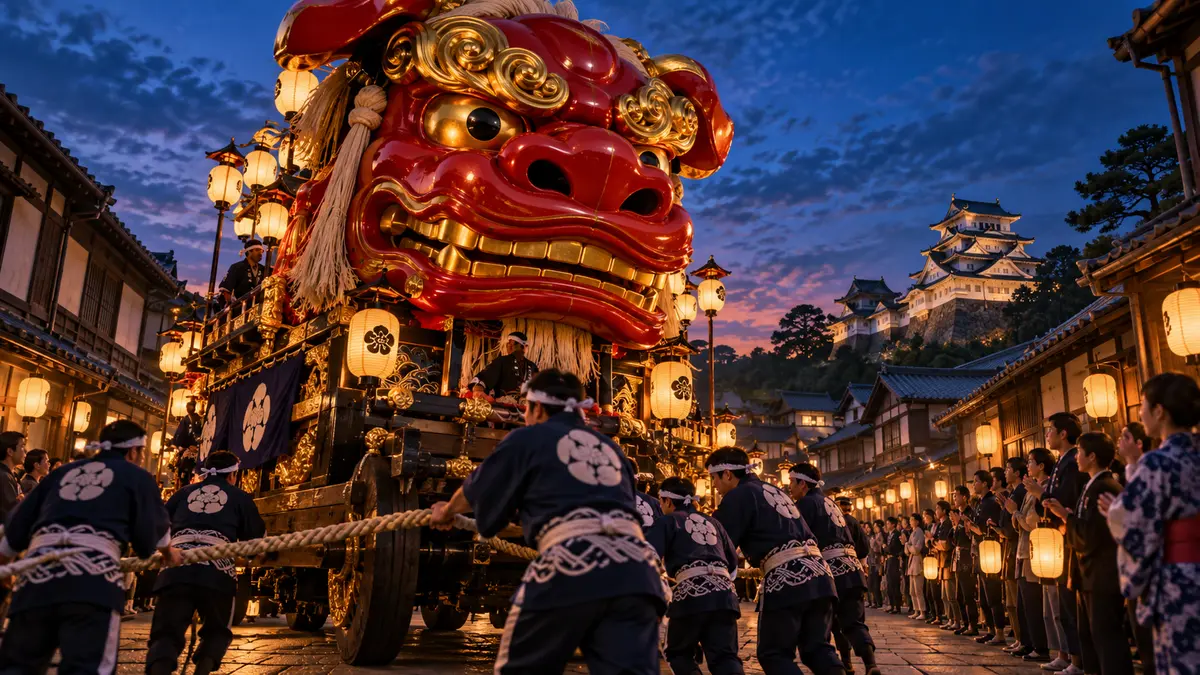
Large suitcases do not belong beside the route. Store luggage at confirmed accommodation or a verified station-area facility before entering the crowd; do not assume lockers will remain available on a national holiday. The article thumbnail is an editorial image created to evoke the night procession and is not documentary photography of the 2026 festival or evidence of exact floats, architecture, weather, lighting or crowd levels.
What to know
What to confirm before leaving your accommodation
Within 48 hours, check the official 2026 route map, any revised times, weather decision, road and pedestrian controls, JR service and the final return train. On November 3, also confirm how spectators may approach and leave Nishinohama; ordinary navigation can point through a street that has become part of the procession.
Save the Japanese names 唐津くんち, 宵曳山, 御旅所神幸 and 翌日祭 with the official pages offline. Bring water, a charged phone, compact rainwear and only a small bag. If a newly dated official or on-site instruction conflicts with this guide, follow the newer instruction.
If that does not work
Use the fallback.
- Nishinohama is full or access is controlled: use a wider lawful part of the route or choose another day instead of pressing toward the sand ground.
- The 2026 traffic map or parking plan is still unavailable: travel by rail and collect current information at Karatsu Station; do not copy the 2025 parking list.
- Rain, wind or lightning changes a procession: wait for a dated organizer decision and use an indoor Karatsu plan rather than assuming a delayed restart.
- The last practical return train is crowded: follow station staff and use a confirmed later departure or licensed transport plan; do not enter the track area or force a full train.
- A camera position becomes unsafe: stop recording and move behind the staff line; no image is worth crossing a rope or standing at a float's corner.
Before you need it
Save this offline.
- November 2, 3 or 4 plan and the final 2026 timetable
- JR route to Karatsu Station plus two return departures
- Current procession, traffic-control and Nishinohama access maps
- Organizer weather notice and JMA warnings
- Accommodation address or licensed late-return option
- Water, compact rainwear, portable battery and a small bag
Frequently asked questions
Karatsu Kunchi 2026: Floats, Schedule and Access FAQ
When is Karatsu Kunchi in 2026?
It is confirmed for Monday, November 2 through Wednesday, November 4, 2026.
What time does Karatsu Kunchi start?
The standing city schedule lists November 2 at 19:30–22:10, November 3 at 09:30–16:15 and November 4 at 10:00–16:40. Recheck the dated 2026 route notice before travel.
Which day is best?
Choose November 2 for lantern-lit floats, November 3 for the mikoshi and Nishinohama sand-ground climax, or November 4 for the final old-town circuit and float return.
What is the nearest station?
JR Karatsu Station. The prefectural listing gives about a ten-minute normal walk to Karatsu Shrine, but festival controls can lengthen the approach.
Do I need a ticket or reservation?
No festival-wide admission ticket or mandatory public-viewing reservation is announced in the reviewed official sources. No public 2026 reserved-seat sale or booking deadline was published as of September 7.
Can official seats sell out?
No public official 2026 seat inventory or sellout condition was announced. Commercial tours and accommodation packages have separate capacity and terms.
What happens if it rains?
The final 2026 rain, wind, postponement and decision rules were unannounced as of September 7. Check Karatsu City, the shrine or tourism association immediately before travel.
Can I drive to Karatsu Kunchi?
The prefectural listing recommends public transport because roads and parking become very crowded. Final 2026 temporary parking, fees, road controls and shuttle details were not yet published.
Can I use a selfie stick or drone?
No. The official English visitor guidance prohibits selfie sticks and drone flights and tells spectators to remain outside the roadway and float ropes.
Primary evidence
Official sources used
Open these pages again before travel. External links lead to the responsible Japanese authority or transport organization.