Do this now
Follow these steps in order.
- 01
Choose the November 2 night program or one of the four November 3 program blocks, then save the exact avenue section you want rather than treating Tenmonkan as a single viewing point.
- 02
Use a Kagoshima City tram from Kagoshima-Chuo Station toward Takamibaba, Tenmonkan-dori or Izuro-dori, depending on your planned position, and recheck diversions before boarding.
- 03
Prepare ¥200 adult tram fare in cash, Rapica or another locally accepted method. The city operator says nationwide interoperable IC cards such as Suica and SUGOCA are not accepted on its trams.
- 04
View from the managed spectator edge. The August 31 application deadline for organized dancers has passed, and the English promotional phrase that anyone can join is not a promise of same-day participation.
- 05
Recheck Kagoshima City, the tourism page, the transport operator and JMA before departure because the final traffic plan and unified weather decision remain unannounced.
What to know
Formal name, dates and the two-day format
The formal event is the 75th Ohara Festival, or 第75回おはら祭. Kagoshima City and its official tourism organization confirm Monday, November 2 and Tuesday, November 3, 2026 in the Tenmonkan district of central Kagoshima.
November 2 is the night festival, built around mass dancing and Ogojo taiko. November 3 is the main festival, with four published blocks combining mass dance, taiko, marching, the Shibuya–Kagoshima Ohara PR segment and the more contemporary Ohara 21 dance.
Traditional performing arts are also scheduled at CenTerrace Square on both days, with public-relations booths on November 3. Those side programs are useful if the avenue edge is crowded, but their capacity and exact performance-by-performance timetable are not published on the reviewed overview page.
What to know
Official 2026 hours — including a ten-minute conflict
The official Kagoshima tourism page lists the November 2 night festival as 18:50–20:20. Kagoshima City's municipal event page lists the same 18:50 start but a 20:30 finish. Because both are current official sources, this guide does not silently choose one as correct; plan to remain flexible until at least 20:30 and recheck the final poster or city notice.
Both official sources list the November 3 main festival as 10:20–15:25. The published program has four parts rather than one continuous identical dance, so a visitor who arrives only near the end should not expect to see every group or every dance style.
Times are scheduled operating windows, not a guarantee that every group reaches every viewing point at the same minute. Allow space for crowd control, pauses and movement between blocks, and avoid booking a tight airport, ferry or Shinkansen connection immediately after the nominal finish.
What to know
Route, viewing and the difference between watching and dancing
The official tourism page describes an approximately 1,480-metre festival zone along the tram road from Takamibaba through Izuro to Sakurajima-sanbashi-dori. This is a long urban route, so choose one or two adjoining blocks and let the procession come to you rather than pushing through the crowd for every segment.
The reviewed pages publish no spectator ticket, timed-entry reservation, paid grandstand or general street-viewing sellout system. Ordinary viewing is therefore treated as open street spectating, but police and staff can restrict a section when it reaches a safe operating level, and no particular curb position or sightline is guaranteed.
Participation is a different decision. The 2026 recruitment page accepted organized dance applications through August 31 and targeted up to 8,000 dancers in each session. That deadline has passed. The official English overview's welcoming description should not be read as permission to enter a registered formation on the day; follow staff and remain in the spectator area unless an authorized same-day activity is explicitly announced.
What to know
Tram access from Kagoshima-Chuo Station and payment
Kagoshima City trams provide the simplest approach from Kagoshima-Chuo Station to the festival corridor. Takamibaba, Tenmonkan-dori, Izuro-dori and the eastern waterfront side each serve different parts of the 1.48-kilometre zone, so select the stop after choosing where you plan to watch.
The city operator lists a flat adult tram fare of ¥200 and child fare of ¥100. Board through the middle door, take a numbered ticket when required and pay as you leave through the front. Keep small yen ready if you do not use a locally accepted card or pass.
The operator states that nationwide interoperable transport IC cards such as Suica and SUGOCA are not accepted on Kagoshima City trams. Rapica and the operator's published local passes are separate products. Do not assume a Tokyo or Osaka IC card will work simply because the vehicle resembles another city's tram.
What to know
Traffic controls, parking and the return plan
The dancing takes place on a major tram avenue, so traffic and surface transport must be controlled. However, the reviewed official festival pages do not yet publish a final 2026 road-closure map, tram-diversion plan, bus-stop change list or reopening time. Do not reuse a previous year's closure map.
No dedicated 2026 visitor-parking plan, reservation system or guaranteed festival lot is published. Public transport is the safer default. If driving is unavoidable, wait for a dated municipal notice and never navigate into the dance zone or use a private business, hotel or resident space without permission.
After the night festival and final November 3 block, expect pressure on nearby tram stops. Walk only along an open official route, follow platform staff and keep a second workable return connection. Store large luggage at accommodation or a confirmed facility before entering the crowd.
What to know
Rain, severe weather and what remains unannounced
The reviewed official pages do not publish one 2026 rule for ordinary rain, heavy rain, strong wind, cancellation, postponement or the time of a final weather decision. There is also no general spectator ticket to refund, while any independently purchased tour or service follows its own terms.
Check Kagoshima City, the official tourism page and JMA warnings on November 2 and again on November 3. Bring compact rainwear rather than opening a large umbrella in a dense dance-viewing line, and follow staff immediately if the tram road or CenTerrace program changes.
A weather delay does not authorize entry into the dance lane or a closed tram track. If a program is suspended, move to a confirmed indoor alternative and wait for a dated official update rather than following an unverified crowd or social post.
What to know
Crowds, photography and final checks
Keep intersections, tram tracks, shop entrances, tactile paving and emergency lanes clear. Use compact camera equipment, do not step backward into a moving formation and ask before making a close portrait of a dancer or child. No festival-wide personal-drone permission is published; do not fly over the crowd or city center.
Before leaving, confirm the final hours, your chosen viewing block, tram operation, last two workable returns, traffic controls, weather notice and any accessibility need. The official page does not describe one festival-wide luggage store, accessible viewing allocation or English interpretation service, so arrange essential support in advance.
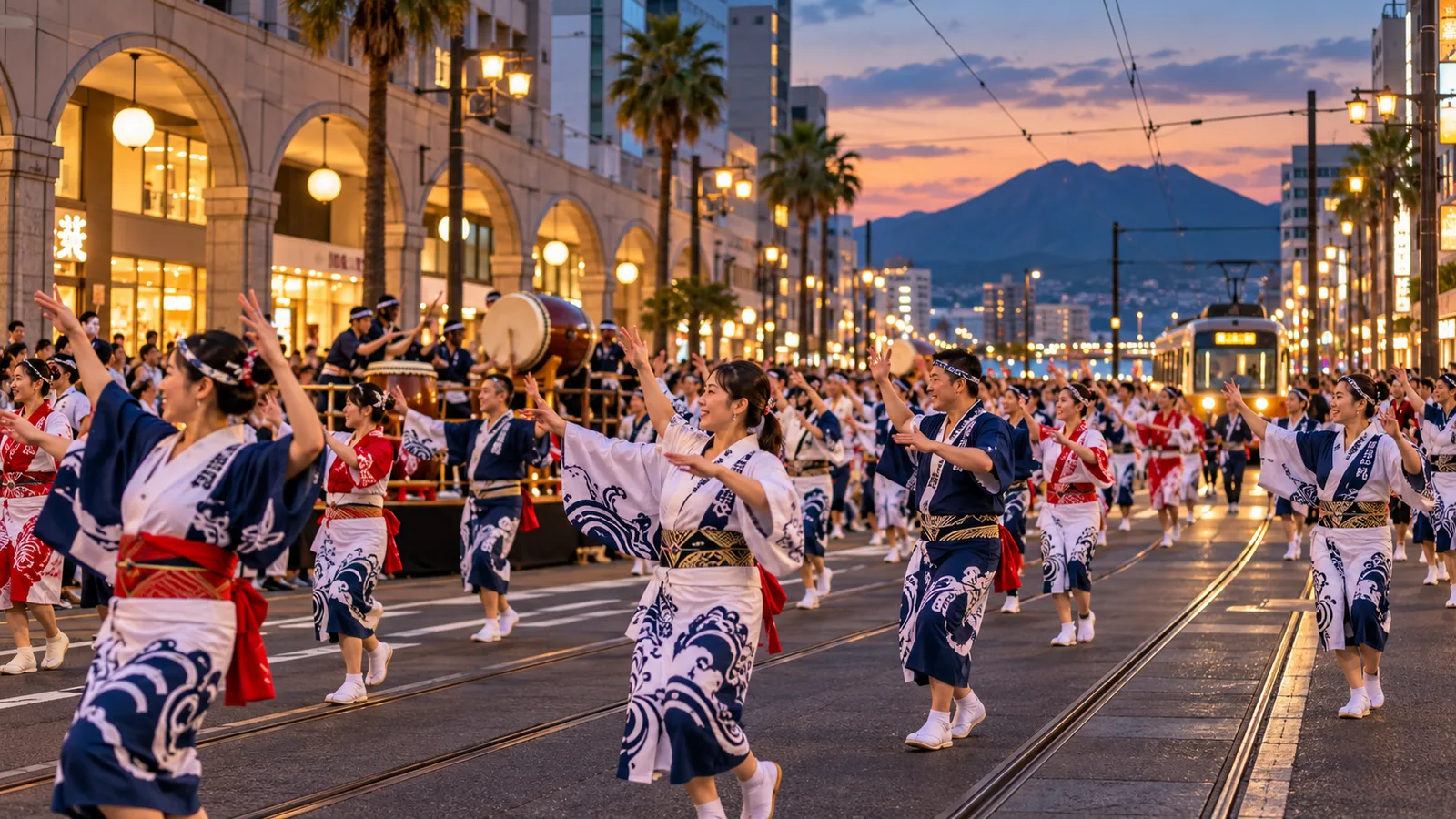
The thumbnail on this page is a generated editorial image inspired by Ohara-style group dancing on a tram-lined Kagoshima avenue. It is not documentary photography of the 2026 festival and must not be used as evidence of the actual costumes, performers, tram, streetscape, crowd, weather or view of Sakurajima.
If that does not work
Use the fallback.
- A preferred avenue section is full: follow staff to another open block or CenTerrace Square; do not force through a controlled edge.
- Trams are diverted or a stop is closed: use the operator's dated notice and staff instructions, then walk only on an open pedestrian route.
- You missed the dancer-registration deadline: remain a spectator and do not enter a registered formation unless the organizer explicitly opens a same-day activity.
- Rain changes the program: use the dated city or tourism notice and a saved indoor Kagoshima alternative rather than assuming a delayed start.
- A nationwide IC card is rejected: pay the published ¥200 adult tram fare with an accepted local method or cash and keep enough yen for the return.
Before you need it
Save this offline.
- November 2 night festival from 18:50, with official pages differing between 20:20 and 20:30
- November 3 main festival 10:20–15:25
- Chosen point on the Takamibaba–Izuro–Sakurajima-sanbashi-dori zone
- Kagoshima City tram route, ¥200 adult fare and two return options
- Current traffic, tram and weather notices
- Cash or locally accepted payment, rainwear and portable battery
- Japanese event name: 第75回おはら祭
Frequently asked questions
Kagoshima Ohara Festival 2026: Dance, Trams and Access FAQ
When is the Kagoshima Ohara Festival in 2026?
Monday, November 2 and Tuesday, November 3. The night festival starts at 18:50; official city pages disagree between 20:20 and 20:30 for its finish. The main festival runs 10:20–15:25 on November 3.
Where is the festival held?
Along about 1,480 metres of the Tenmonkan tram avenue from Takamibaba through Izuro to Sakurajima-sanbashi-dori, with related programs at CenTerrace Square.
Do spectators need a ticket?
No spectator ticket or advance-booking system is published for ordinary street viewing. Staff can still restrict a crowded section, and no sightline is guaranteed.
Can visitors join the dancing?
Do not assume walk-in participation. The 2026 application for organized dancers closed August 31; remain in spectator areas unless the organizer explicitly announces an authorized same-day activity.
How much is the tram from Kagoshima-Chuo?
Kagoshima City Transportation Bureau lists a flat ¥200 adult and ¥100 child tram fare. Pay when exiting through the front.
Can I use Suica or SUGOCA on Kagoshima City trams?
No. The operator states that nationwide interoperable IC cards are not accepted. Use cash, Rapica or another method the operator currently lists.
What happens if it rains?
A unified 2026 rain, severe-weather, postponement and decision-time policy is not yet published. Check Kagoshima City, official tourism and JMA on the day.
Will roads and trams be restricted?
Traffic control is expected on the tram avenue, but the final 2026 road-closure, tram-diversion, bus-stop and parking plans are not yet published on the reviewed festival pages.
Primary evidence
Official sources used
Open these pages again before travel. External links lead to the responsible Japanese authority or transport organization.