Do this now
Follow these steps in order.
- 01
Choose a viewing area before buying: Kyoto Gyoen shows the parade near departure, Oike-dori is central, and Jingu-michi catches the final approach to Heian Jingu.
- 02
If you want a chair and fixed sightline, open the official Ticket Pia route before 10:00 JST on September 8; every paid seat is reserved and finite.
- 03
Save the correct station for your chosen point instead of navigating only to Heian Jingu: Marutamachi or Imadegawa for Kyoto Gyoen, central subway access for Oike-dori, and Higashiyama for the shrine end.
- 04
Keep October 23 flexible and check Heian Jingu's official website around 07:00 on October 22 if weather is uncertain.
What to know
Why the Festival of the Ages is worth a Kyoto day
Jidai Matsuri is one of Kyoto's three major festivals. Its roughly two-kilometer procession moves backward through eight historical periods, from the Meiji Restoration to the Enryaku era, using carefully researched costumes, equipment and ceremonial objects rather than generic festival dress.
The organizer describes about 2,000 participants; Kyoto's official English guide adds around 20 groups and about 70 horses and oxen. The sacred carriages of Emperors Kanmu and Komei are part of a living shrine ritual, so the event is more than a costume parade.
For a traveler, the main decision is where to watch. The front of the procession covers the route in about two and a half hours, but the whole column takes approximately two hours to pass one location. Choose one section and stay there rather than trying to chase the head of the parade across central Kyoto.
What to know
Confirmed 2026 date, procession route and timing
The 2026 procession is scheduled for Thursday, October 22. The official sequence begins with a 07:00 rite at Heian Jingu, the sacred carriages leave for Kyoto Gyoen at 09:00, and a ceremony is held in front of the Imperial Palace's Kenreimon Gate at 10:30 before the historical procession departs at noon.
The front is expected at Kenreimon 12:00, Sakaimachi Gate 12:15, Karasuma-Marutamachi 12:30, Karasuma-Oike 12:50, Kawaramachi-Oike 13:20, Kawaramachi-Sanjo 13:30, Sanjo Bridge 13:40, Sanjo-Jingu-michi 14:10 and Heian Jingu 14:30. These are passage estimates, not a guarantee that every group reaches each point at that minute.
Paid-seat planning times are approximately 12:00 at Kyoto Gyoen, 13:20 on Oike-dori and 14:20 on Jingu-michi. Arrive well before the listed time for ticket checks, toilets and crowd controls. Heian Jingu's paid Shin-en garden accepts visitors only from 09:30 to 11:30 on October 22 and closes at noon for the festival.
What to know
Paid seats, prices and the September 8 sale
Individual reserved-seat sales begin at 10:00 JST on Tuesday, September 8, 2026. The official page links to Ticket Pia, where account registration is required, and also lists Seven-Eleven counter sales under P-code 661-579. Payment or ticketing fees can be added, and one transaction is limited to nine seats.
At Kyoto Gyoen, standard seats cost ¥7,500 in the front row or ¥5,000 from the second row; Japanese-learning commentary seats cost ¥10,500 in the front row or ¥8,500 behind it. Oike-dori standard seats are ¥7,500 front row or ¥5,000 behind. Jingu-michi standard seats use the same prices, while Otenmon Gate special seats cost ¥15,500 front row or ¥13,500 behind and include commentary in Japanese and English.
Every individual seat includes the official guidebook, browser-based audio guide, commemorative token and tote bag. The learning seats require your own internet-capable phone or tablet, earphones and preferably a battery; the Otenmon special area supplies an earphone receiver. The official page does not publish a final individual-purchase deadline or live inventory threshold. Treat the roughly 7,500 seats as capacity-limited and buy through the official channel only if a fixed seat matters.
What to know
Free viewing and what a paid ticket changes
The official 2026 materials do not publish a general admission ticket for watching from ordinary public parts of the route. A paid ticket buys a numbered chair, designated viewing area and included materials; it is not required to enter Kyoto or to see any part of the procession from an open public section.
Free viewing has trade-offs: sightlines are uncertain, popular corners can fill early, and police or staff may keep crossings and narrow areas clear. Do not stand inside a paid block, on tactile paving, in a doorway, in the road or anywhere staff are trying to preserve movement.
If historical explanation is important, the Otenmon special seat is the only 2026 option explicitly advertising Japanese and English specialist commentary. The learning seats advertise Japanese commentary. Do not assume every audio track or printed guide is available in English unless the ticket description says so.
What to know
Nearest stations and access by viewing area
For the Kyoto Gyoen start area, the National Gardens Association lists a five-minute normal walk from Marutamachi Station to Ainomachi entrance and a five-minute walk from Imadegawa Station to Inui Gate. The actual Kenreimon and paid-seat approach is inside a very large park, so allow substantial additional walking and use the event map rather than treating the gate time as your seat-arrival time.
For Oike-dori, use a central subway station that matches the block printed on your ticket; Karasuma-Oike and Kyoto Shiyakusho-mae provide practical approaches to different parts of the avenue. Road controls and crowds can disrupt surface buses, so the subway is usually the more predictable base plan.
For Heian Jingu and Jingu-michi, the shrine lists Higashiyama Station Exit 1 as a ten-minute normal walk and Sanjo or Jingu-marutamachi stations as about 15 minutes. Heian Jingu has no visitor parking. The shrine recommends public transport or taxis even on ordinary days, and a parade route makes driving still less reliable.
What to know
Rain, postponement and refund rules
If rain or severe weather prevents the October 22 procession, it is postponed to Friday, October 23. The same paid ticket remains valid on the 23rd and is not refunded merely because of that one-day postponement. If both days are unsuitable and the procession is cancelled, ticket refunds are offered, but payment and delivery fees are excluded and the refund must follow the purchase channel's instructions.
Heian Jingu's current 2026 participant notice tells people to check the shrine website and official X account at around 07:00 on October 22 when weather is in doubt. Visitors should use the same dated organizer decision rather than a forecast, hotel rumor or old social post.
Umbrellas and parasols are prohibited in the paid seating because they block views; bring a raincoat and sun hat instead. Heat can persist in Kyoto in October, and official seat rules ask visitors to manage hydration. The final 2026 road-control and city-bus diversion notice was not yet published in the official sources reviewed on September 3.
What to know
Crowds, animals, photography and final checks
The procession includes horses and cattle. Paid-seat rules prohibit flash photography and pets because they can startle the animals; tripods are also prohibited in the seating areas. Photograph or film without blocking nearby spectators, and keep equipment inside your own space.
Expect controlled crossings and long waits on the route. Use toilets before taking a place because the official ticket page warns that facilities are limited. Keep bags compact, do not step into the procession, and obey staff even if a route-control decision temporarily separates you from a companion.
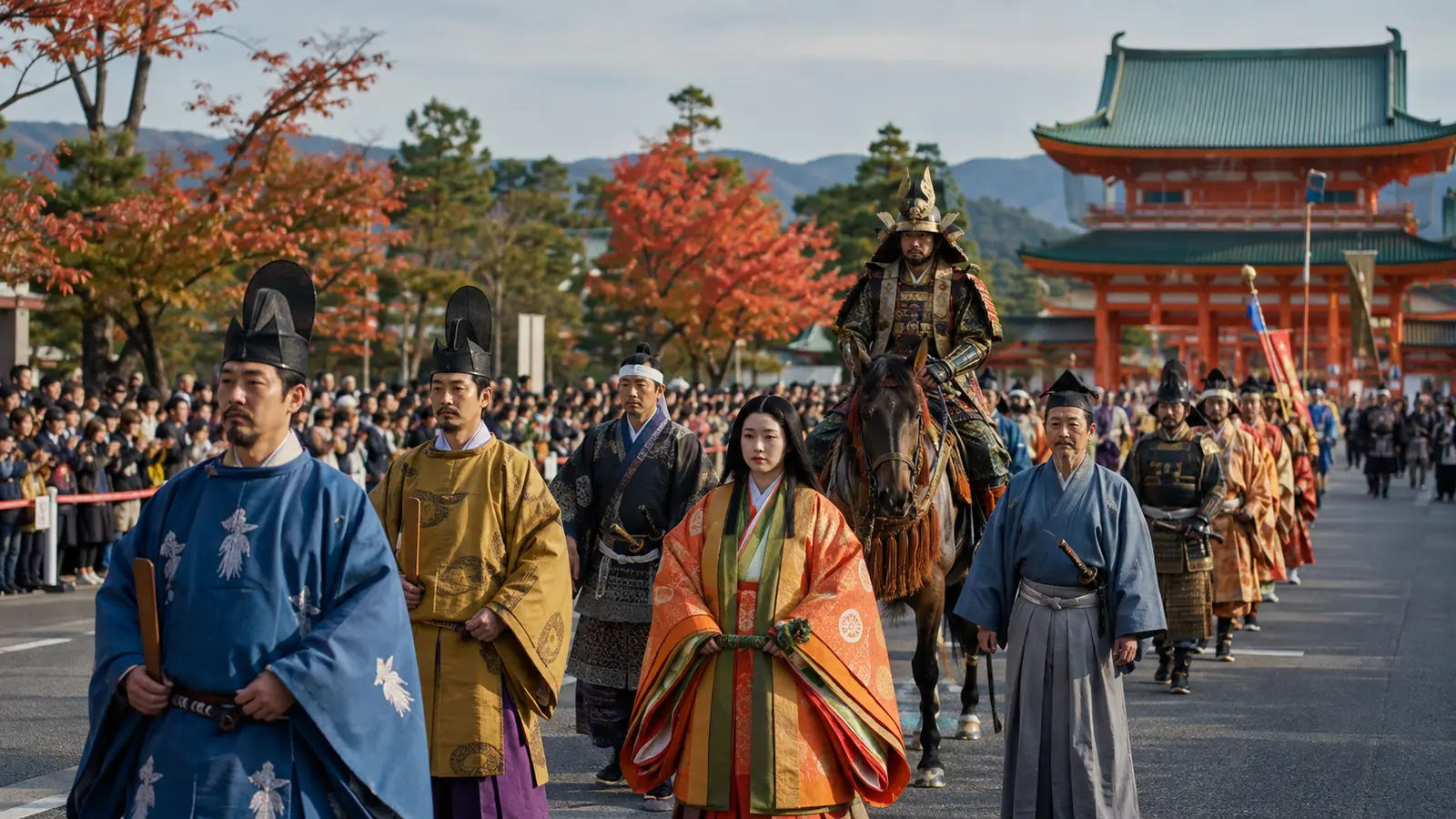
Before departure, recheck paid-seat availability, your exact block and entrance, the October 22 weather decision, the final traffic and bus notices, and return transport. The article thumbnail is an editorial illustration created to evoke Jidai Matsuri and is not documentary photography of the 2026 event or proof of its participants, weather or crowd level.
If that does not work
Use the fallback.
- Reserved seats sell out: select a legal public section of the route, arrive early and accept an obstructed or standing view rather than buying from an unofficial reseller.
- October 22 is postponed: use the same ticket on October 23 and confirm hotel and transport changes separately because the seat is not refunded for a one-day delay.
- Both procession days are cancelled: follow Ticket Pia or the original seller's refund instructions; booking and delivery fees are not refundable.
- Your chosen street is already full: move to a wider section or watch later near the route end; do not push toward a controlled crossing or animal procession.
- A bus is diverted: use the subway or walk from a station outside the closed route, then follow police and operator notices for the last section.
Before you need it
Save this offline.
- Official October 22 route and estimated passage-time map
- Paid-seat confirmation, block, entry instructions and purchase-channel refund terms
- Walking route from the nearest station to the chosen viewing area
- Heian Jingu weather-decision page and official X account
- Final city-bus diversion and road-control notice when released
- Raincoat, hat, water, earphones and portable battery
Frequently asked questions
Jidai Matsuri 2026: Tickets, Route and Access FAQ
When is Jidai Matsuri in 2026?
The procession is scheduled for Thursday, October 22, 2026. If weather prevents it, the official fallback date is Friday, October 23.
What time is the Jidai Matsuri procession?
The front leaves Kyoto Imperial Palace at 12:00 and is expected at Heian Jingu around 14:30. The complete procession takes roughly two hours to pass one point.
When do 2026 paid seats go on sale?
Individual sales begin at 10:00 JST on Tuesday, September 8 through Ticket Pia and participating Seven-Eleven stores using P-code 661-579.
How much are paid seats?
Standard seats are ¥5,000 from the second row or ¥7,500 in the front row. Japanese learning seats cost ¥8,500–¥10,500, and Otenmon special seats with Japanese and English commentary cost ¥13,500–¥15,500.
Do I need a ticket to see Jidai Matsuri?
No general street-viewing admission fee is published. A ticket is needed only for the official reserved viewing areas and their included seating and materials.
Can Jidai Matsuri seats sell out?
The approximately 7,500 reserved seats are finite. The official page does not state a final individual-sale deadline or a specific sellout trigger, so check live official inventory once sales open.
What happens if it rains?
The procession moves from October 22 to October 23 if necessary. The ticket stays valid and is not refunded for that postponement; if both days are cancelled, ticket refunds exclude payment and delivery fees.
What is the best station?
It depends on the viewing point: Marutamachi or Imadegawa for Kyoto Gyoen, central subway access for Oike-dori, and Higashiyama for Heian Jingu and Jingu-michi.
Primary evidence
Official sources used
Open these pages again before travel. External links lead to the responsible Japanese authority or transport organization.