
Do this now
Follow these steps in order.
- 01
Identify the exact municipality or prefecture of every accommodation; a city name in an itinerary is not enough when the property is outside its boundary.
- 02
Open the price breakdown and find the room-only charge, service fee and any mandatory cleaning charge separately from meals, consumption tax and optional extras.
- 03
Divide a per-room charge by the actual number of guests, then apply the local per-person, per-night band to each night.
- 04
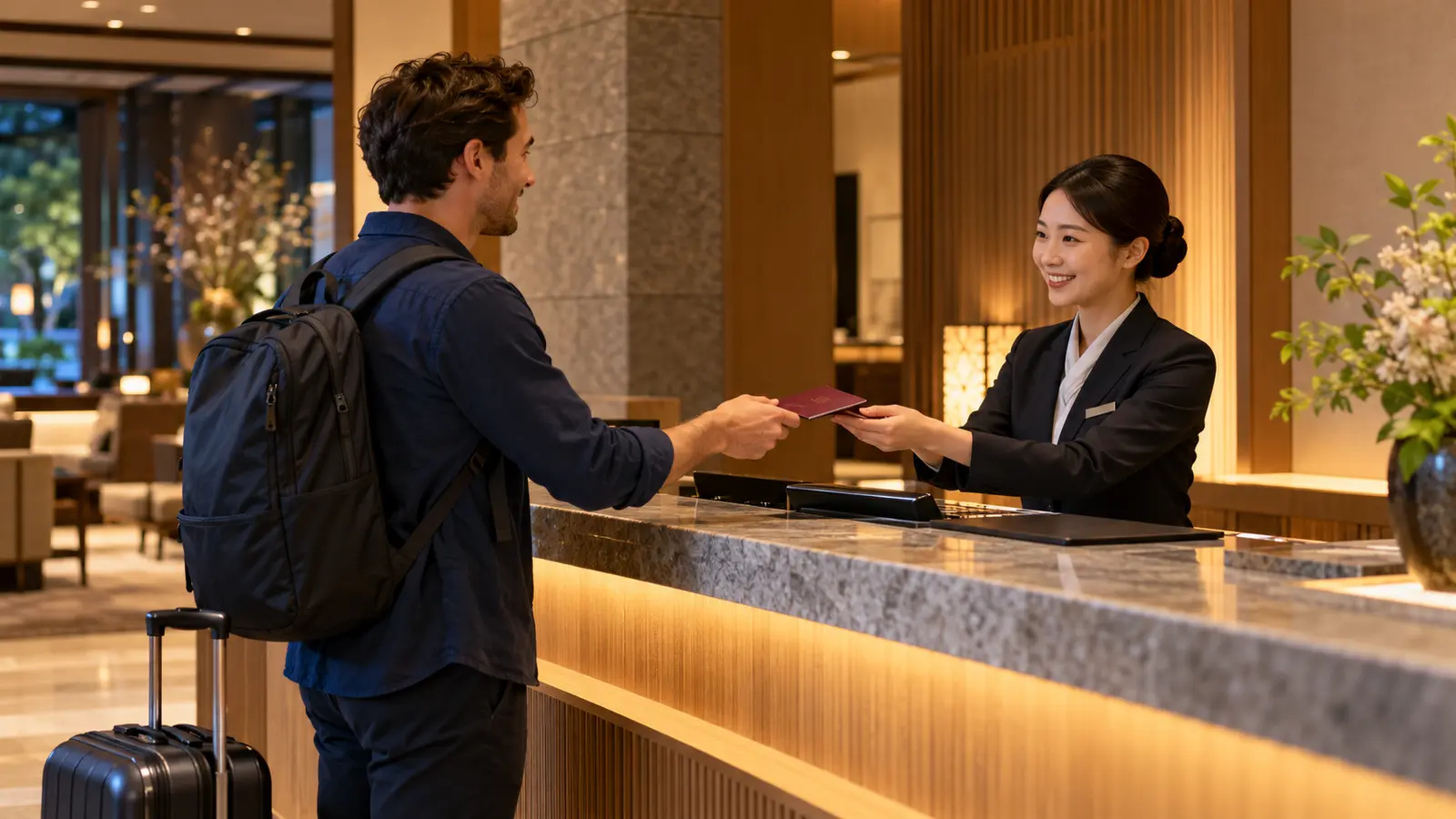
Ask the property in writing whether accommodation tax is already included, prepaid to the booking platform or payable at the property, and which payment methods it accepts.
- 05
Save the booking breakdown and the property's answer; at check-in or checkout, ask for an itemized receipt if the collected amount differs from the confirmation.
What to know
Accommodation tax is local, not one nationwide hotel fee
Japan does not use one nationwide accommodation-tax table. Tokyo, Kyoto City and Osaka Prefecture each publish their own taxable facilities, thresholds and rates, and other destinations can have different systems. Check the authority for the place where the bed is physically located, not the airport used, the day-trip destination or the nearest famous city.
JNTO also notes that accommodation is subject to 10% consumption tax and that properties with hot springs may charge a separate bathing tax. Those are not substitutes for a local accommodation tax. A booking can therefore show a room charge, service charge, consumption tax, accommodation tax and, where applicable, bathing tax as separate lines.
What to know
Tokyo rates on October 21, 2026—and the announced 2027 change
For stays in Tokyo now, the Tokyo Metropolitan Government lists ¥100 per person per night when the qualifying accommodation charge is ¥10,000 to under ¥15,000, and ¥200 when it is ¥15,000 or more. A charge under ¥10,000 is not taxed. The current public summary applies to people staying at hotels or ryokan and warns that the tax may be collected separately from the travel price at the front desk.
Tokyo has already announced a different system from April 1, 2027: a 3% rate for a per-person, per-night accommodation charge of ¥13,000 or more, with hotels, ryokan, simple lodgings and minpaku included. If a trip reaches that date, use the new official page and the property's calculation rather than the 2026 fixed ¥100/¥200 table. Do not assume a reservation made in 2026 preserves the old rate for a 2027 stay.
What to know
Kyoto City rates since March 1, 2026
Kyoto City's current table applies per person per night to paid stays: ¥200 below ¥6,000; ¥400 from ¥6,000 to under ¥20,000; ¥1,000 from ¥20,000 to under ¥50,000; ¥4,000 from ¥50,000 to under ¥100,000; and ¥10,000 at ¥100,000 or more. There is no general low-price zero band for an ordinary paid stay.
The city defines the accommodation charge as the room-only price including service charges, while excluding meals and consumption tax. Guests normally pay the accommodation facility, but Kyoto says the tax may already be included in the amount paid to a booking site or travel business. Confirm which route applies before paying a second time.
Kyoto also states that the stay date controls the rate. Its transition FAQ says a guest whose post-March 1, 2026 stay was prepaid at an older tax amount must pay the difference. That is why a historic booking confirmation can be useful evidence without necessarily being the final tax calculation.
What to know
Osaka Prefecture rates since September 1, 2025
Osaka Prefecture's current table charges nothing below ¥5,000 per person per night, ¥200 from ¥5,000 to under ¥15,000, ¥400 from ¥15,000 to under ¥20,000, and ¥500 at ¥20,000 or more. The prefectural system covers qualifying hotels, ryokan, simple lodgings, special-zone minpaku and registered private-lodging facilities throughout Osaka Prefecture—not only central Osaka City.
Osaka tells guests to pay the accommodation facility together with the lodging charge and warns that a prepaid booking-site total may not include the tax. If an older prepayment used the pre-September 2025 rate, the official guest page says the shortfall must be paid; the property decides the collection method.
For the taxable price base, Osaka includes the room-only charge, related service charges and mandatory cleaning charges. It excludes consumption tax and non-accommodation services such as meals. A compulsory cleaning fee cannot be ignored merely because a platform displays it on a separate line.
What to know
Calculate a room booking per person, per night
The tax bands are not normally applied to the entire multi-night reservation total. First isolate the relevant accommodation charge for each night, then divide a room-based price by the guests using that room. Tokyo's official FAQ says a room occupied by two or more people is converted to a per-person charge; Osaka publishes the same approach in its calculation examples.
For example, if two adults share one ¥24,000 room-only night and no other taxable mandatory charge applies, the starting figure is ¥12,000 per person. Under the rates checked for October 21, 2026, that corresponds to ¥100 each in Tokyo, ¥400 each in Kyoto City and ¥200 each in Osaka Prefecture. This comparison is only an illustration: the property's real breakdown, location, guest count, compulsory fees and exemptions control the result.
A rate that changes between nights should be considered night by night. Do not average an expensive Saturday and a cheaper Sunday into one amount unless the responsible authority or property confirms that method for the actual booking.
What to know
Prepaid does not always mean every local tax is settled
The phrase 'taxes and fees included' can refer to consumption tax and platform charges without proving that a city or prefectural accommodation tax was remitted. Read the line items and the small print for 'pay at property,' 'excluded charges,' 'city tax,' 'accommodation tax' or a Japanese line containing 宿泊税.
Send the property the reservation number, stay dates, guest count and displayed price breakdown. Ask: 'Is the accommodation tax included in this prepaid booking? If not, how much will be collected, when, and can I pay by card?' Keep the response offline. Payment methods are a property decision; this guide does not claim that every hotel accepts cash, cards or a particular wallet for the tax.
If the amount collected differs from the booking estimate, ask for the per-person, per-night taxable room charge and the local rate band. An itemized explanation is more useful than arguing from the grand total, which can contain meals, consumption tax and unrelated services.
What to know
Keep accommodation tax separate from bathing and departure taxes
An onsen property may collect an 入湯税 (bathing tax) under local rules in addition to accommodation tax. JNTO gives about ¥150 per person as a common planning figure but says the amount varies by region. Treat the property's current notice and the responsible municipality as authoritative; do not subtract one tax from the other.
Japan's international tourist tax is also separate. It is a departure tax that is normally included in the international ticket, not a nightly hotel charge. A checkout request labeled accommodation tax should be assessed against the local lodging rules, not the departure-tax amount.
Service charges can affect both the payable total and the tax base. Tokyo and Kyoto include service charges tied to the room in the accommodation charge, and Osaka includes service and mandatory cleaning charges. Optional meals, telephone use or other separate services are treated differently. Use the local authority's definitions and the property's invoice.
What to know
Challenge a possible double charge with documents, not assumptions
If both the booking platform and property appear to have collected the same accommodation tax, do not initiate an immediate card chargeback while the stay is active. Show the confirmation and receipt, identify the exact tax line and ask whether one amount was a platform estimate, a different tax or a payment that was not passed to the property.
Request an itemized receipt and written explanation from the property, then contact the booking platform through its official support channel if the records still conflict. Record the property name, municipality, stay dates, guests, nightly room charge and both tax amounts. If necessary, use the contact details on the relevant Tokyo, Kyoto or Osaka official tax page rather than a third-party forum.
If that does not work
Use the fallback.
- If the booking does not show whether local tax is included, contact the property directly and budget the published local maximum for your rate band until it answers.
- If reception requests an unexpected amount, ask for the per-person, per-night taxable charge, rate band and an itemized receipt before paying or disputing it.
- If the property and booking platform disagree, keep both receipts and contact the platform through its official support channel; avoid paying a second time without documentation when the tax is clearly shown as prepaid.
- If the property cannot explain the local rule, use the official authority page and its listed contact route. Do not rely on an old blog table for a current or future stay.
Before you need it
Save this offline.
- Booking confirmation with nightly room price, guest count and all tax and fee lines
- Written property answer stating whether accommodation tax is included and how any balance is collected
- Current Tokyo, Kyoto City or Osaka Prefecture tax page for the stay date
- A payment backup for check-in or checkout and a copy of the final itemized receipt
Frequently asked questions
Japan Hotel Taxes: Tokyo, Kyoto and Osaka Rates Explained FAQ
Is Japan's accommodation tax included in an online hotel price?
Sometimes, but not always. Kyoto says it may be included in a booking-site or travel-agency payment, while Osaka and Tokyo warn that it may be collected separately. Check the line items and confirm with the property.
Is accommodation tax charged per room or per person?
The Tokyo, Kyoto City and Osaka Prefecture tables covered here are per person per night. A room price is converted to a per-person amount before selecting the rate band.
Do children pay accommodation tax?
Do not assume that age alone creates a general exemption. The ordinary tax calculation follows the relevant accommodation charge, while official exemptions can apply to specified school trips and similar organized educational stays. Ask the property about the exact child rate and exemption documents.
Does an onsen hotel charge both accommodation tax and bathing tax?
It can. Accommodation tax and local bathing tax are separate. Ask the property to identify each line and check the municipality's current bathing-tax rule.
What changes in Tokyo on April 1, 2027?
Tokyo has announced a 3% accommodation tax for a per-person, per-night accommodation charge of ¥13,000 or more, with a wider set of lodging types covered. Recheck the official Tokyo page for a stay on or after that date.
Can I pay the accommodation tax by credit card?
Payment method depends on the property or booking route. Ask before arrival and keep a backup method; the local tax table does not guarantee card acceptance at every lodging.
Primary evidence
Official sources used
Open these pages again before travel. External links lead to the responsible Japanese authority or transport organization.