Do this now
Follow these steps in order.
- 01
Open the exact plan details and find whether it says Data Only or Data, Voice & Text; do not infer call support from the eSIM label.
- 02
If you need ordinary calls or SMS, confirm that the plan includes them and note the assigned number, country code, allowance, validity and outgoing-call conditions.
- 03
When using a data-only travel eSIM, keep the home line active only after checking the home carrier's voice, SMS, voicemail and roaming charges.
- 04
Set the travel eSIM as the mobile-data line and the voice-capable line as the default for calls and SMS; disable automatic data switching when it could create home-line data charges.
- 05
Save 110 for urgent police help, 119 for fire or ambulance and 118 for a maritime emergency. Dial the three digits without an area code from a working voice line in Japan.
- 06
Save the accommodation address in Japanese and the nearest landmark. Emergency operators need the location, what happened, your name and a callback number.
- 07
Locate a public telephone near the hotel, station or airport and save the official public-telephone map before an emergency occurs.
- 08
For a booking that requires a Japanese number or SMS code, use a plan that explicitly provides that function or the provider's official web, hotel-concierge or support alternative; never invent a number.
- 09
Test ordinary calling only with a non-emergency number. Never call 110 or 119 merely to test whether the eSIM works.
What to know
Start with the plan type, not the eSIM label
An eSIM describes how a mobile plan is stored, not which services it includes. Airalo's official help separates Data Only plans from Data, Voice & Text plans and states that a data-only eSIM has no cellular voice service, SMS or phone number. Ubigi likewise describes its travel service as data-only and directs users to internet calling apps or a separate home line for traditional calls and messages.
A phone settings screen can still show a data-only profile among the available call or message lines. Selecting that profile does not create a number or voice service that the provider did not sell. Check the plan details before payment and again in the provider account after installation.
A plan that includes voice and text can have its own number, but do not assume it is Japanese. Record the country code, whether incoming and outgoing service are both included, which destinations are permitted and what happens when the allowance or validity ends.
What to know
Use Dual SIM deliberately when keeping the home number
Apple's Dual SIM guidance supports separate voice and data plans: one line can remain the call and message number while another supplies mobile data. The same practical arrangement exists on compatible Android phones, although menu names and active-line limits vary by model and carrier.
Set the Japan eSIM as the data line and the voice-capable home line as the default call and SMS line. Turning off data roaming for the home line can prevent home-line mobile-data use, but it does not make voice calls, SMS or voicemail free. The home carrier controls those prices and whether Wi-Fi Calling works abroad.
If receiving a bank, airline or hotel verification text is essential, confirm the home carrier's current roaming behavior before flying. Also prepare an authenticator app, recovery code or another official verification method where the service allows one.
What to know
A data-only eSIM is not an emergency voice plan
Japan's urgent numbers are 110 for police, 119 for fire and ambulance, and 118 for the Japan Coast Guard. They are voice emergency routes. Because a data-only eSIM has no cellular voice service, do not treat that plan itself as a way to dial them. A separate active voice line or another calling route is needed.
Internet apps such as WhatsApp, FaceTime, LINE or ordinary VoIP can help with personal contacts when data works. They do not automatically connect to 110 or 119. NTT East warns that some IP-phone services, including many 050 services, cannot reach emergency numbers, so an app call is not a safe substitute unless that exact service expressly documents emergency access in Japan.
A phone or carrier may present its own emergency-call behavior, but support depends on the device, available network and active service. Do not build the safety plan around an unverified emergency screen or a claim that every phone can call without a usable voice subscription.
What to know
Prepare the words and location for 110 or 119
Dial 110 without an area code for an urgent crime, traffic accident or immediate police need. Tokyo Metropolitan Police says an interpreter can assist callers who do not speak Japanese. For a non-urgent police consultation, use the local official route rather than occupying 110.
For 119, first say whether it is a fire or medical emergency, then give the municipality, address or a nearby building or intersection. The Fire and Disaster Management Agency's English ambulance guide says the operator will ask what happened, the patient's condition and age, your name and a callback number. A high-priority ambulance can be dispatched before every question is complete.
Keep the hotel name, Japanese address, floor or room, station exit and a map pin offline. Location is more useful than a long explanation of the phone problem. Do not call an emergency number to test service.
What to know
Use a public telephone when the mobile call will not connect
The Fire and Disaster Management Agency says that when 119 is difficult to reach because of a communications or voice-call problem, use a public telephone, ask a nearby person or shop to call, or go directly to a fire station. Apply the same principle of seeking immediate nearby help when any urgent mobile call cannot be completed.
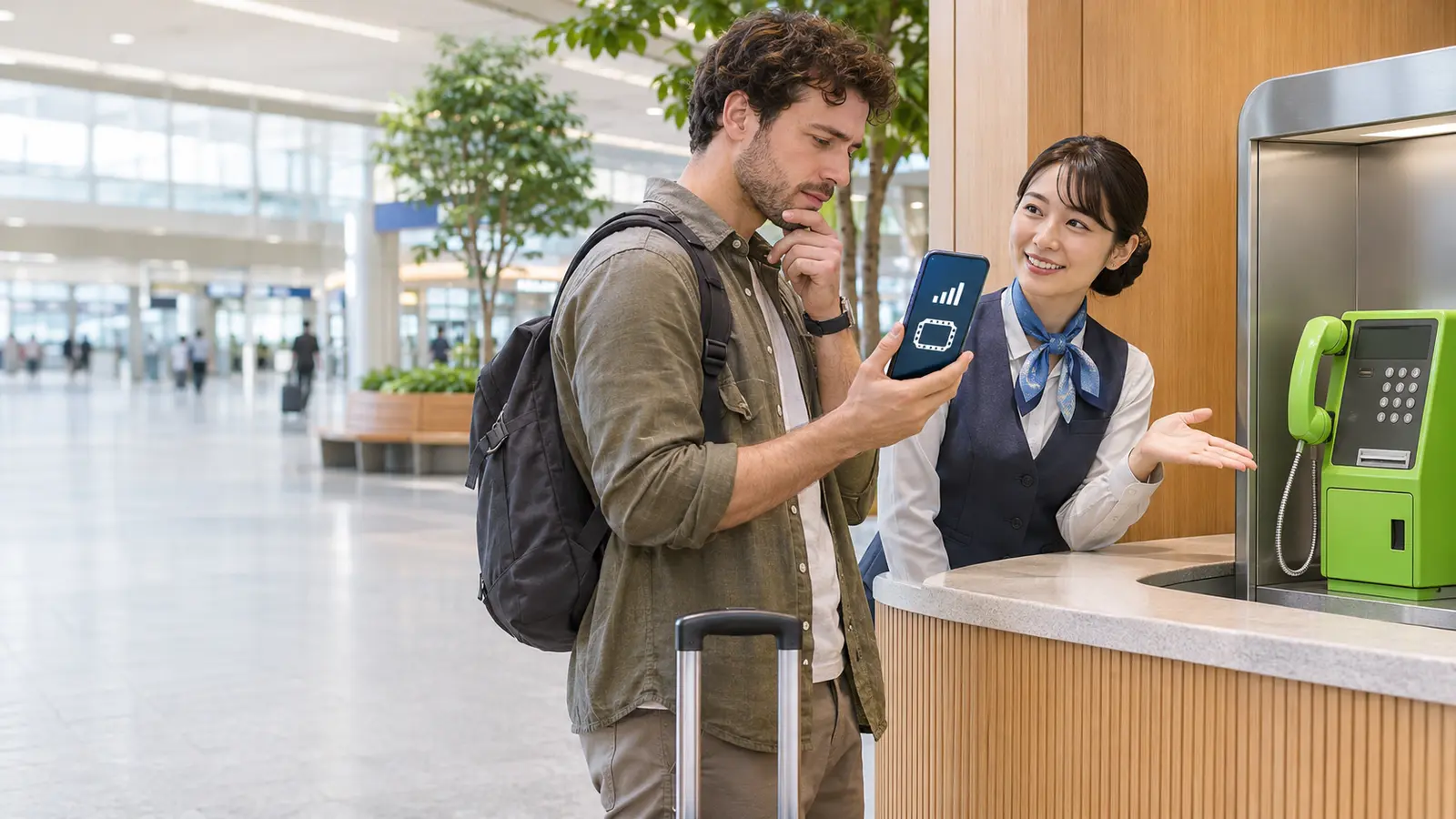
NTT East states that public telephones can call 110, 118 and 119 without coins or a telephone card. On a phone with a red emergency button, lift the receiver, press the button and dial the number. Without that button, lift the receiver and dial the three digits directly.
Save the official NTT East or NTT West public-telephone map for the region you will visit. The number of public phones has decreased, so finding one during an emergency without a saved location is not a complete backup plan.
What to know
Ordinary hotel, restaurant and booking calls need a separate decision
A data-only eSIM can reach a hotel's or restaurant's internet contact page, email, chat or supported messaging account. It cannot call an ordinary telephone number merely because data is working. Use a voice-capable line, ask reception or a concierge to help, or choose the business's documented online contact route.
Some delivery, ticket and reservation services require a callable Japanese number or an SMS code. A home number, internet app number or data-only profile may not satisfy that field. Use only a number assigned to you and follow the service's stated eligibility; never enter a hotel's number without permission or invent a local number.
The JNTO Japan Visitor Hotline is 050-3816-2787 from Japan or +81-50-3816-2787 from overseas and operates 24 hours in English, Chinese and Korean. It provides travel and emergency assistance but does not replace 110 or 119 for an urgent dispatch. A data-only plan still needs an app or service capable of reaching the hotline's ordinary 050 number.
What to know
Checked November 10, 2026 — recheck the exact plan
This guide was checked on November 10, 2026 against JNTO, the Fire and Disaster Management Agency, Tokyo Metropolitan Police, NTT East, Apple, Airalo and Ubigi official information. The plan purchased, not the provider's brand as a whole, controls whether voice, SMS or a phone number is included.
Phone models, roaming agreements, app features and provider products change. Recheck the product details and home-carrier terms shortly before departure, especially after changing phones, transferring an eSIM or replacing the home plan.
No call price is quoted because roaming, voice-plan and ordinary-call charges depend on the user's carrier and purchased product. Confirm those prices directly with the responsible provider.
If that does not work
Use the fallback.
- The eSIM is data-only: use internet apps for non-emergency contacts and a separate voice-capable line or public telephone for ordinary and emergency numbers.
- The home line shows No Service: check the home carrier's roaming support and line settings; do not repeatedly change every eSIM setting at once.
- 110 or 119 will not connect: use a public telephone, ask a nearby person, hotel, shop or station employee to call, or go directly to a police box or fire station as appropriate.
- An internet calling app cannot dial the number: switch to a supported cellular voice line or public telephone rather than assuming every VoIP service reaches Japanese special numbers.
- A booking form rejects the number: use the provider's official international-number, web-support or concierge route, or choose a service that accepts your actual contact method.
- An SMS verification code does not arrive: verify which line owns the number, check the home carrier's roaming conditions and use an official backup verification method if offered.
- The provider's product description is unclear: ask its official support whether the exact plan includes outbound voice, inbound voice, SMS and a number before purchase.
- The phone is lost or dead: use a public telephone or ask nearby staff to call, then follow the device maker and carrier's official lost-device process.
Before you need it
Save this offline.
- Exact eSIM plan type and provider support page
- Assigned number and country code if voice or SMS is included
- Home-carrier roaming and voicemail terms
- Police 110, fire and ambulance 119, maritime emergency 118
- Accommodation name and address in Japanese
- Nearest public telephone, police box and fire station
- JNTO Japan Visitor Hotline: 050-3816-2787
- Account recovery codes and a non-SMS verification method
Frequently asked questions
Japan eSIM Calls and SMS: Phone Numbers, 110/119 and Backups FAQ
Does every Japan travel eSIM include a phone number?
No. An eSIM can be data-only and have no ordinary voice service, SMS or phone number. Buy only after the exact plan explicitly lists the functions you need.
Can I call 110 or 119 with a data-only eSIM?
Do not rely on the data-only plan itself; it has no cellular voice service. Keep a verified voice-capable line or know the public-telephone and nearby-help fallback.
Can WhatsApp, LINE or FaceTime call Japan's emergency numbers?
Do not assume so. Internet apps can call supported users or numbers, but they do not automatically connect to 110 or 119. Some IP and 050 services explicitly cannot reach emergency numbers.
Can I keep my home SIM active for calls and texts?
Often yes on a compatible Dual SIM phone. Use the travel eSIM for data and the home line for voice or SMS, but confirm roaming, incoming-call, outgoing-call, text and voicemail charges with the home carrier.
Will turning off data roaming stop all home-line charges?
No. It controls that line's mobile data, not necessarily voice calls, SMS or voicemail. Those services follow the home carrier's roaming terms.
How do I make a free emergency call from a Japanese public telephone?
Lift the receiver. If there is a red emergency button, press it and then dial 110, 118 or 119. If there is no emergency button, dial the three digits directly. No coin or telephone card is required.
What should I tell the 119 operator?
Say fire or medical emergency, give the municipality and exact address or landmark, explain what happened and the person's condition, then provide your name and a callback number if available.
Is the JNTO Visitor Hotline a replacement for 110 or 119?
No. It provides multilingual travel and emergency assistance, but urgent police, fire or ambulance dispatch should use 110 or 119 through a working route.
Primary evidence
Official sources used
Open these pages again before travel. External links lead to the responsible Japanese authority or transport organization.