Do this now
Follow these steps in order.
- 01
Before carrying a suitcase across a large station, check the operator's station map and decide whether you need storage inside or outside the ticket gates.
- 02
At the locker bank, read the displayed size, fee, accepted payment, access hours, daily fee reset and maximum storage period before closing the door.
- 03
Keep essentials and valuables with you, close the door firmly, complete payment and confirm that the locker is actually locked.
- 04
Save the key, PIN or payment card exactly as instructed; take the receipt and photograph the locker number, bank, floor and nearest exit.
- 05
Set a phone reminder before the facility closes and collect the bag with the same key, code or IC card used at deposit.
What to know
Choose the location before choosing the empty door
A locker inside paid railway gates may be inconvenient if you return by a different operator or after finishing your rail journey. A locker outside the gates may require a long transfer through a large station. Check the station map, gate name, floor and exit first, then choose a bank that will still be accessible when you return.
JR East says its station information pages show whether a station has coin lockers, and its Tokyo Station guide maps mark locker locations. Availability can change because lockers may be full, moved or removed. A map proves a facility is listed, not that a suitable door will be empty when you arrive.
What to know
Size, price and time limits are local—not nationwide rules
JNTO says lockers of various sizes are available at most stations and tourist facilities and gives ¥300–¥600 as a general size-based expectation. That is planning guidance, not a nationwide tariff. Newer, reservable or extra-large lockers and facilities outside that guidance may cost more. Read the current price on the screen or door before paying.
Do not assume that 'one day' means 24 hours from deposit. The fee-reset time, maximum storage period, late charges and procedure for uncollected items are set by the operator and posted at the locker. Access may also end when the station concourse, underground passage, shopping center or attraction closes. If any term is unclear, use staffed storage and ask before paying.
What to know
Cash, IC card, PIN and app lockers work differently
Older key lockers may require coins. Screen-operated lockers may accept an IC transit card, cash, a code or another displayed payment method. Compatibility is not universal. JNTO says many modern facilities accept various IC cards; the individual locker screen is the final check.
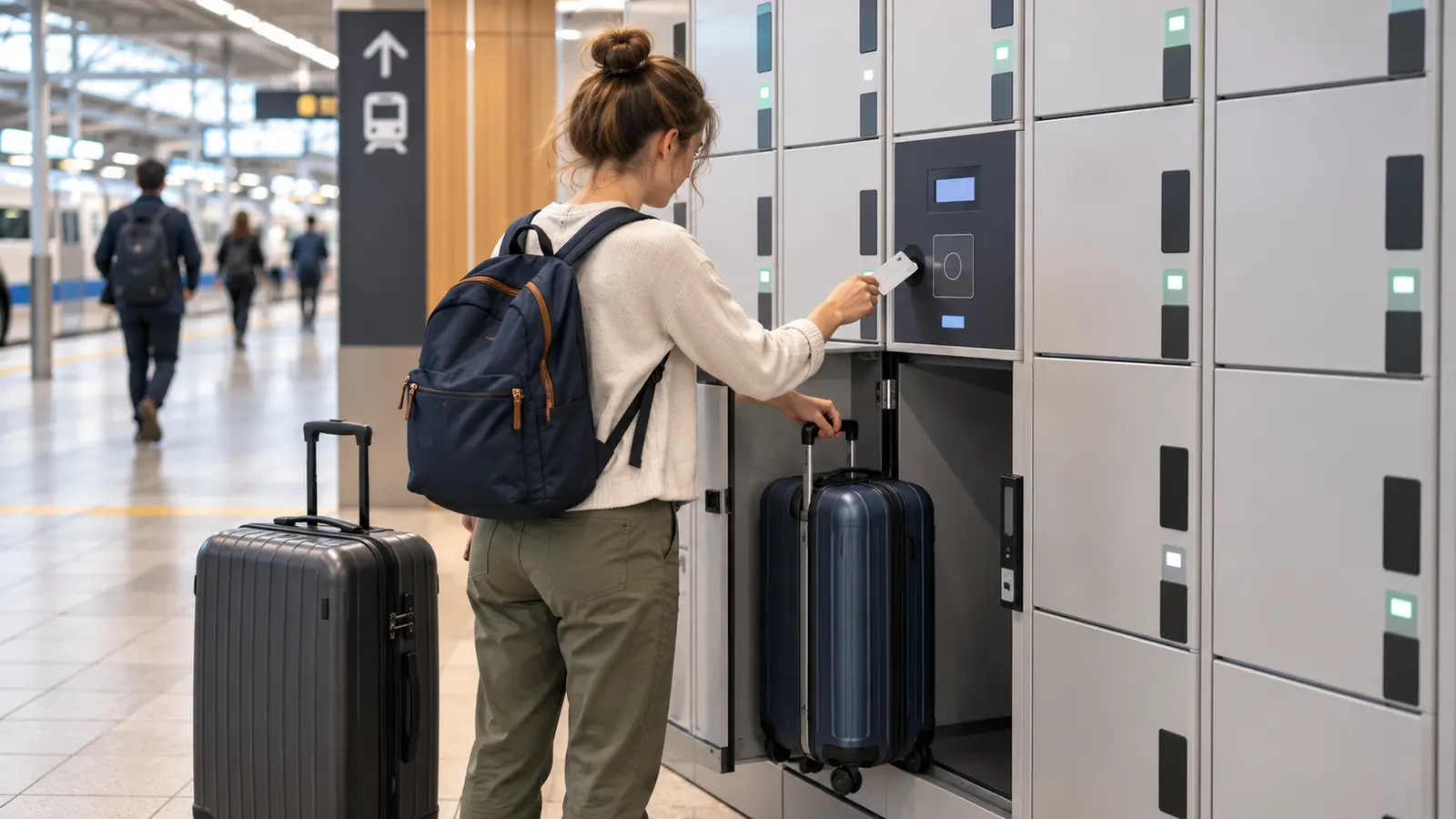
On a supported JR East Suica locker, Welcome Suica can be used both to pay and as the key. JR East instructs users to choose the Suica payment option, tap the card, take the receipt and tap the same card to retrieve the bag. It also says cash and card cannot be combined for one payment and that the process varies by model. Do not lock the card itself inside the locker.
What to know
Make the locker findable again
Large stations can contain several locker banks on different floors and on both sides of the gates. Before walking away, photograph the whole bank, locker number, floor, nearest gate or exit and a useful landmark. Save the receipt because JR East notes that it includes the locker location and contact details for its supported Suica lockers.
Keep the physical key attached to you, and store any printed PIN securely. If an IC card is the key, keep that exact card available and charged enough for the journey back. If using an app-based or reserved service, save the confirmation and collection deadline offline in case mobile data fails.
What to know
What should never go into a station locker
Keep your passport, wallet, cash, prescription medicine, rail tickets, phone, keys and anything needed before collection with you. Do not store prohibited, dangerous, leaking, perishable or illegal items. Exact exclusions and liability limits belong to the operator's posted terms, so read them when the contents are unusual or valuable.
A locker is short-term storage, not a secure deposit box or a replacement for checked baggage. If the bag contains something irreplaceable, choose another plan. Also check that wheels, straps and handles are fully inside before closing the door; forcing an oversized case can jam the locker or damage the bag.
What to know
When every large locker is full
Do not lose sightseeing time circling a huge station without a plan. First check the station's official map or availability tool where offered, but remember that availability changes. Then look for an official staffed baggage counter, ask the tourist information desk, or move to a pre-identified storage option near the next stop rather than an unknown locker bank across town.
Reservation-based storage is useful when certainty matters. Ecbo cloak lists the price, availability and reception window by location and takes supported credit-card payment in advance; check the individual space's cancellation rule and opening hours before booking. A hotel may hold bags before check-in or after checkout only if that property confirms it. For moving between cities, luggage forwarding may be a better tool than storage.
What to know
If the key, receipt, code or IC card is lost
Do not force the door or ask another traveler to open it. Use the contact details on the locker bank or receipt, or ask station or facility staff to contact the operator. Be ready to identify the locker, describe the contents and show identification. The operator may require a verification process and charge a key or unlocking fee under its own terms.
If the facility is closing, contact staff immediately rather than waiting until the next day. If a bag has passed the posted maximum period, it may no longer be in the locker; follow the operator's instructions for transferred or uncollected property.
If that does not work
Use the fallback.
- Use an official staffed baggage counter when no suitable locker is free, the bag does not fit or the posted rules are unclear.
- Reserve a storage location only after checking its exact opening hours, accepted bag size, price, cancellation terms and collection deadline.
- Ask the hotel in writing whether it will store luggage before check-in or after checkout; do not assume every property or self-check-in rental provides this service.
- For an intercity move, compare luggage forwarding and keep an overnight bag; delivery time and acceptance must be confirmed separately.
Before you need it
Save this offline.
- Photos of the locker bank, locker number, floor, gate or exit and nearby landmark
- Receipt, key, PIN or reservation confirmation kept outside the stored bag
- Collection reminder set before the station, building or counter closes
- One staffed-storage or hotel fallback with current hours and contact details
Frequently asked questions
Coin Lockers in Japan: Sizes, Payment and Full-Locker Fallbacks FAQ
How much do coin lockers cost in Japan?
JNTO currently gives ¥300–¥600 as a general size-based expectation, but there is no single nationwide price. The exact locker display controls, and reservable, extra-large or newer lockers may cost more.
Can I pay for a coin locker with Suica or another IC card?
Many modern lockers accept an IC card, but not all do. On a compatible JR East locker, Welcome Suica can be both payment and the key; use the exact card again to retrieve the bag. Follow the icons and instructions on that locker.
Is a coin-locker day always 24 hours?
No. The fee-reset time and maximum storage period are operator-specific and posted on the locker. Check them before deposit and collect the bag before the station or building becomes inaccessible.
Will a large suitcase fit?
Only if an available door has sufficient internal dimensions. Do not force the bag. Large lockers fill first at busy locations, so identify a staffed counter or reservable storage fallback.
What if I lose the locker key, receipt, code or IC card?
Contact the locker operator or station or facility staff immediately. Be ready to identify the locker and contents and show ID; verification and a fee may apply under the operator's terms. Never force the door.
Can my hotel store luggage before check-in?
Policies differ. Ask the specific property in advance and get confirmation, especially for apartments, unmanned reception and self-check-in stays.
Primary evidence
Official sources used
Open these pages again before travel. External links lead to the responsible Japanese authority or transport organization.