Before you book
Make these decisions in order.
- 01
Match your travel date to the published seasonal first stop; the summer route does not normally include Chureito Pagoda.
- 02
Choose one final activity—outlet shopping or onsen—and verify whether any admission fee is included in the selected package.
- 03
Select the exact guide, meeting-point, hotel-pickup or charter package and save the final pickup email offline.
- 04
Keep the evening free, pack for mountain weather and decide whether the day is still worthwhile if Mt. Fuji is hidden.
What to know
This tour is defined by two choices, not one fixed sightseeing list
The product title compresses several alternatives into one line. The first major stop changes by season: the published base route uses Fuji Subaru Line 5th Station from April 26 through November 30 and Arakurayama Sengen Park from December 1 through April 25. The last major stop is also a choice between Gotemba Premium Outlets and a day-use hot spring.
That means a July booking should not be sold as a Chureito Pagoda tour, and an onsen booking should not be sold as two hours of outlet shopping plus a bath. The honest product is a seasonal Fuji viewpoint, a short Oshino Hakkai visit and one selected Gotemba activity.
The operator may still change the order or substitute a stop for road, weather or operating reasons. Use the seasonal rule to understand what you are buying, not as a guarantee that every listed place will operate normally.
What to know
Choose among four materially different package types
Klook’s current English selector shows an English-speaking meeting-point package, a Mandarin-speaking meeting-point package, a shared hotel-pickup package for a small group of 4–9 people and a chartered 10-seat vehicle for a maximum of nine guests.
A meeting-point seat, a shared hotel pickup and a private charter are different products even when the sightseeing route looks similar. Compare the total price, pickup area, guide language, group exclusivity and cancellation rule after choosing the actual date.
The hotel-pickup label does not prove that every Tokyo address is accepted. Enter the complete hotel name and address, confirm the eligible area and use the time in the supplier’s final email. An apartment, airport hotel or property outside central Tokyo should not be assumed eligible.
What to know
The final meeting email matters more than a saved marketing map
The published meeting-point itinerary uses central Tokyo pickup options, and the page tells guests to look for a guide holding a GOGODAY flag. It also warns guests not to change the selected meeting point on their own.
The supplier says it sends the next day’s guide and vehicle information between 20:00 and 21:00 on the night before departure. Check the email address used for booking, the spam folder and the most recent message if more than one arrives.
Save the exact map pin, meeting time, vehicle plate and contact method offline. A tour title that says “Tokyo/Shinjuku” is not enough to identify the correct curb in two of Japan’s busiest station districts.
What to know
Mt. Fuji visibility is never included in the price
Cloud, fog, rain and rapidly changing mountain weather can hide Mt. Fuji even when central Tokyo is bright. The seller specifically notes that visibility is lower in summer. A clear summit, a sea of clouds and a reflection in a pond are possibilities, not deliverables.
Book only if Oshino Hakkai and your chosen Gotemba activity still make the day worthwhile without the mountain view. Travelers whose single goal is a clear photograph should keep a flexible date and consider independent transport after checking the forecast.
The 5th Station is at 2,305 metres. Bring a light layer and rain protection even on a hot Tokyo day, and do not use the Tokyo forecast as a substitute for the official mountain-weather and road-status pages.
What to know
The summer 5th Station stop is sightseeing, not a climb
From April 26 through November 30, the seller’s base itinerary uses Fuji Subaru Line 5th Station. The stop gives visitors the feeling of being on the mountain and access to shops and viewpoints when the road is open, but the limited tour stop is not a summit attempt.
For 2026, the Yoshida Trail climbing season runs from July 1 through September 10. The ¥4,000 entrance fee, trail gate hours and daily climber limit apply to people proceeding above the 5th Station, not to an ordinary sightseeing stop that stays below the climbing gate.
The Fuji Subaru Line can close or shorten operations because of rain, wind, snow or road conditions. Private-car restrictions from July 3 at 18:00 through September 10 at 18:00 also affect how vehicles approach. Do not assume that a small-group or charter package has unconditional access; the operator controls the safe alternative on the day.
What to know
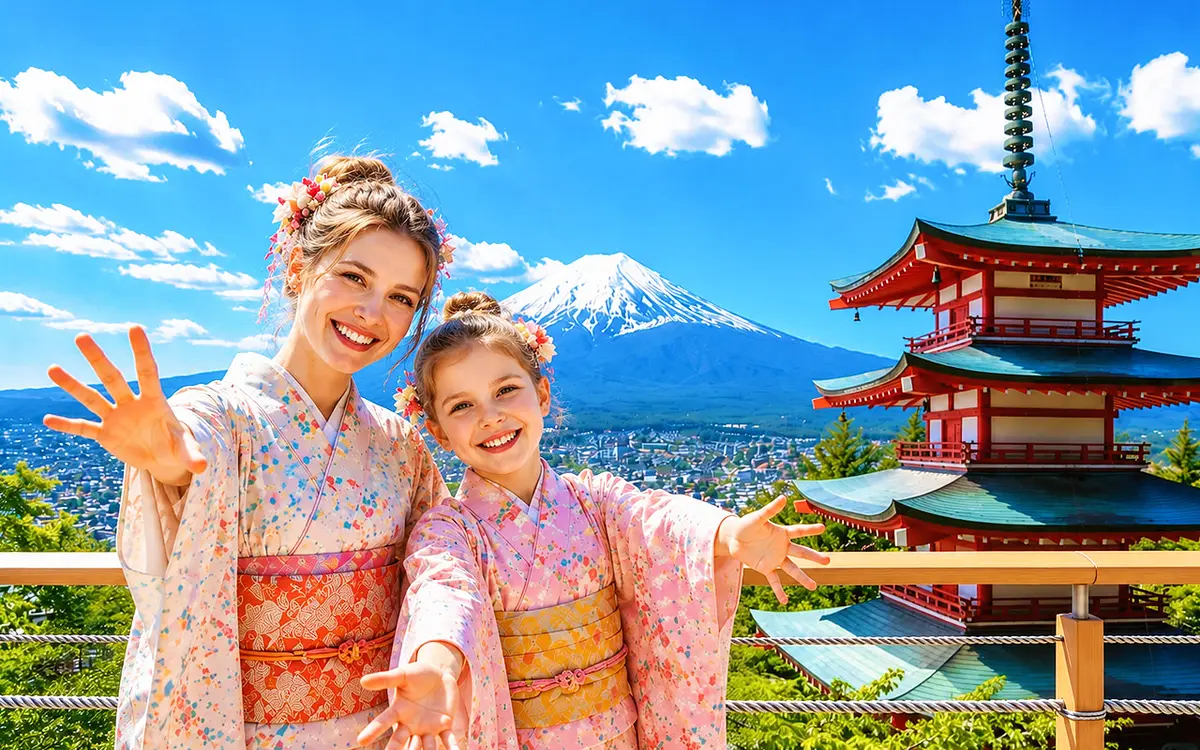
The winter route uses 398 steps to reach the famous pagoda view
From December 1 through April 25, the published route replaces the 5th Station with Arakurayama Sengen Park. Fujiyoshida’s official guide counts 398 steps to the upper observation deck, while some Klook copy rounds or misstates the count as 397.
The reward is the well-known composition of Chureito Pagoda, Fujiyoshida and Mt. Fuji when visibility cooperates. The climb and a limited tour stop make the route unsuitable for anyone who needs a step-free guarantee or a slow photography session.
Cherry-blossom photographs are seasonal marketing, not a year-round promise. Even during the blossom period, bloom timing and crowd management change. Respect barriers and private residential space around the park rather than leaving the route to reproduce a social-media angle.
What to know
A short Oshino Hakkai stop cannot cover all eight ponds
Oshino Hakkai is a group of eight spring-fed ponds and one of the component sites in the UNESCO inscription of Fujisan. The value lies in the spring water, pilgrimage history and village landscape—not in ticking off one crowded photo spot.
Oshino Village’s official walking guidance allows roughly 1.5 to two hours to visit all eight ponds. A group-tour stop of around an hour cannot reliably cover the complete route, food stalls and lunch. Choose a few official ponds in advance and return independently if the heritage landscape is your main interest.
Most outdoor pond areas are free, but Sokonuke Pond is inside the Hannoki Bayashi Shiryokan, which has separate hours and admission. Do not throw coins or rubbish into the water. The village warns that this harms water quality, wildlife and the protected landscape.
What to know
Outlet or onsen means make one deliberate choice
The final scheduled block is approximately two hours and asks travelers to choose Gotemba Premium Outlets or a nearby day-use onsen. The two facilities are close, but that does not make two full experiences fit into the same group-tour window.
Choose the outlet if you have specific stores, tax-free purchases or gifts in mind. Choose the onsen if recovery matters more than shopping and everyone accepts communal-bath rules. A mixed family should agree before departure so the guide is not solving the decision in a parking area.
If your selected package does not state how the choice is recorded, send it in the booking remarks and confirm it in the night-before message. Never assume that choosing the onsen automatically adds admission to the tour fare.
What to know
Two hours at Gotemba needs a store shortlist
Gotemba Premium Outlets lists 290 stores and spans a large outdoor site. Its official regular hours are 10:00–20:00 from March through November and 10:00–19:00 from December through February, with individual shops and restaurants able to differ.
Open the official map before travel and select a small number of priority stores near one another. Use the first part of the stop for must-buy items and leave time to walk back to the vehicle; a missed group departure can cost far more than an extra bargain is worth.
Klook describes the annual closure as the third Thursday in February, but the outlet’s current official page names February 25, 2027 as the next closure. Use the official date and the operator’s replacement plan rather than a repeating calendar formula.
Tax-free eligibility varies by store and normally requires your passport at purchase. Lockers exist but size and availability are limited, so the tour’s own one-bag-per-person rule remains the safer packing limit.
What to know
Konohana no Yu has current rules that old reseller copy can miss
Klook identifies Konohana no Yu as the normal hot-spring option. The facility’s official July 2026 information lists 10:30–22:00 operation with last admission at 21:00. Communal-bath admission is ¥1,800 for adults and ¥950 for children aged 3 through elementary school on weekdays, or ¥2,200 and ¥1,150 on weekends and holidays. Towels are included.
The facility applies holiday pricing during August 9–16, 2026 as well as selected Golden Week and year-end dates. A weekday on the calendar can therefore use the higher price during those published holiday-rate periods.
The official facility says tattoo-related bathing restrictions were lifted on April 1, 2025. Klook’s current note says April 2026, so use the venue’s own date. If the tour substitutes another onsen during a closure, that replacement may still prohibit tattoos.
Communal bathing is nude and separated by gender. Cameras and phones are prohibited in the bath area; children under three, diaper users and intoxicated guests cannot use the communal baths, and mixed-gender bathing is not allowed from age seven. A Mt. Fuji view from the open-air bath still depends on weather.
What to know
An onsen fee should be treated as extra until checkout proves otherwise
The public Klook overview promotes the outlet-or-onsen choice but does not expose a stable inclusion list for every date and package. The onsen is a paid facility, so do not advertise admission, lunch or a private bath as included without seeing it in the selected package.
Take a screenshot of the final “What’s included” panel before paying. Confirm communal-bath admission, towel rental, meals, attraction charges and any holiday surcharge separately.
Konohana no Yu’s next published maintenance closure is September 8–9, 2026, with reopening at 15:00 on September 10. Future maintenance can be added, so open the official venue page for the exact tour date.
What to know
A selected English package may still share a multilingual vehicle
Klook warns that shared tours may carry guests speaking different languages in one vehicle. Select the English-speaking meeting-point package when English guidance matters, but do not assume a private monolingual commentary service.
The vehicle type is assigned according to the final group size and cannot be selected on shared packages. A 4–9-person hotel-pickup label describes the small-group package, not a promise that your own booking party will be alone.
For a truly private day, compare the chartered-car package’s total price and confirm the driver or guide language in writing. “Private vehicle” and “English-speaking guide” are separate conditions.
What to know
Declare children, mobility needs and luggage before paying
Every infant and child must appear in the passenger count even when a child price or free-infant rule is offered for a selected date. The public overview does not show one reliable age table across all four package types, so use the selected checkout rule rather than copying an age band from another seller.
Klook permits one piece of luggage per guest when declared in the special-requirements field. An undeclared additional bag can create a safety problem; the guide may refuse boarding without a refund. Keep bags small because the vehicle class can change with group size.
The listing does not guarantee an accessible vehicle. The winter park route has 398 steps, and the onsen has separate bathing and age restrictions. Wheelchair users and travelers with limited walking ability should obtain written confirmation of the exact vehicle, stop access and alternative arrangements before booking.
What to know
Do not place a train, flight or paid dinner after this tour
The itinerary’s departure, stop and return times are estimates. Tokyo traffic, Fuji road conditions, weather, crowds and late participants can change the order and shorten or extend stops.
Klook explicitly recommends avoiding other activities after the tour and says it is not responsible for losses caused by a delayed return. Treat the evening as recovery time rather than a connection window.
The same caution applies to a charter. A private vehicle gives group control, but it does not remove expressway traffic or road closures around Mt. Fuji.
What to know
Late arrival and leaving the group create expensive failures
Arrive before the time in the final message and stay at the selected point. The seller says a guest who changes the meeting place personally or arrives late can miss the tour without a refund.
Early departure or leaving the group midway is not permitted on the shared itinerary. If you separate voluntarily, the unfinished portion is forfeited and onward transport becomes your responsibility.
Keep one group member responsible for the guide’s messages at every stop. Photographing the vehicle plate and saving the meeting pin makes it easier to return to the correct bus in a large outlet car park.
What to know
Bad weather can change the route without creating a view-based refund
The operator may change stop order, reduce outdoor activity or make an alternative arrangement for weather, traffic or safety. Seasonal flowers, foliage, snow and Mt. Fuji visibility are not guaranteed, and disappointment with natural conditions is not itself a refund reason.
A complete tour cancellation by the operator is different from a cloudy day or substituted stop. The current public page does not expose one stable cancellation cutoff for every package, so read the selected package and voucher before payment.
Save the cancellation deadline and contact Klook through the booking record if conditions change. Do not rely on a “free cancellation” badge from a different Fuji tour or related-product card.
What to know
How this tour differs from the other Fuji and Gotemba route
Japan Travel Tech also covers Klook activity 10233, which publishes a four-stop route through the 5th Station, Lake Kawaguchi, Oshino Hakkai and Gotemba Premium Outlets. That product emphasizes breadth and includes Lake Kawaguchi.
This activity, number 87225, drops the normal Lake Kawaguchi stop, uses Arakurayama Sengen Park as the published winter alternative and lets you choose an onsen instead of outlet shopping. It also exposes hotel-pickup and charter package types in the current selector.
Choose 10233 if Lake Kawaguchi and four quick stops matter more. Choose 87225 if the outlet-versus-onsen decision or pickup format is more valuable. Never compare only the headline price because the route, group format and inclusions differ.
What to know
Use this final checkout checklist
Confirm the activity number, travel date, seasonal first stop, outlet or onsen choice, package type, guide language, pickup point, eligible hotel address, every passenger and each bag.
Then verify meals, onsen admission, other attraction fees, cancellation cutoff, change rules, confirmation timing and the consequence of weather substitution. Save the selected package screen and voucher, not only the broad product title.
On the night before departure, check the final supplier email and official Fuji Subaru Line, outlet or onsen operating page. This tour earns its price when it removes transport decisions without hiding the route’s real limits.
Compare a related booking
Mt. Fuji Day Tour Guide: Lake Kawaguchi, Oshino Hakkai & Gotemba
Compare this seasonal outlet-or-onsen route with activity 10233, which adds a dedicated Lake Kawaguchi stop and ends at Gotemba Premium Outlets.
A good fit
Put it on your list if...
- First-time visitors who want a simplified road trip from Tokyo to the Fuji area
- Travelers happy to choose one Gotemba activity: shopping or onsen
- People who value hotel pickup or a private-car option more than the lowest seat price
- Visitors who will enjoy Oshino and Gotemba even if clouds hide Mt. Fuji
Think twice
Skip or reconsider if...
- Summer visitors who require Chureito Pagoda in the confirmed itinerary
- Travelers who want both a complete outlet visit and an onsen session
- Anyone trying to visit all eight Oshino ponds or spend a full photography day
- Guests with a fixed evening train, flight, restaurant or performance reservation
Booking option
Check the current ticket before paying.
The link opens Klook’s English activity page with USD selected. Select the exact date and package before comparing the route, pickup, language, inclusions and final price.
- The first main stop changes by season and remains subject to road and weather conditions.
- Gotemba Premium Outlets and the onsen are alternatives, not two complete included stops.
- Confirm whether onsen admission, meals and any other fees are included in your selected package.
- Declare every passenger and bag, then save the night-before guide and vehicle email.
- Read the selected cancellation, change, late-arrival and weather-substitution terms before paying.
Evidence and commercial terms
Sources checked
Government and operator or venue pages establish rules and practical details. Booking-service pages are commercial sources for the package and checkout terms only. Open the relevant sources again before travel.