
Do this now
Follow these steps in order.
- 01
Decide whether the situation is an emergency. Call 119 immediately for serious breathing difficulty, loss of consciousness, major bleeding, a severe injury or another urgent condition; do not wait for an insurer's approval.
- 02
Give the 119 operator the location first, say that it is a medical emergency, describe what happened and provide the patient's age, name and reachable phone number.
- 03
For non-emergency care, open JNTO's official medical-institution search and filter by current area, required language and medical department. Treat the result as a starting point rather than a guaranteed appointment.
- 04
Call the medical facility before leaving. Confirm that it is open, can see the condition, can support the required language at that time, accepts walk-ins or needs an appointment, and explain any infectious symptoms before arrival.
- 05
Contact the travel insurer's assistance line if doing so will not delay urgent care. Ask for a case number, an approved provider, interpretation support, any guarantee-of-payment process and the exact claim documents required.
- 06
Carry the passport, insurance certificate or policy number, insurer case number, card and cash, medication list, allergy information, hotel address and a phone that can receive calls.
- 07
At reception, show the information accurately and ask about the estimated payment method. Do not assume that a foreign health card or travel-insurance card makes treatment cashless.
- 08
Before leaving, collect the original receipt, itemized statement, prescription and any medical certificate the insurer requested. Photograph them as a backup but keep the originals.
- 09
Follow the provider's instructions for medicine and follow-up. If travel must change, contact the insurer and airline, hotel or transport operator separately before assuming the medical bill covers those changes.
What to know
Emergency first: call 119 before insurance
Japan's ambulance and fire emergency number is 119. The Fire and Disaster Management Agency says to state that it is a medical emergency, give the address or a nearby landmark, explain the symptoms or accident, give the patient's age, and provide your name and phone number. If the situation is urgent, call first rather than searching for a clinic or seeking insurer authorization.
The official ambulance guide lists examples that warrant calling without hesitation, including loss of consciousness, difficulty breathing, sudden severe pain, major blood loss, a serious burn, a strong impact or other unusual and rapidly changing conditions. This article cannot decide whether a particular symptom is an emergency. When in doubt about a potentially serious condition, use professional emergency help.
Prepare the location in Japanese if possible. A hotel desk, station employee, venue staff member or nearby Japanese speaker may help communicate, but do not spend time looking for a translator before a dangerous delay. The Fire and Disaster Management Agency reports that many fire departments use three-way telephone interpretation for multilingual 119 calls, but local implementation is not a reason to postpone the call.
What to know
What to have ready for an ambulance
The Fire and Disaster Management Agency recommends preparing the patient's passport, health-insurance or patient card if held, cash, shoes, current medicines and the medication schedule. Tell the crew what happened, how the condition changed, what first aid was given, and any chronic disease, usual clinic or medical instructions.
A short offline medical note can help: full name, date of birth, allergies, medicines with generic names and doses, important conditions, emergency contact, insurer and policy number. Keep it accurate and update it before travel. Do not stop, repeat or change medicine based on this guide.
An ambulance takes the patient to an appropriate receiving facility; it is not a booking service for a preferred English-speaking clinic. Be ready for the destination to depend on urgency, available departments and local capacity.
What to know
For non-emergency care, use the official medical search
The Ministry of Health, Labour and Welfare and the Japan Tourism Agency maintain an official list of medical institutions that accept foreign patients. The JNTO search presents facilities by area, language and medical department, and the government list was most recently revised for several prefectures on September 30, 2026.
JNTO warns that its search supplies basic information only. Opening hours and language support must be confirmed with the facility, treatment may be unavailable, and a patient may be referred elsewhere depending on the illness or injury. A search result is not a confirmed appointment or guarantee that an interpreter will be present.
Choose the department only when you can do so safely. If unsure, call the facility, your insurer's medical assistance line or the JNTO Japan Visitor Hotline for logistical guidance. The Japan Visitor Hotline is listed by JNTO at 050-3816-2787 and operates 24 hours every day in English, Chinese, Korean and Japanese for visitor emergencies and travel assistance; it does not replace 119 or provide a diagnosis.
What to know
Call before you travel to the clinic
Confirm five points: the department can assess the problem, the facility is accepting patients now, the required language support is available, the consultation is walk-in or appointment-only, and the expected payment methods. Ask where to enter after hours because an emergency entrance may differ from the daytime reception.
If fever, rash, vomiting, diarrhea, respiratory symptoms or another potentially infectious condition is present, say so during the call and follow the facility's arrival instructions. Do not enter a crowded waiting room first and explain later if the provider directs patients to a separate route.
Save the facility name, address, phone number and appointment or reception instructions offline. Check the last train or bus only after care is safely arranged; if the clinic is far from public transport, ask the facility, hotel or insurer about a taxi or other safe route.
What to know
Contact travel insurance before treatment when it is safe
JNTO recommends carrying the insurer's emergency contact and knowing how it pays medical costs. Call the assistance number shown for the country where you are traveling, not a general sales line. Give the location, symptoms in plain language, policy number and a phone number that works in Japan.
Ask the insurer to confirm coverage, exclusions, excess or deductible, an approved facility, interpretation, preauthorization, transport and any guarantee-of-payment arrangement. Record the case number, representative's name, time and written instructions. An insurer may require its own referral or documents, but an emergency must not wait for administrative approval.
Credit-card travel insurance may require that the trip was purchased in a particular way, may apply only during a defined period and may have a separate assistance company. Confirm activation and limits with the card issuer before relying on it. A card benefit summary is not the same as a guarantee that a Japanese provider will bill the insurer directly.
What to know
Cashless treatment is a confirmed arrangement, not a card feature
JNTO defines cashless service as an arrangement in which the insurer pays the medical provider on the traveler's behalf. It also warns that other insurers require the traveler to pay upfront and that some clinics do not accept credit cards. Carry a usable card and access to yen even when a policy advertises cashless treatment.
Ask whether the insurer has actually issued a guarantee of payment to that named facility for that visit. Ask the provider whether it has received and accepted the arrangement. Until both sides confirm it, plan for self-payment. A policy card, claim number or email alone may not settle the bill.
Cashless approval can cover only eligible treatment. Deposits, medicines, upgrades, transport, follow-up, chronic or pre-existing conditions and services outside the policy may be treated separately. Get the insurer's explanation in writing when possible and ask the provider what remains payable before discharge.
What to know
Short-term visitors should prepare for the full bill
A short-term visitor normally does not join Japan's resident public health-insurance system merely by entering the country. Do not present a foreign health card as though it guarantees Japan's insured rate. The medical facility and travel insurer determine billing and reimbursement under their own rules.
Ask the provider for an estimate when practical, but understand that tests, treatment or admission can change the amount. Never delay necessary emergency care solely to obtain a final price. Japan's tourism and health authorities strongly recommend private medical insurance with sufficient coverage because care can be very expensive.
Pay only through the provider's official method and keep proof. If the amount is more than your card limit, call the issuer and insurer, ask the provider about accepted options, and avoid informal transfers or unverified payment links. Unpaid medical fees can create serious consequences, including stricter immigration review on a future visit.
What to know
Documents to request before leaving
Tell reception that you may file a travel-insurance claim and show the insurer's required-document list. Request the original receipt and an itemized statement showing the services and amounts. If the insurer requires a medical certificate, diagnosis form or attending physician's signature, ask before discharge because returning later can be difficult and may involve a fee.
Keep the prescription, medicine receipt, referral, test results supplied to you and any written work or travel restriction. Names and formats differ by provider, so use the insurer's terminology rather than assuming one Japanese document satisfies every foreign claim.
Photograph every page and store the copies securely, but do not discard originals. Note exchange rates only as the insurer requests. Submit the claim within the policy deadline and answer requests through the insurer's official channel.
What to know
Medicines and pharmacies after the consultation
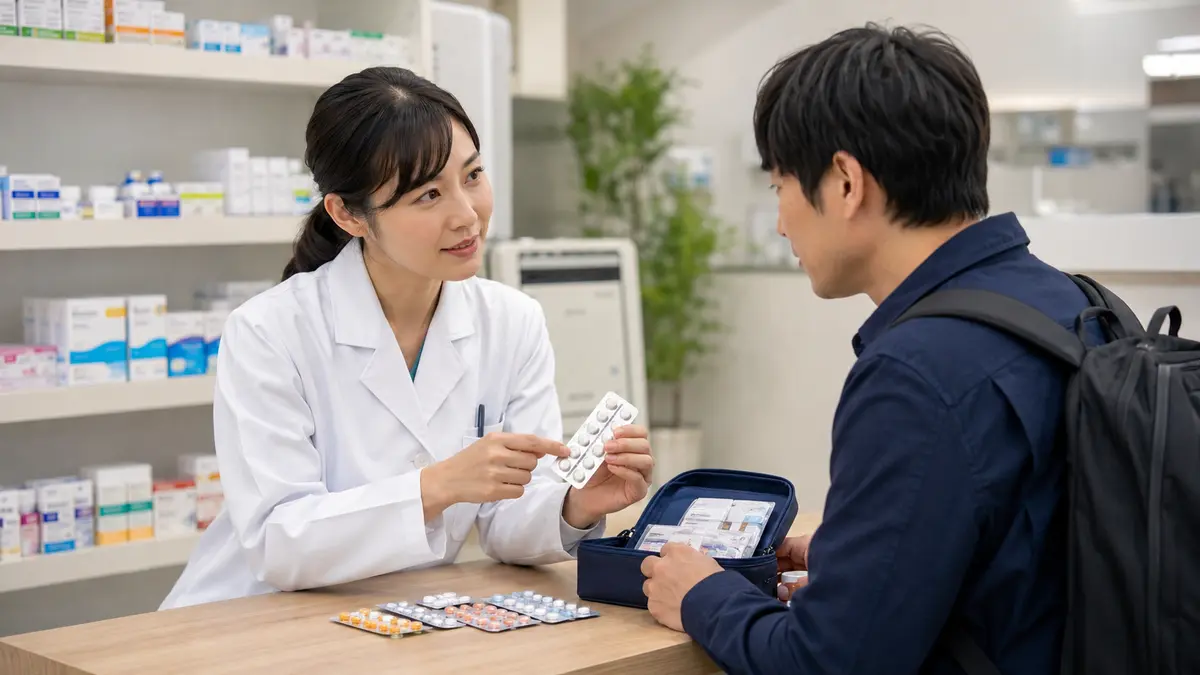
A clinic or hospital may issue a prescription to be filled at a separate dispensing pharmacy. Ask where the nearest suitable pharmacy is, whether it is still open, how long the prescription remains usable and what identification or payment is required. Do not assume the medical facility itself will hand over every medicine.
Check the medicine name, dose, timing, warnings and interactions with a clinician or pharmacist. If an explanation is unclear, request written instructions or interpretation before taking it. A familiar brand name may contain a different ingredient or strength in Japan.
If you plan to take newly prescribed medicine out of Japan or continue it through another country, check the destination and transit rules separately. Medical permission to use a medicine in Japan does not override another country's import controls.
What to know
If the first clinic cannot accept you
A provider may lack the required department, equipment, language support, after-hours capacity or appointment space. Ask for the reason, the name and phone number of an alternative, and whether a referral is needed. Recheck the destination before traveling there.
If the condition worsens or becomes urgent while arranging an alternative, call 119. Do not continue a long cross-city search because a website once listed English support. Current medical capacity matters more than a preferred language or neighborhood.
If communication fails, ask the insurer about interpretation, use the JNTO resources, or ask accommodation staff for logistical help. Machine translation can help with basic reception details, but do not use an uncertain translation to change treatment or medicine.
What to know
Changing flights, hotels and plans is a separate process
A medical bill does not automatically change an airline ticket, train reservation, hotel booking or tour. Contact each operator before its deadline, explain only what is necessary, and ask what evidence it requires. Keep cancellation confirmations and receipts.
Ask the insurer whether trip interruption, extra accommodation, companion expenses, medical transport or a new flight is covered before committing when the situation is not an emergency. Coverage and approval rules vary, and a clinician's advice does not by itself guarantee reimbursement.
If a clinician says you are not fit to fly, ask what document the operating airline and insurer need and who can complete it. Airlines may use their own medical-information form and approval timeline.
If that does not work
Use the fallback.
- The situation may be life-threatening: call 119 now; do not wait for the insurer, JNTO or a preferred-language clinic.
- You do not know the address: give the hotel, station, shop, intersection or nearby landmark and share a map pin with someone who can help communicate.
- The JNTO search lists a facility but it does not answer: try another listed facility, contact the insurer's assistance line or use the Japan Visitor Hotline for logistical support.
- No English-speaking staff member is available: ask whether telephone or remote interpretation is possible; keep symptoms, medicines and allergies written in simple language.
- Cashless treatment is not confirmed: plan to pay the provider, ask for the insurer's exact claim documents and preserve originals.
- The card is declined or the limit is too low: contact the issuer and insurer, ask the provider about official accepted methods and do not use an unverified third-party payment request.
- The clinic cannot treat the problem: ask for a referral or a named alternative; call 119 if the condition becomes urgent.
- You must cancel travel: obtain the provider document that the insurer and operator actually require, then contact each booking separately before its deadline.
Before you need it
Save this offline.
- Emergency ambulance and fire number: 119
- JNTO Japan Visitor Hotline: 050-3816-2787
- Passport and secure passport-page copy
- Travel-insurance company, policy number, assistance number and case number
- Allergies, conditions, medicines, generic names and doses
- Emergency contact and accommodation address
- Payment card, backup payment method and access to yen
- Medical facility name, address, phone, department and arrival instructions
- Insurer's required receipt, statement and certificate checklist
Frequently asked questions
Sick or Injured in Japan? Clinics, Insurance and Medical Bills FAQ
What number should I call for an ambulance in Japan?
Call 119. Say that it is a medical emergency, give the location, explain what happened, provide the patient's age, and give your name and reachable phone number.
How do I find an English-speaking doctor in Japan?
Use JNTO's official medical-institution search and filter by area, language and department. Call before visiting because opening hours, acceptance and language support are not guaranteed by the listing.
Is the Japan Visitor Hotline a medical advice service?
No. The 24-hour hotline can support visitors with emergency and travel information, but it does not replace 119, a clinician or the insurer's medical-assistance service.
Will travel insurance pay a Japanese hospital directly?
Only when the insurer and provider confirm a cashless or guarantee-of-payment arrangement for that visit. Otherwise, expect that you may need to pay upfront and claim later.
Do Japanese clinics accept foreign credit cards?
Not all do. JNTO warns that some clinics do not accept credit cards, so confirm with the facility and carry a backup payment method and access to yen.
What should I bring to a clinic or hospital in Japan?
Bring your passport, insurance details, insurer case number, payment methods, medication list, allergy information, emergency contact and a working phone. For an ambulance, the official guide also recommends shoes, cash and current medicines.
What documents do I need for a travel-insurance claim?
Requirements vary. Ask the insurer before discharge and request the original receipt, itemized medical statement and any medical certificate or signed form it specifies. Keep prescriptions and medicine receipts too.
Can a clinic refuse or refer a foreign visitor?
A listed facility may still be unable to provide the required department, language support or capacity. Call first and ask for a named alternative or referral; use 119 if the condition becomes urgent.
Primary evidence
Official sources used
Open these pages again before travel. External links lead to the responsible Japanese authority or transport organization.