Do this now
Follow these steps in order.
- 01
Write every allergen, derivative and cross-contact limit in English and Japanese; add anything missing from Japan's official communication sheet.
- 02
Contact the restaurant before booking and ask about the exact dish, stock, sauce, garnish, shared fryer, grill and utensils—not only the main ingredient.
- 03
For packaged food, read the current Japanese ingredients and allergen statement on the outer package; do not rely only on front-of-pack icons or an app translation.
- 04
Confirm the same order again on arrival. If staff cannot give a clear answer, choose a sealed labelled alternative or eat somewhere else.
- 05
Carry your prescribed emergency medication and personal action plan, keep your location available offline and know that Japan's ambulance number is 119.
What to know
Packaged-food labels and restaurant answers are different systems
Japan's Consumer Affairs Agency requires Japanese labelling for foods sold in Japan. The national allergen system applies to packaged processed foods and food additives. On a package, look for the ingredients heading 原材料名 and an allergen statement that may appear in parentheses or after the ingredients. Keep the outer package: individual pieces inside a multipack may not repeat the complete label.
The same mandatory system does not cover restaurant and delivery meals, food sold loose or by weight, or alcoholic beverages. A menu without an allergen mark is not evidence that a dish is safe, and a restaurant may decide it cannot accommodate a request. Ask directly and treat an uncertain answer as a reason to change the order or venue.
What to know
The nine mandatory allergens in Japan in 2026
From April 1, 2026, the nine mandatory allergens are shrimp, crab, walnut, wheat, buckwheat, egg, milk, peanuts and cashew nuts. Japan also has a separate list of 20 allergens for which labelling is recommended rather than mandatory, including sesame, soy, fish, meat, fruit, gelatin, pistachio, almond and macadamia nut. Your own allergy may therefore be absent even when the package follows Japanese rules.
Cashew nuts moved into the mandatory category on April 1, 2026, but the Consumer Affairs Agency set a two-year transition period. During that period, an older label may not yet reflect the change. Pistachio moved into the recommended list, not the mandatory list. Write your exact allergens rather than relying on a foreign 'top allergens' list or a numeric count.
What to know
Prepare a written card before the trip
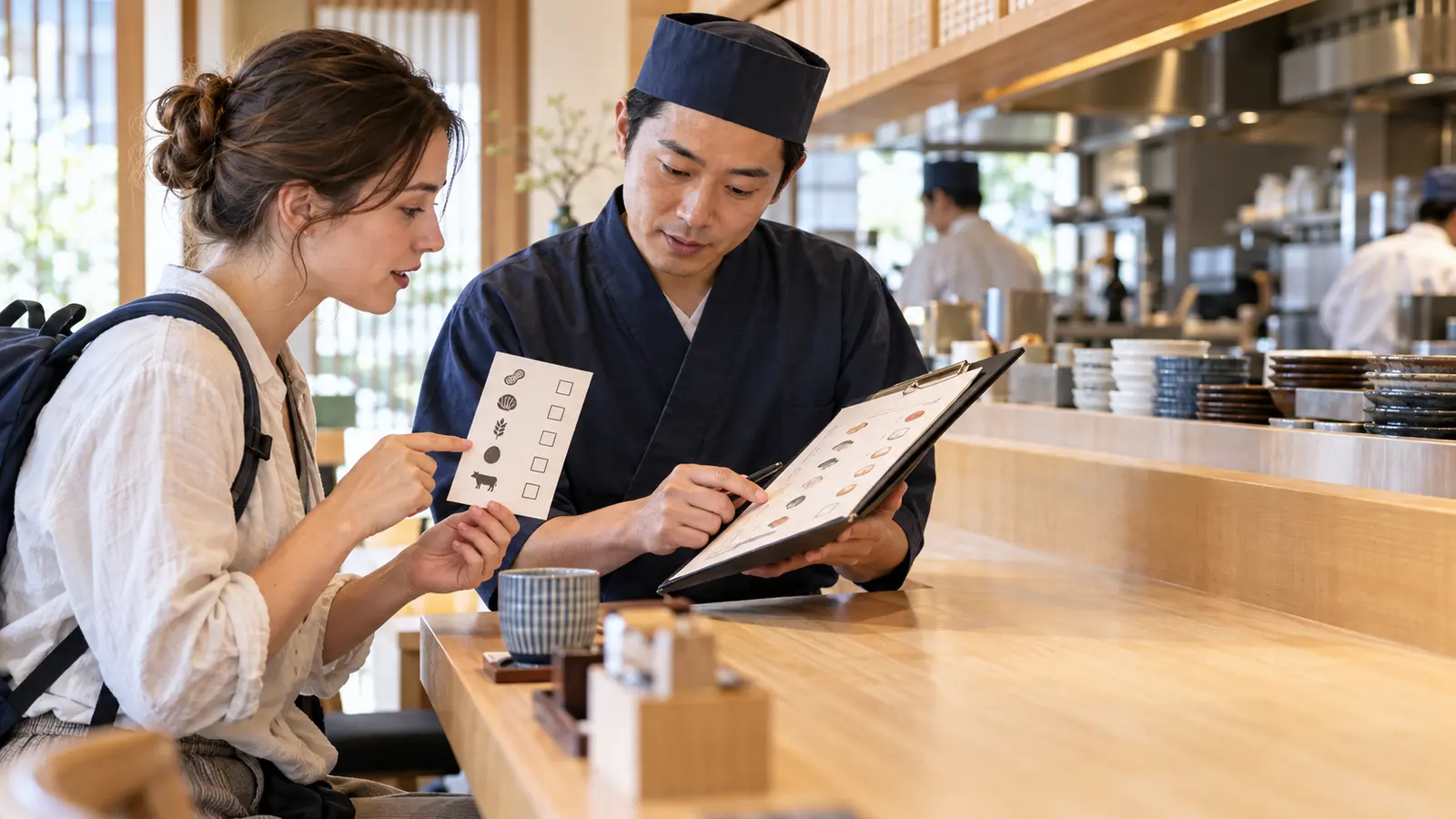
Download the Consumer Affairs Agency's English Food Allergy Communication Sheet and complete it before travel. Its checkbox fields work after download, according to the agency. Because the sheet predates the April 2026 cashew and pistachio changes and cannot describe every individual risk, add a separate line for anything not listed and for cross-contact limits.
Useful opening phrases are 食物アレルギーがあります (I have a food allergy), 〇〇を食べることができません (I cannot eat ___), and 同じ油・調理器具を使っていますか (Do you use the same oil or cooking utensils?). A card and translation app support a conversation; neither certifies a dish. Ask staff to point to the ingredient or explain the kitchen process rather than accepting a polite but unclear response.
What to know
Ask before reserving, then confirm the exact dish
Send the restaurant your written list before any cancellation deadline. Ask whether the kitchen can check the specific menu item and whether stock, dashi, sauce, batter, noodles, garnish or dessert components contain the allergen. Also ask about shared fryers, grills, chopping boards, tongs and buffet utensils when cross-contact matters to you.
Confirm again at the restaurant because recipes, suppliers and the staff on duty can change. Vegetarian, vegan, halal, gluten-free and 'allergen conscious' descriptions answer different questions and do not guarantee the absence of your allergen or cross-contact. If the restaurant declines, thank the staff and use a prepared alternative instead of asking them to improvise.
What to know
Read convenience-store, bakery and souvenir food carefully
Factory-sealed food with a current Japanese label can be easier to assess than a loose bakery item, buffet tray or street-stall dish, but it is not automatically safe. Read the ingredient and allergen information every time; recipes and suppliers can change. Photograph or keep the whole package until you finish eating so the information is available if a question arises.
A translation app can help locate characters, but it can miss compound ingredients and context. When the label is too small, damaged or unclear, ask store staff for the outer packaging or choose a product whose label you can verify. During the cashew transition, people avoiding cashew should not treat the absence of the new mandatory wording as conclusive.
What to know
Build a no-guesswork fallback
Identify more than one meal option near the hotel and major day-trip stops. A hotel concierge, tour operator or Japanese-speaking companion may help make an advance call, but you still need to confirm the final dish. Carry an appropriate personal backup meal where storage and venue rules allow; do not depend on finding an accommodating kitchen after the last train or in a remote area.
JNTO warns that not all restaurants and packaged foods provide allergy information and advises travelers with severe allergies to check in advance and confirm directly with staff. If the information you need is unavailable, changing the plan is the safest practical choice.
What to know
If a serious reaction happens
Follow the personal emergency plan given by your clinician and use prescribed emergency medication as directed. For severe symptoms such as difficulty breathing, collapse or loss of consciousness, call 119 for an ambulance or ask someone nearby to call. Say 'medical emergency,' give the location first and ask a Japanese speaker, hotel desk or venue staff to help if available.
Japan's Fire and Disaster Management Agency says 119 is available to anyone in Japan. Keep your passport, medication information, hotel address and emergency contact accessible. This article cannot assess symptoms or replace individual medical advice.
If that does not work
Use the fallback.
- Choose a factory-sealed item only when you can understand its current Japanese label and it meets your personal plan; remember the cashew transition and that recommended allergens may be omitted.
- Ask the hotel or a Japanese-speaking helper to contact a restaurant before you travel there, then reconfirm with the staff serving the meal.
- Use your prepared backup food when storage and venue rules allow, or change restaurants rather than pressuring a kitchen to promise what it cannot verify.
- For a severe reaction, follow your personal emergency plan and call 119; give the location before trying to explain every detail.
Before you need it
Save this offline.
- Downloaded Consumer Affairs Agency allergy communication sheet plus your own exact English-and-Japanese allergen list
- Prescribed emergency medication, personal action plan and medication names
- Restaurant confirmations, cancellation deadlines and two backup meal locations
- Hotel address, current-location screenshot, travel-insurance details and emergency contact
Frequently asked questions
Food Allergies in Japan: How to Order Safely and Read Labels FAQ
Are Japanese restaurants required to list every allergen?
No. The mandatory national allergen-labelling system applies to packaged processed foods and additives, not restaurant, delivery, loose or made-to-order food. Restaurant information is voluntary, so ask directly and use a fallback when staff cannot confirm.
What are Japan's nine mandatory allergens in 2026?
Shrimp, crab, walnut, wheat, buckwheat, egg, milk, peanuts and cashew nuts. Other allergens may be recommended for labelling or outside the national lists, so write your exact allergy instead of relying only on the nine.
Why might cashew be missing from a label after April 1, 2026?
Cashew nuts became mandatory on that date, but the Consumer Affairs Agency established a two-year transition period. People avoiding cashew should check products cautiously and not treat an older label's silence as proof of absence.
Does vegetarian, vegan or gluten-free mean allergy-safe?
No. Those descriptions answer a different question and do not guarantee the absence of your allergen, shared oil, utensils or other cross-contact.
Can I rely on an allergy card or translation app?
Use them to support a conversation, not as a guarantee. Add allergens and cross-contact limits not covered by the card, ask about the exact dish and kitchen process, and change the meal if the answer remains unclear.
What should I do if I have a severe reaction in Japan?
Follow your clinician's emergency plan, use prescribed medication as directed and call 119 for an ambulance when symptoms are severe. Give the location first and ask nearby staff or a Japanese speaker to help.
Primary evidence
Official sources used
Open these pages again before travel. External links lead to the responsible Japanese authority or transport organization.