Do this now
Follow these steps in order.
- 01
Approach Shoro Nagashi as a family memorial tradition, not a staged entertainment parade.
- 02
Save the city's acceptance-site information and the police traffic-control map before entering central Nagasaki.
- 03
Use public transport and walking where practical; road controls begin at 17:00 and can prevent cars from entering or leaving affected parking areas.
- 04
Bring hearing protection, avoid smoke if it may affect your health, and check same-day weather and transport notices before travel.
What to know
It is a family memorial observance, not a staged festival
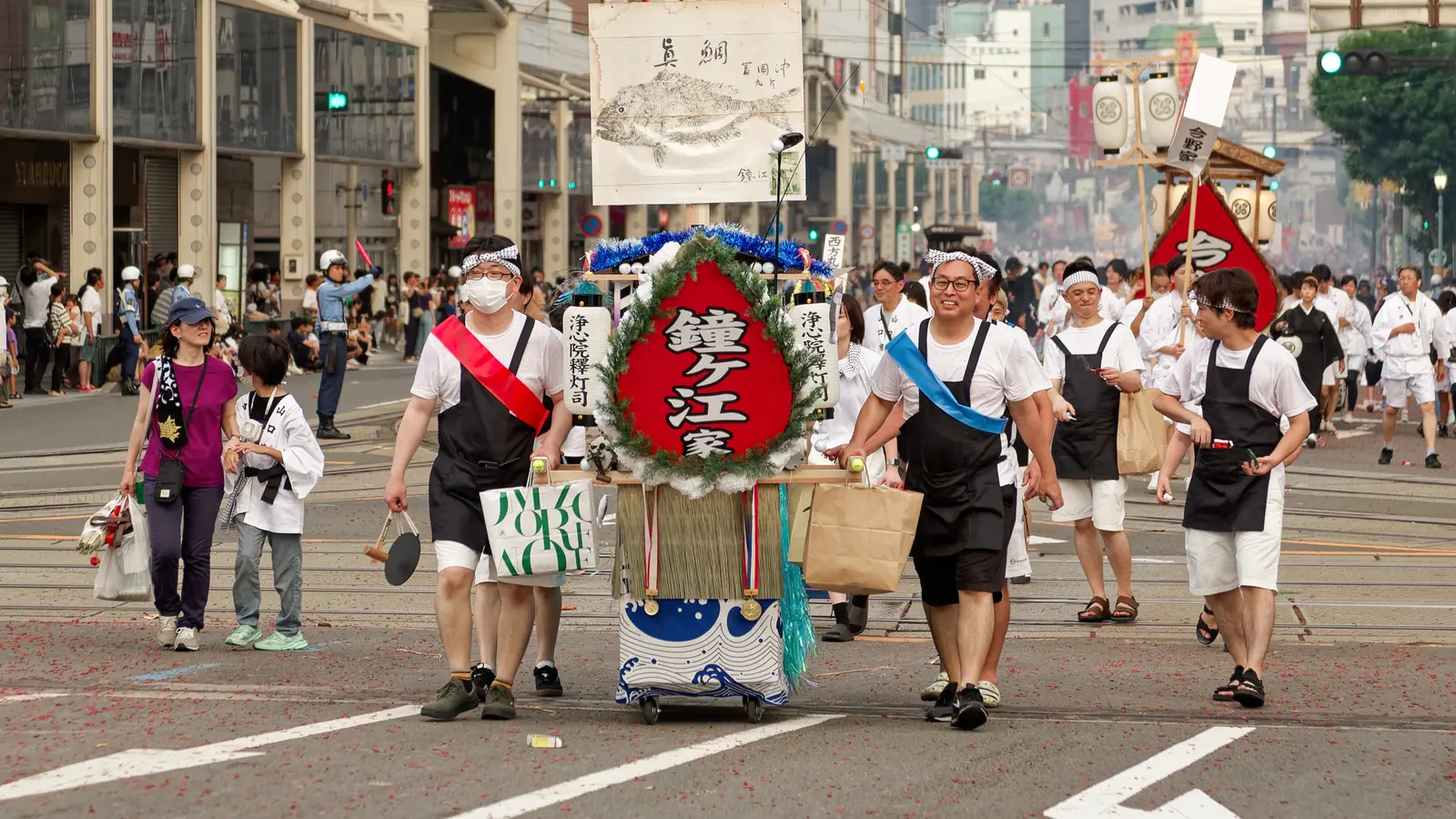
Shoro Nagashi is held on August 15 for families observing the first Obon after a person's death. Families build and decorate spirit boats, then accompany them through the city to send the deceased onward. Bells, chants and firecrackers are part of the tradition, but visitors are watching a bereavement observance rather than a performance created for spectators.
Nagasaki City states that there is no single organizer. Each family decides whether and how to participate, while the city, police and other public bodies coordinate safety and collection arrangements. There is therefore no one stage, procession leader or citywide start signal.
What to know
The city's 2026 acceptance window is 17:00–21:00
For Saturday, August 15, 2026, Nagasaki City plans to accept spirit boats and offerings from 17:00 until 21:00. Participating families must reach an official acceptance site within that window. Some sites that accept offerings only may open earlier, so the time shown for one site should not be applied to every part of the city.
This is not a single parade scheduled to pass one point at a precise time. Families move independently from different neighborhoods. Arriving at 17:00 does not guarantee that a particular boat or procession will be visible immediately, and a crowd at one street is not proof that another route is inactive.
What to know
There is no spectator ticket or reserved viewing area
The official 2026 sources reviewed do not list spectator admission, reserved seats or an advance viewing reservation. There is therefore no spectator sell-out condition. Accommodation and transport can still fill independently during the Obon period, and an unofficial listing should not be treated as an official Shoro Nagashi viewing ticket.
A public street is not a guaranteed viewing space. Follow police barriers and staff directions, keep intersections and emergency routes open, and move on if a location becomes restricted or too crowded.
What to know
Use the Motofuna and police maps rather than one event pin
Nagasaki City identifies Motofuna as an acceptance site and links the current site details, while Nagasaki Prefectural Police publishes separate traffic maps for central Nagasaki, Inasa and eastern Nagasaki. These official maps are more useful than a single generic event pin because the observance begins in many neighborhoods and converges through controlled streets.
Do not assume that a normal navigation route will remain available after controls begin. Stay outside the moving boat route, never touch or turn a boat, and do not follow families into spaces closed to general pedestrian traffic.
What to know
Plan transport before the 17:00 road controls
Police says traffic controls operate in multiple Nagasaki City areas from 17:00 until the procession ends. A car parked inside or behind a controlled section may be unable to enter or leave during that period. Avoid driving into the central route and do not rely on an ordinary parking-app estimate for the return.
The official sources reviewed on August 12 do not publish one consolidated event timetable for every tram and bus route. Check the relevant Nagasaki transport operator on the day, save a walking route to your hotel or station, and leave extra time for diversions and dense foot traffic.
What to know
Expect extreme firecracker noise and smoke
The official tourism site warns that Shoro Nagashi produces exceptionally loud firecracker noise and heavy smoke and continues into the evening. Hearing protection is sensible for adults and children. Travelers with asthma, sensory sensitivity or other health concerns should keep well outside the densest route or choose not to enter it.
Visitors should not light fireworks. Nagasaki City prohibits all fireworks inside acceptance sites and bans dangerous rocket and multi-shot fireworks that can cause fire or injury. Firecracker and firework rubbish must be taken home rather than left on the street.
What to know
Photograph the tradition without intruding on grief
Wide street scenes can document the atmosphere without turning a bereaved family into an attraction. Ask before taking a close portrait, avoid flash in people's faces, do not block the procession for a photograph and never place a tripod in the moving route. Do not touch the boats or decorations.
These are respectful visitor practices rather than a claim that every family follows one photography rule. If a participant, police officer or staff member asks you to move or stop filming, comply immediately. A telephoto view from a lawful edge position is preferable to moving into a family's space.
What to know
There may be no single cancellation announcement
Because Shoro Nagashi has no single organizer, Nagasaki City says it cannot decide whether the whole observance proceeds or is cancelled. The official sources reviewed do not publish one universal rain rule or alternate date for 2026. Do not wait for a single festival-wide cancellation notice before responding to severe weather.
Check Nagasaki City, Nagasaki Prefectural Police, your transport operator and Japan Meteorological Agency warnings on August 15. If a warning, road closure or transport suspension makes the route unsafe, change the plan even if individual families appear to be moving elsewhere.
What to know
Choose a quieter plan when the central route is unsuitable
The combination of crowds, smoke, explosive noise and controlled streets makes the central route a poor fit for some travelers. A shorter visit from an outer lawful position can be a better choice than following the procession toward the acceptance area.
Families with small children and travelers who use mobility aids should avoid assuming that the normal shortest path will remain step-free or uncrowded. Identify an exit direction before stopping, keep the visit flexible and leave before conditions become uncomfortable.
If that does not work
Use the fallback.
- If the central route is too loud, smoky or crowded, move to a lawful outer position or leave rather than pushing toward the acceptance site.
- If road controls affect the planned return, walk to a station or hotel using the police map and current operator guidance instead of attempting to cross a closed section.
- If the transport operator has not yet published an event timetable, recheck on August 15 and plan enough walking time for diversions.
- If severe weather or a warning develops, prioritize the official safety information; there may be no single citywide cancellation notice.
Before you need it
Save this offline.
- Nagasaki City 2026 acceptance-site information
- Nagasaki Prefectural Police traffic-control map for the intended area
- Hotel, station and return walking route
- Current tram, bus and rail status
- Hearing protection and a smoke-avoidance exit plan
- Japan Meteorological Agency warnings and current Heat Stroke Alert
- Emergency contacts and a charged phone
Frequently asked questions
Nagasaki Shoro Nagashi 2026: Time, Route and Safety Guide FAQ
When is Nagasaki Shoro Nagashi in 2026?
It is held on August 15. Nagasaki City plans to accept spirit boats and offerings from 17:00 until 21:00 in 2026, although some offering-only sites may begin earlier.
Is Shoro Nagashi a parade?
Not in the usual staged sense. It is a decentralized family memorial observance with no single organizer, stage or fixed citywide start. Families move spirit boats from different neighborhoods.
Do spectators need a ticket?
No spectator admission, reserved seating or advance viewing reservation is listed in the official 2026 sources reviewed. Public streets remain subject to police and crowd controls.
Where should I watch Shoro Nagashi?
Use the Nagasaki City acceptance-site information and the police maps for central Nagasaki, Inasa and eastern Nagasaki. There is no single event pin that guarantees a view.
What time do road closures start?
Nagasaki Prefectural Police says controls operate from 17:00 until the procession ends in affected areas. Cars in some parking areas may be unable to enter or leave during controls.
Is Shoro Nagashi loud?
Yes. The official tourism site warns of exceptionally loud firecrackers and substantial smoke. Bring hearing protection and keep away from the densest route if smoke or noise may affect you.
What happens if it rains?
The reviewed official sources do not publish one universal rain or cancellation rule. Because there is no single organizer, check city, police, transport and weather information and respond to warnings without waiting for one citywide cancellation notice.
Can I photograph Shoro Nagashi?
Photograph from a lawful position without blocking the route. Ask before close portraits, avoid flash in faces, never touch a spirit boat and follow any request from a family, staff member or police officer.
Primary evidence
Official sources used
Open these pages again before travel. External links lead to the responsible Japanese authority or transport organization.