Do this now
Follow these steps in order.
- 01
Open the itinerary and identify the operating airline, departure terminal and whether the domestic sector is issued under international conditions of carriage.
- 02
Separate ordinary non-alcoholic drinks from toiletries, medicines, alcohol and chemical products; they do not share one rule.
- 03
For an ordinary domestic departure, keep toiletries and non-radioactive medicines within 0.5 kg or 0.5 L per container and 2 kg or 2 L in total per passenger.
- 04
Check the alcohol percentage on the retail container. Keep beverages over 24% and up to 70% ABV within 5 L per passenger, and do not pack alcohol over 70% ABV.
- 05
Protect caps, valves and spray nozzles, seal leak-prone items in secondary bags and keep fragile glass where the airline advises.
- 06
If any sector departs from an international terminal or an international connection follows, pack cabin liquids to the stricter 100 ml-container and one-liter transparent-bag rule unless the airline confirms an exemption.
- 07
Keep essential medicine accessible and in its original packaging when practical. Carry the prescription or medical information that the airline or security staff may request for an international-liquid exemption.
- 08
Ask the operating airline before travel about an unidentified chemical, aerosol, fuel, solvent, liquid battery, large medical liquid or product without a readable ingredient or hazard label.
- 09
At security, declare the item accurately and follow the screener's instruction. A nominal size limit does not make a dangerous good acceptable.
What to know
First decide which liquid rule applies
The familiar international rule—containers no larger than 100 ml inside one transparent resealable bag—does not automatically apply to every flight within Japan. Haneda Airport states that liquid rules differ between domestic and international flights, and its domestic guidance allows drinks plus cosmetic liquids within the separate toiletry quantity limits.
Do not decide from the city pair alone. Jetstar warns that international-terminal liquid limits also apply to a domestic flight departing from an international terminal. ANA states that international baggage rules can apply to a Japanese domestic sector when the ticket uses international conditions of carriage. A domestic connection followed by an international flight creates another point where the stricter rule may apply.
Check the operating airline, terminal, ticket conditions and every onward sector. A codeshare seller, airport building or itinerary label is not a substitute for the operating carrier's current baggage page.
What to know
Ordinary drinks are allowed on a normal domestic departure
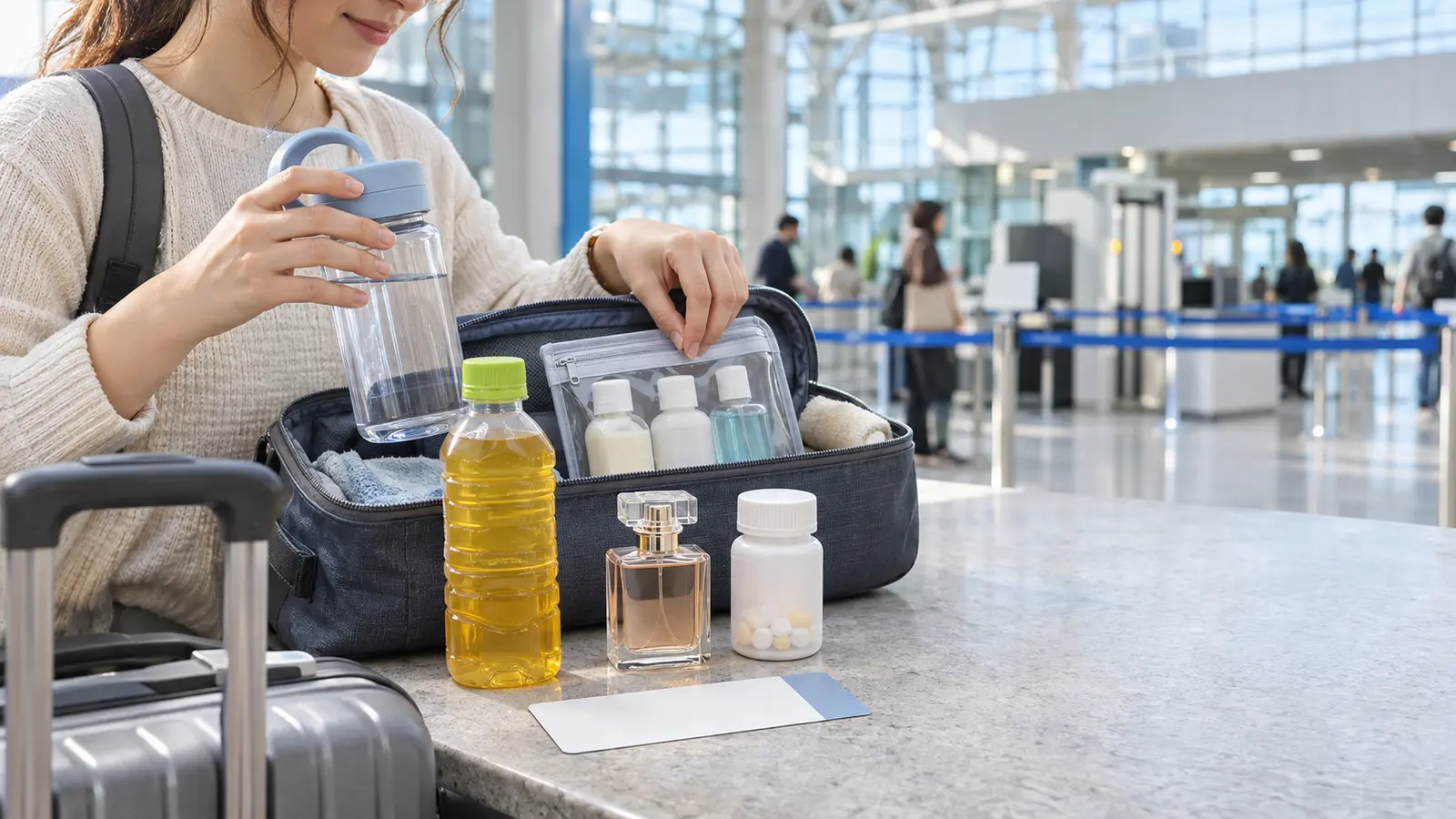
JAL says tea and other drinks may be carried in the cabin on domestic flights, including PET bottles bought before security, cans, glass bottles, flasks and tumblers. Peach also lists beverages such as tea as permitted in the cabin on domestic flights. This is the practical difference travelers most often miss when applying an international rule to a domestic terminal.
Security staff may still inspect a container, and leak prevention remains your responsibility. Keep a reusable bottle easy to remove, close it securely and do not put an open or leak-prone drink above another passenger's seat. ANA advises secure packing for liquid-heavy checked foods such as seafood and pickles.
Permission for an ordinary drink does not convert an unknown chemical, fuel, solvent or other dangerous liquid into baggage. When the product is not clearly a normal beverage, toiletry or medicine, use its safety data and ask the airline before arrival.
What to know
Cosmetics and medicine use a 0.5 L / 2 L framework
The current JAL, ANA and Peach domestic guidance permits non-radioactive toiletries and medicines in both carry-on and checked baggage when each container is no more than 0.5 kg or 0.5 L and the combined amount per person is no more than 2 kg or 2 L. The total is shared across the covered products rather than renewed for every bag.
The category includes common items such as skin lotion, perfume, shaving foam, hair products, nail products, hand sanitizer and some medicinal or disinfectant sprays. A half-empty one-liter bottle is still a one-liter container, so move only permitted products into compliant containers when the product can safely be decanted and correctly identified.
Medicine must not contain radioactive material under the cited domestic rules. Keep essential doses in the cabin, protect them from leaks and temperature damage, and retain the prescription label or medical documentation when it may help staff identify the product. Import rules for bringing medicine into Japan are separate from flight-security rules.
What to know
Alcohol depends on its strength
For domestic air transport, alcohol at 24% ABV or less has no dangerous-goods quantity limit under the reviewed JAL and ANA rules. Alcohol over 24% and up to 70% ABV is limited to 5 L per passenger in carry-on and checked baggage. ANA specifies retail packaging for this category.
Alcohol over 70% ABV is prohibited in both carry-on and checked baggage. Do not treat a sealed bottle, souvenir status or duty-free receipt as an exemption from that dangerous-goods ceiling.
Glass can break. JAL recommends carrying fragile glass bottles in the cabin, but cabin weight, item count and any stricter international-liquid rule still apply. Protect the bottle, confirm the airline's baggage allowance and do not open or consume your own alcohol unless the airline permits it.
What to know
Sprays, gels and unusual products need another check
Aerosol cosmetics and non-radioactive medicinal sprays can fit the same 0.5 kg or 0.5 L per-container and 2 kg or 2 L combined framework, but the valve must be protected against accidental release. ANA distinguishes these from sprays containing flammable or toxic gas, which can be prohibited.
Paste, gel, foam and semi-solid products may count as liquids under the stricter international cabin rule. Toothpaste, creams, shaving foam, perfume and aerosols should therefore be packed to the 100 ml standard whenever an international-terminal departure or onward international screening applies.
Products for sport, repair, cleaning or hobbies are not automatically toiletries. Paint, lubricant, varnish, waterproofing spray, fuel and some waxes can be dangerous goods. Find the exact product name, ingredients, hazard pictograms and safety data sheet, then ask the operating airline before the airport if the classification is uncertain.
What to know
International connections can undo a domestic packing plan
A bottle accepted through a domestic checkpoint can still fail at the next international security checkpoint. If the bag remains with you for an international connection, containers over 100 ml may have to be checked or disposed of unless a current exemption applies.
Do not assume that duty-free packaging, a domestic receipt or an unopened seal guarantees transfer through another country's screening. JAL warns that some liquid duty-free purchases can be lost at a later Japan security check, and the rules at the next country or airport can differ.
The safest through-itinerary plan is to pack cabin toiletries into containers of 100 ml or less inside one transparent resealable bag from the start, keep medically necessary liquids documented and place larger permitted items in checked baggage only after confirming through-checking, baggage deadlines and destination rules.
What to know
What to do when security questions an item
Stop and answer with the product's exact purpose and contents. Show the original label, prescription or safety data rather than describing an unknown liquid as harmless. The final transport decision belongs to the airline and security authorities for that flight.
If a permitted item is too large for the applicable cabin rule, ask whether it can be checked before bag drop closes. Remove anything prohibited from checked baggage, protect the container from leakage and pay any baggage charge shown for the booking. A low-cost carrier may not accept a late bag without a fee or after its deadline.
If the product cannot be carried or checked, use the airport's instructed disposal route. Do not hide it in another container, abandon it unattended or retry a different lane without disclosing the earlier decision. Replace ordinary toiletries after arrival when that is safer than risking the flight.
What to know
Checked November 7, 2026 — recheck the exact flight
This guide was checked on November 7, 2026 against current Japanese government, airport and airline pages. The domestic drink permission, toiletry and medicine quantities, alcohol bands and international-terminal caveat were current on that date.
Airlines can change pages, terminals and operating carriers, while security authorities can inspect an item individually. Recheck after a schedule, terminal or operator change and ask before travel about any medical, chemical or high-value liquid that cannot simply be replaced.
No universal baggage price is quoted because a checked-bag charge depends on the airline, fare, route, purchase time and channel. The amount and deadline shown in the current booking are the relevant terms.
If that does not work
Use the fallback.
- The itinerary does not show the terminal: open the airport and operating-airline departure pages or contact the airline; pack to the stricter 100 ml rule until confirmed.
- A domestic flight leaves from an international terminal: follow the international-terminal liquid instructions, including the 100 ml containers and transparent bag when required.
- A toiletry container is larger than 0.5 L: replace it with a compliant retail size or leave it; a partly filled oversized container does not solve the container limit.
- The combined toiletries and medicinal products exceed 2 L or 2 kg: reduce the amount or contact the airline about a necessary medical item before travel.
- The alcohol label is missing or unclear: do not pack it until the ABV and retail packaging can be verified.
- A spray has a flammable or toxic-gas warning: do not assume the cosmetic allowance applies; ask the operating airline with the exact product details.
- Security will not accept the item in the cabin: ask about checked baggage before the cutoff, then dispose of it through the instructed route if it cannot be checked.
- An international connection follows: keep medically necessary liquids documented and pack ordinary cabin liquids to the strictest checkpoint on the full itinerary.
Before you need it
Save this offline.
- Operating airline, flight number and departure terminal
- Domestic-only or international-conditions ticket status
- Onward connection and next security checkpoint
- Product names, container sizes and total toiletry/medicine quantity
- Alcohol percentage and retail packaging
- Prescription or medical documentation for essential liquids
- Safety data sheet for an unusual chemical or spray
- Checked-baggage purchase and bag-drop deadline
- Airline restricted-items page saved offline
Frequently asked questions
Liquids on Japan Domestic Flights: Drinks, Cosmetics and Medicine FAQ
Does the 100 ml liquid rule apply to domestic flights in Japan?
Usually not on an ordinary domestic flight from a domestic terminal. It can apply when the flight departs from an international terminal, uses international conditions of carriage or is followed by international screening. Check the exact itinerary.
Can I take a full water bottle through domestic airport security in Japan?
JAL and Peach permit ordinary drinks on domestic flights, and JAL includes bottles bought before security, cans, glass bottles, flasks and tumblers. The container may still be inspected, and different rules apply at an international checkpoint.
How much shampoo, lotion or perfume can I carry?
Under the reviewed domestic rules, each toiletry container must be no more than 0.5 kg or 0.5 L and the covered toiletries and medicines together must be no more than 2 kg or 2 L per person.
Can I carry liquid medicine on a Japan domestic flight?
Non-radioactive medicine is generally allowed within the domestic 0.5 L per-container and 2 L combined framework. Keep essential medicine accessible and documented, and contact the airline in advance for a necessary amount or product outside the ordinary rule.
Can I bring alcohol on a domestic flight in Japan?
Alcohol over 24% and up to 70% ABV is limited to 5 L per person; alcohol over 70% is prohibited. Alcohol at 24% or less has no dangerous-goods quantity limit under the reviewed rules, but baggage size, weight and connection rules still apply.
Do aerosols count as liquids?
Cosmetic and non-radioactive medicinal aerosols can be allowed within the 0.5 kg or 0.5 L per-container and 2 kg or 2 L combined limits with the valve protected. Flammable or toxic-gas sprays can be prohibited.
What happens to a large bottle on an international connection?
It can fail the next 100 ml checkpoint even if accepted on the domestic flight. Pack ordinary cabin liquids to the strictest checkpoint on the itinerary or place larger permitted items in checked baggage after confirming through-checking.
Can I check a liquid that security refuses in the cabin?
Sometimes, if the product is permitted in checked baggage and bag drop is still open. Dangerous goods can be prohibited from both places, and a baggage fee or cutoff may apply. Ask the operating airline before repacking.
Primary evidence
Official sources used
Open these pages again before travel. External links lead to the responsible Japanese authority or transport organization.