Do this now
Follow these steps in order.
- 01
Check the care label on every item. Keep hand-wash-only, dry-clean-only and no-tumble-dry garments out of an ordinary machine or heated dryer.
- 02
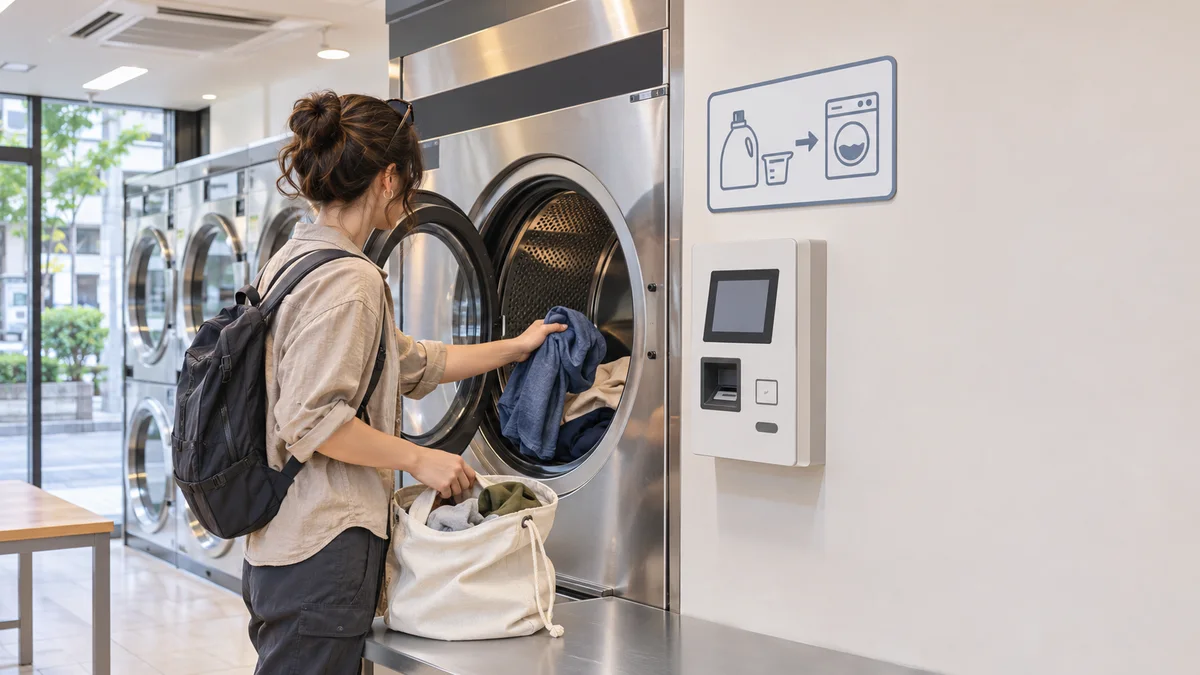
Read the store rules and the panel before loading. Identify whether the machine washes only, dries only or completes both steps, and note the stated capacity and prohibited items.
- 03
Inspect the empty drum, remove anything left inside, empty all pockets, close zippers and place small or delicate items in a laundry net if their labels permit machine washing.
- 04
Confirm the detergent instructions. Many modern laundromats add detergent and softener automatically, but older or different machines can require your own; do not add extra unless the panel says to.
- 05
Load loosely within the stated limit and close or lock the door exactly as shown. An overloaded or unbalanced drum may not wash, rinse or spin correctly.
- 06
Choose the course that matches the load, check the displayed total, then pay with an accepted method. Carry yen coins because cashless support is not universal.
- 07
Save the machine number and finish time, stay reachable and return before completion. Do not assume another customer or staff member will protect or leave finished laundry untouched.
- 08
Move items to a dryer only when their labels allow tumble drying. Choose the permitted heat, start with a shorter interval for unfamiliar fabrics and remove items as soon as they are dry.
- 09
Check the drum, door seal and folding area for every item before leaving. Follow the posted support instructions if the door, payment or cycle does not behave as shown.
What to know
Start with the garment label, not the available machine
A free machine is not proof that an item is safe to wash or dry in it. Japan's Consumer Affairs Agency explains that the wash-tub symbol sets the highest permitted wash temperature and treatment strength, while a crossed wash-tub means the item must not be washed by the indicated household process.
For drying, a square containing a circle is the tumble-dry symbol. Two dots permit a higher limit, one dot indicates a lower limit, and a crossed symbol means do not tumble dry. If you cannot confidently interpret a label, use the gentler hotel or professional-laundry alternative rather than testing the item with heat.
Separate obvious color-bleed risks, remove tissues, receipts and coins from pockets, and secure parts that can snag. WASHHOUSE's English instructions specifically warn against drying rubber materials and items with strings or metal fittings because they can melt or tangle.
What to know
Identify the machine and course before you pay
Japanese laundromats can place washer-only units, dryer-only units and washer-dryer combinations in the same room. A combined unit may offer washing and drying, washing only or drying only. Read the English menu if available and confirm the machine number before using a central payment terminal.
WASHHOUSE's English washer-dryer instructions show the usual sequence: load the laundry, select a course, lock the door, check the price, insert payment and remove the clothes after completion. The exact order can differ, so use the sequence printed on that machine rather than forcing a familiar routine from home.
Capacity is a safety and performance limit, not a target. WASHHOUSE warns that a small load in a very large washer can become unbalanced during spinning, while TOSEI warns that exceeding the rated capacity can worsen washing and drying and contribute to machine trouble. Choose a sensible drum size and load loosely.
What to know
Detergent may be automatic, but confirm it every time
WASHHOUSE states that detergent and softener are automatically added in its washer-dryer machines. AQUA's commercial-laundry guidance likewise says automatic dispensing is common, but notes that some older stores can require customers to bring their own products.
That means there is no safe universal instruction to pour detergent into every Japanese laundromat machine. Look for an automatic-dispensing notice or a clearly marked detergent compartment. If the machine supplies detergent, adding your own can create excess foam, poor rinsing or a stopped cycle.
Travelers with fragrance, skin or ingredient concerns should not assume the shop can substitute another product. Check the posted product information before paying, choose a machine or service that fits the requirement, or use a hand-wash or professional-laundry alternative.
What to know
Payment, price and change are store-specific
Some machines start after the displayed coin amount is inserted; others use a central terminal. WASHHOUSE's English guide describes coin payment and its own cashless app. TOSEI says its newer payment terminals can support cash, electronic money, prepaid methods and credit cards, but that is a manufacturer capability, not a promise that every store has enabled every method.
Check the symbols on the actual machine or terminal before loading irreplaceable clothing. Keep enough accepted yen coins for the wash and a possible additional drying interval. Do not assume that a nearby vending machine, convenience store or staff member must provide change.
Treat any published price as a store example rather than a national tariff. Machine size, course, time and location can all change the amount. The controlling price is the total displayed on the specific machine before you confirm payment.
What to know
Dry by the label and check in short intervals
Commercial dryers can be hotter and faster than the small machine in a hotel room. The Consumer Affairs Agency's current label guide distinguishes tumble drying up to the indicated high or low temperature from no tumble drying. A dryer being available does not override the garment label.
Remove no-tumble-dry items after washing and air-dry them in a place your accommodation permits. For an unfamiliar but dryer-safe item, use the allowed lower setting or a short paid interval and inspect it before adding time. Stop if rubber, adhesive, elastic, decoration or heat-sensitive material changes shape or smell.
A combined wash-dry course is convenient only when every item in the load is safe for both stages. If the load mixes dryer-safe clothes with line-dry items, choose washing only, remove the line-dry pieces, then transfer the remaining items to a dryer.
What to know
Return on time and keep the machine number
Record the machine number, start time and displayed remaining time. WASHHOUSE warns that another customer may remove finished laundry, and TOSEI advises collecting it promptly so the next customer can use the machine.
A completion call or app notification is useful only if the machine and store provide it and your phone can receive it. Set your own timer and return early. Do not leave passports, electronics, handbags or purchases in the laundromat while waiting elsewhere.
Before leaving, rotate the drum by hand only when it is safely stopped and unlocked, then check the door seal, drum and folding surface for socks and small items. Keep a clean bag separate from the bag used for dirty laundry.
What to know
Checked November 27, 2026 — the machine instructions control
This guide was checked on November 27, 2026 against the Consumer Affairs Agency's current care-label rules and official instructions from WASHHOUSE, TOSEI and AQUA. It describes common workflows but does not claim that every shop uses the same price, payment method, detergent, temperature, operating hours or support service.
Use the label on the garment and the instructions on the actual machine. If those instructions conflict with this guide, stop and follow the shop operator's current notice or contact the posted support number before paying.
Hotel guest laundries can have different access hours, room-key controls and payment rules from public laundromats. Ask the accommodation directly when its machine or house rules are unclear.
If that does not work
Use the fallback.
- The panel has no English menu: photograph the machine number and instructions, use a translation tool before paying, or choose a staffed laundry service.
- You cannot confirm automatic detergent: do not pour anything into the drum. Check the shop notice or call the posted operator first.
- Cashless payment is rejected: use a method explicitly shown as accepted, including the required yen coins, or choose another store; repeated attempts can create multiple holds.
- The machine will not start: confirm the door lock, course, machine number and full displayed amount, then use the posted support channel instead of forcing the door or controls.
- The cycle stops or the door stays locked: note the machine number and error, keep your receipt or payment record and call the posted operator. Do not pry the door open.
- A dryer-safe item is still damp: redistribute the load and buy a short additional interval only if the label still permits the selected heat.
- An item shrinks, smells hot or changes shape: stop using heat, remove it when safe, allow it to cool and follow the manufacturer's care instructions or a professional cleaner's advice.
- All machines are occupied: wait without blocking the aisle, use your accommodation's laundry if available, or choose another public laundromat rather than moving another customer's active load.
- You need washing the same day but cannot use the machines safely: ask the hotel about a laundry service, use a staffed wash-and-fold service, or hand-wash only items whose labels permit it.
Before you need it
Save this offline.
- Photo of each unfamiliar care label
- Laundromat name, address and operating hours
- Machine number and selected course
- Start time and displayed finish time
- Displayed price and accepted payment methods
- Whether detergent and softener are automatic
- Posted support phone number or QR code
- Photo of the machine panel before payment
- Accommodation rules for hanging wet clothing
- A clean bag for finished laundry
Frequently asked questions
How to Use a Coin Laundry in Japan: Payment, Detergent and Drying FAQ
Do Japanese coin laundries provide detergent?
Many modern machines dispense detergent and softener automatically, but not every shop or machine does. Read the actual panel before paying and do not add extra detergent when it is automatically supplied.
Can I pay by credit card or IC card?
Some modern central terminals support cashless methods, while many machines still require coins. Only rely on the payment logos shown at that store and carry accepted yen coins as a fallback.
How much does a coin laundry cost in Japan?
There is no national price. The store, machine capacity, course and drying time determine the amount. Check the displayed total on the specific machine before loading and paying.
Can I put all travel clothes in the dryer?
No. Check each care label. A crossed tumble-dry symbol means do not use a tumble dryer; one or two dots indicate the permitted temperature limit under Japan's label system.
Can I leave while the machine is running?
You may be able to leave the room, but keep the machine number and return before the cycle ends. Finished laundry may be moved, and personal belongings should not be left unattended.
What should I do if the washer door will not open?
Do not force it. Note the machine number and error, keep the payment record and follow the operator contact instructions posted in the store.
Can I wash shoes in a normal washer?
Do not put shoes in an ordinary clothing machine unless the store explicitly allows it. Some laundromats have separate shoe machines, but availability varies by location.
Can I wash a suitcase, sleeping bag or futon?
Only use a machine and course that explicitly permits the item and only when its care label allows the treatment. Large-item capability varies by store and machine.
What if I accidentally add detergent to an automatic-dosing machine?
Do not start another cycle or add more water on your own. Use the posted support channel, identify the machine and follow the operator's instructions.
Is a hotel coin laundry used the same way?
The basic workflow can be similar, but hotel machines may require a room key, a different payment method or restricted hours. Follow the hotel's own instructions.
Primary evidence
Official sources used
Open these pages again before travel. External links lead to the responsible Japanese authority or transport organization.