
Before you book
Make these decisions in order.
- 01
Choose nigiri or temari before checkout; both currently include maki sushi.
- 02
Ask Klook to confirm the actual toppings, allergens and any dietary substitution in writing before payment.
- 03
Open the selected package details for age, accessibility, inclusions, group size, cancellation and late-arrival rules.
- 04
Save the full S-PLAZA Yayoi II meeting instructions, floor or room and a screenshot of the voucher before leaving for Shinbashi.
What to know
This is a short activity, not a professional sushi course
Klook currently presents the experience as a 90-minute joined class in Shinbashi. The public description promises a choice between maki with temari and maki with nigiri, plus English- and Chinese-language support. That makes it easier to place before an afternoon in Ginza or an evening elsewhere in central Tokyo than a half-day market-and-cooking program.
The trade-off is depth. A 90-minute group booking must cover arrival, explanation, preparation or assembly, eating and cleanup. Do not assume it includes fish selection, knife skills, breaking down a whole fish, rice cooking from the first stage or professional restaurant technique unless those items appear in the package you select.
Treat it as an accessible introduction and a shared travel activity. Travelers seeking advanced instruction should ask for the precise lesson sequence or choose a longer specialist class.
What to know
Choose nigiri when technique is the main attraction
JNTO defines nigirizushi as a hand-moulded mound of seasoned rice with a topping placed over it. It is the form many international visitors picture first when they hear “sushi,” and Klook describes its nigiri course as the more recognisable of the two options.
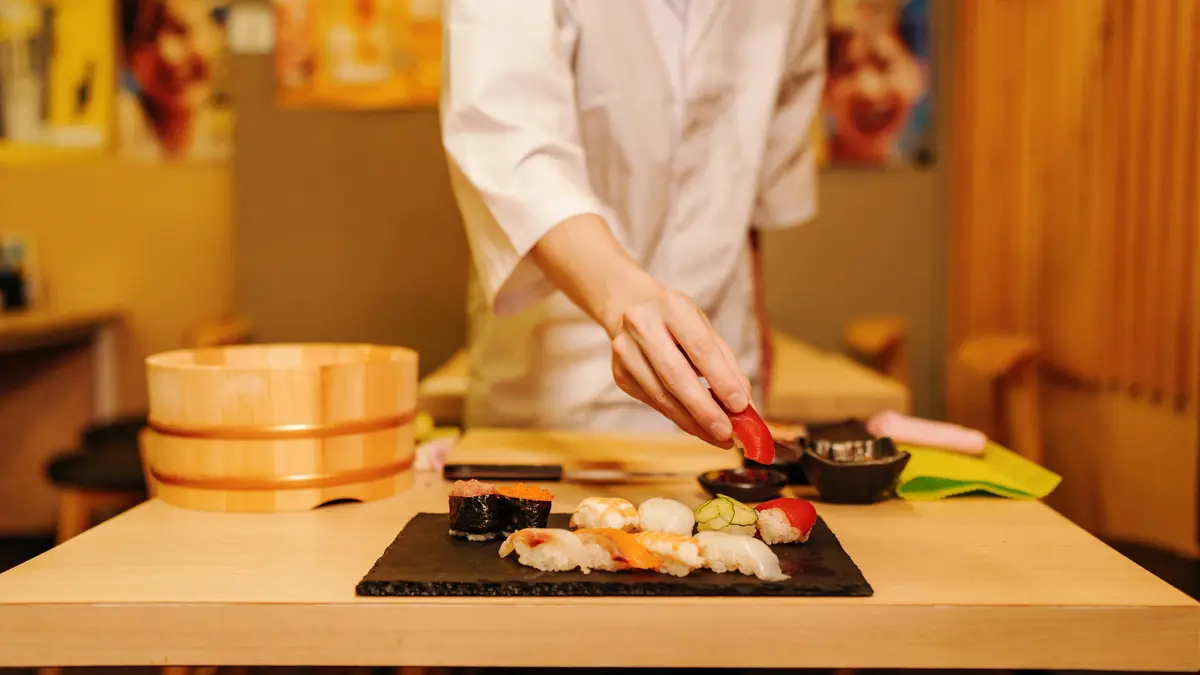
Choose maki plus nigiri when you want to practise forming individual pieces and handling the rice-and-topping balance. The class image shows an instructor placing a topping onto formed rice, but an advertising image does not guarantee the number, species or preparation of toppings in every session.
Ask whether the seafood is raw, cooked or mixed; whether the instructor demonstrates topping preparation; and how many pieces each participant makes. The answer determines whether the course suits a raw-fish concern or a learner who expects actual knife work.
What to know
Choose temari for decorative shaping and a softer first step
Temari sushi uses small, rounded portions of rice with toppings arranged over them. Klook calls this option easy to make and visually attractive. That makes it the more intuitive choice for travelers who care about presentation, photographs and a lower-pressure introduction.
“Easy” does not make the course automatically suitable for every child or mobility need. Participants may still handle food, work at a counter or table and follow a timed group demonstration. The public activity page does not currently state the minimum age, whether a child may work with an adult or whether every workstation is seated.
Families should request the child rule and the actual work-surface arrangement before payment. A child who can eat the result may not necessarily qualify for the booked participant category.
What to know
Both courses include maki, but the exact roll is not guaranteed
JNTO explains makizushi as toppings placed on rice and rolled tightly, traditionally with a bamboo mat. Both of Klook’s current package names include maki, so the meaningful choice is the second style—nigiri or temari.
The public listing does not publish the roll size, fillings, number of pieces or whether each guest independently rolls a complete portion. It also does not promise a particular inside-out, futomaki or thin-roll style.
Use the selected package description and voucher as the contract. If a specific filling, nori-free version or fully individual workstation matters, obtain confirmation rather than inferring it from gallery photographs or another reviewer’s session.
What to know
Do not treat a review as a vegetarian guarantee
One public Klook review says a vegetarian option was provided for that reviewer. This is useful evidence that a substitution has happened, but it is not a published package entitlement and does not establish that it is available on every date or for both courses.
Vegetarian, vegan, seafood-free and allergy-safe are different requirements. Sushi rice seasoning, soy sauce, dashi, mayonnaise, egg, fish roe and shared utensils can matter even when the visible topping is a vegetable.
Send Klook the exact excluded ingredients and ask the activity provider to confirm the complete menu, broth or seasoning, cross-contact procedure and whether the alternative still allows meaningful participation. Do this before buying a restrictive or non-refundable package.
What to know
Allergies need an ingredient answer, not a general reassurance
A sushi class can involve fish, shellfish, soy, wheat in ordinary soy sauce, sesame, egg and other session-dependent ingredients. Klook’s public overview currently gives no complete ingredient or allergen table.
Write the allergen and severity in plain English, include the Japanese ingredient name if available and ask whether the provider can prevent cross-contact at a shared workstation. “Can provide vegetarian food” does not answer a severe soy, sesame or seafood allergy.
If the reply is vague, choose an activity whose operator publishes a menu and allergy process. A booking platform’s live-chat response should be saved with the order, but it is not a substitute for medical advice or an emergency plan.
What to know
Raw seafood is a decision to make before checkout
The nigiri imagery includes seafood toppings, and sushi commonly includes raw fish, but the public package summary does not itemise what is served. Travelers who are pregnant, immunocompromised, very young, older or otherwise concerned about raw seafood should obtain advice appropriate to their circumstances and confirm the menu before booking.
Asking for “no raw fish” is not the same as ordering a vegetarian menu. Confirm whether cooked toppings, vegetables and separate utensils are available, and whether the substitute applies to both the maki and the second sushi style.
Do not carry uneaten class-made sushi around Tokyo unless the provider explicitly gives safe storage and takeaway instructions. The sensible default for a short hands-on session is to eat the prepared food during the activity.
What to know
The venue is in Shinbashi, not at a fish market
Klook places the class at S-PLAZA Yayoi II in Shinbashi. The activity is a meet-at-location workshop; the public listing does not advertise a Tsukiji market visit, ingredient-shopping walk, hotel pickup or restaurant crawl.
Shinbashi is a useful transport hub rather than a themed tourist complex. JR East, Tokyo Metro, Toei Subway and Yurikamome serve the wider station area. The Ginza Line station is G08 and the Toei Asakusa Line station is A10.
Different operators use different concourses and exits. Navigate to the exact building from the line on which you arrive, not merely to “Shinbashi Station,” and allow time for street-level orientation.
Compare the selected package
Check live packages and the total price for your date.
Use the same date, guests and included services when comparing Klook with the operator’s official page or direct booking option. Choose the better complete price, change, late-arrival and cancellation terms for your trip.
Check the Shinbashi sushi-making class on Klook↗Paid link. Commercial details checked July 26, 2026; availability and terms can change.What to know
Save the building floor and room from the voucher
The public Klook header names S-PLAZA Yayoi II but does not expose a floor, room or reception procedure in the text available without selecting a session. A multitenant building name alone is not enough to find a time-sensitive class.
After booking, confirm the street address, Japanese building name, floor, room, entrance photograph and contact method. Screenshot those details because mobile reception can fail inside stations or lifts.
If the voucher and map pin disagree, ask Klook before travel. Do not choose a floor from an old review or unrelated business listing in the same building.
What to know
English support is published, but the session remains joined
The current listing advertises staff fluent in English and publishes Chinese and English as activity languages. That supports basic international participation, but it does not mean the class is private, that every instructor is equally fluent or that all written ingredient information is available in both languages.
A joined class moves at the group’s pace. Ask about private arrangements before booking if you need repeated interpretation, one-to-one physical assistance or a different teaching speed.
Arrive early enough to check in without interrupting the introduction. The public page does not state a late-entry promise, so assume that missing the start can reduce or end participation unless Klook confirms otherwise.
What to know
Children and accessibility are not sufficiently published
Klook’s public summary available during this review does not state a minimum age, child-ticket definition, wheelchair access, seating arrangement or accessible restroom. Those are essential booking questions, not details to resolve after arrival.
Ask whether the route from the street to the room is step-free, whether the lift serves the correct floor, whether work can be done seated and whether a companion needs a paid place. Station accessibility does not establish venue accessibility.
Parents should also ask about hot surfaces, sharp tools and whether one adult can supervise while completing their own portion. Do not infer suitability solely from the word “easy” in the temari description.
What to know
Optional drinks are separate from the core class
Klook says sake, shochu and other beverages can be added as options. It does not publish the current drink list, quantity, price, tasting format or inclusion in the base package on the public overview.
Japan’s legal drinking age is 20. Anyone planning an alcohol add-on should confirm age verification, identification, price and whether the drink is consumed during or after food preparation.
A beverage add-on does not turn the class into a guided sake tasting. Choose a dedicated tasting when instruction about breweries, regions and styles is the main goal.
What to know
Photography permission has two separate layers
A cooking class is naturally photogenic, but permission to take personal images is separate from permission to film other participants, instructors or the venue for commercial publication. The public Klook overview does not publish a filming policy.
Ask before setting up a tripod, light, microphone or live stream. Creators should disclose the channel, equipment, intended use and whether identifiable guests will appear.
Keep food handling safe and the shared timetable moving. A paid class ticket does not grant a location release, model release or exclusive access.
What to know
Cancellation and inclusions appear only after package selection
Klook’s public page requires a date and package selection before the complete booking flow. During this July 26, 2026 review, the accessible overview did not publish a reliable cancellation cutoff, complete inclusions, participant ages or no-show rule for the two active packages.
Open the package details after choosing the real date. Check confirmation timing, cancellation in Japan time, rescheduling, minimum participants, what happens if the provider cancels and whether ingredients, equipment, drinks and the food you eat are included.
Save the final conditions and voucher. A cancellation label shown on another Tokyo cooking class, an old review or a secondary reseller does not control activity 122869.
What to know
Final booking sequence
First, decide whether this compact joined format is more useful than a longer market or professional-technique class. Second, select nigiri for the familiar hand-pressed form or temari for decorative rounded pieces; both active options currently include maki.
Before payment, obtain written answers for ingredients, raw seafood, allergies, vegetarian or vegan requirements, child eligibility, accessibility, language needs and photography. Then read the selected package’s exact inclusions and cancellation rule.
After booking, save the Shinbashi building, floor, room, entrance and contact instructions offline. Packages, menus, timings and terms can change after this July 26, 2026 review, so reopen the voucher before travel.
Compare a related booking
Akihabara Nikuya Yokocho Guide: Which Wagyu Yakiniku Course Should You Book?
Compare this hands-on 90-minute class with an Akihabara all-you-can-eat yakiniku booking when your priority is a meal rather than learning a food-making technique.
A good fit
Put it on your list if...
- First-time sushi makers wanting a short central-Tokyo activity
- Couples, friends or solo travelers comfortable in a joined group
- Visitors deciding specifically between nigiri and decorative temari
- Travelers who want an indoor activity near Shinbashi and Ginza
- English-speaking guests whose dietary and access needs have been confirmed
Think twice
Skip or reconsider if...
- Travelers expecting a fish-market tour or whole-fish knife lesson
- Anyone with an unconfirmed severe allergy or dietary substitution
- Families without a confirmed minimum age and supervision arrangement
- Guests needing step-free access or seated work without written confirmation
- Creators assuming an ordinary ticket grants commercial filming permission
Booking option
Check the current ticket before paying.
The paid link opens Klook’s English activity 122869 page in USD without fixing a date, package or participant count. Select the actual session, then verify all package details before payment.
- Choose Maki + Nigiri or Maki + Temari; do not rely on the gallery to select the course.
- Confirm the exact ingredients, raw seafood, allergens and every requested dietary substitution in writing.
- Check participant ages, group size, language, accessibility, inclusions and late-arrival rules.
- Read the selected package’s cancellation, rescheduling, provider-cancellation and no-show terms.
- Save the complete S-PLAZA Yayoi II meeting instructions, including the correct floor or room.
Evidence and commercial terms
Sources checked
Government and operator or venue pages establish rules and practical details. Booking-service pages are commercial sources for the package and checkout terms only. Open the relevant sources again before travel.