Before you book
Make these decisions in order.
- 01
Confirm that repeated hammering, heat, sharp tools and standing workshop tasks are suitable for every participant.
- 02
Read the latest Klook message before departure because the assigned Sakyo Ward studio can change.
- 03
Protect at least three hours for the activity plus the full journey from central Kyoto and a schedule buffer.
- 04
Confirm checked-baggage, airline, transit-country and destination import rules before paying.
- 05
Compare the exact Klook package with Studio JIN’s direct booking, including price, wooden-handle options and cancellation terms.
What to know
This is a working craft session, not a blacksmith show
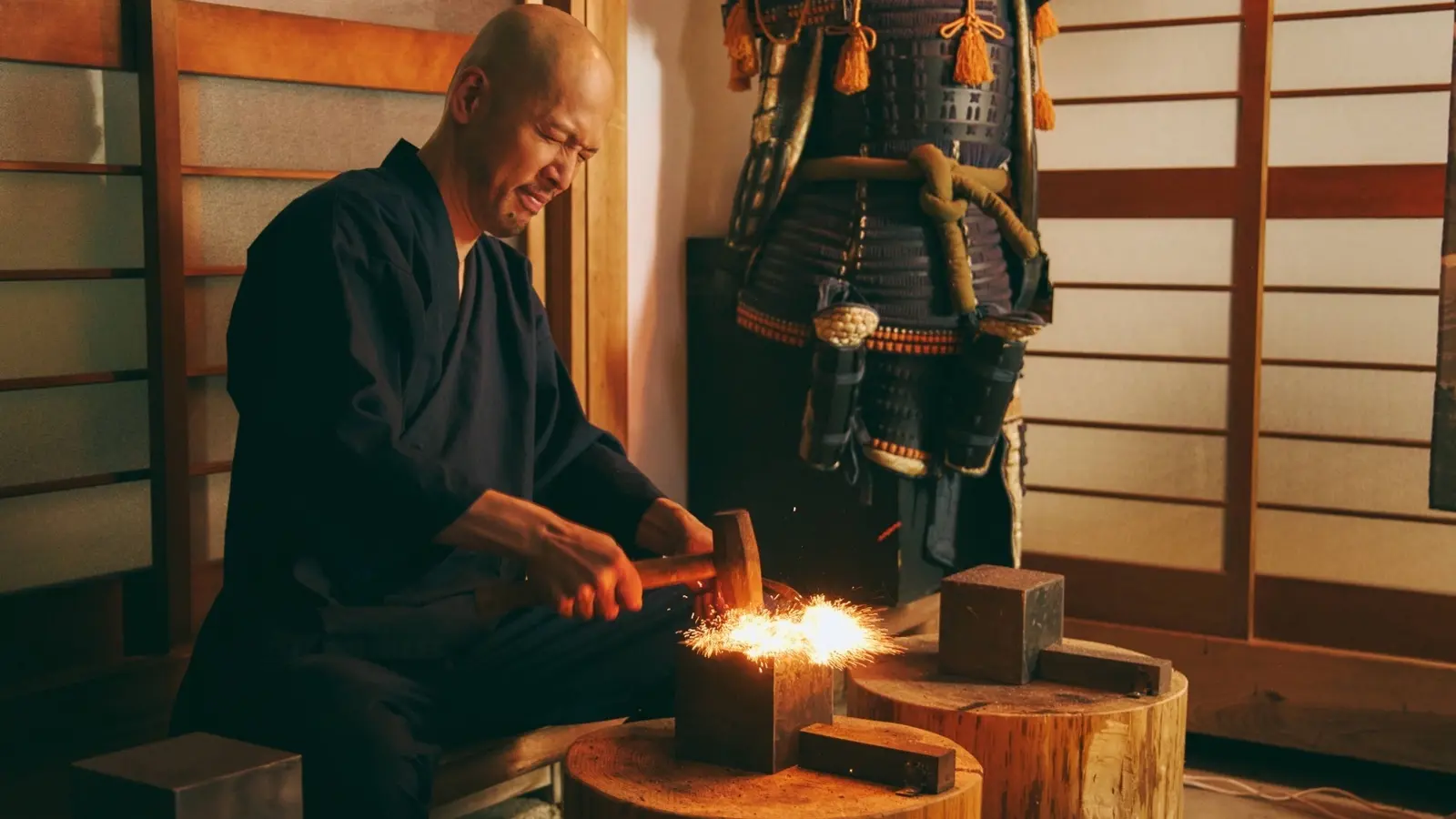
Studio JIN’s experience is built around doing the work yourself. The operator describes changing into traditional attire, learning the tools, heating and forging iron, then sharpening and polishing the result. The central task is repeated hammering of heated metal. Instructors guide beginners, but the finished object comes from a physical workshop rather than a staged photo session.
The current Klook package produces a practical knife approximately 13–15 cm long. Because every piece is handmade, the final dimensions and appearance vary. The operator uses an iron handle as the standard design, so do not expect the familiar wooden handle of a retail Japanese chef’s knife.
That distinction is the reason to book. You are paying for guided participation, the story of transforming raw material and a knife you helped make. If your main goal is simply to own the best kitchen knife for the money, visiting a specialist retailer may offer more sizes, steels and handle choices.
What to know
What the shorter knife format means
Klook explains that an ordinary full-size cooking knife would normally require more than five hours in this format and cost more than US$400. The listed workshop shortens the process to roughly two and a half hours by making a smaller knife. This is an introductory, practical forging experience—not a full professional bladesmithing course.
The smaller format does not make it decorative. Klook presents the finished piece as a usable knife, and the process includes sharpening. Treat it as a sharp tool from the moment the instructor hands it over. Ask how to protect the edge, prevent rust and care for the iron handle before leaving the studio.
The operator’s own page says a wooden handle can be requested as a ¥5,000 optional upgrade. The current Klook description, however, says the package has no wooden handle. Do not assume the direct-booking upgrade can be added to a Klook reservation; ask Studio JIN before paying if the handle material is important.
What to know
Allow more than the headline duration
Klook displays a three-hour duration while the listing text describes a two-and-a-half-hour experience. Use three hours as the minimum protected workshop block, then add travel and a buffer. Handmade work can progress at different speeds, and a tight dinner, train or flight connection would turn a valuable session into a rush.
From central Kyoto, reaching Yase requires getting to Demachiyanagi and taking the Eizan Line toward Yase-Hieizanguchi. The operator places the usual studio around one minute from that station, but the train journey is only part of the transfer. Hotel-to-station navigation, waiting, ticketing and the return trip all belong in the itinerary.
A realistic plan is one major workshop plus one nearby or central-Kyoto activity, rather than treating this as a quick addition between temples. Avoid booking it on departure day. You need time to finish, secure the sharp knife, return to the hotel and place it in checked luggage.
What to know
The studio can change after booking
The current Klook listing says the usual meeting point is Studio NIN Yase at 168-1 Yasenosecho, Sakyo-ku. It also says the operator runs two forging workshops with the same facilities and experience. Depending on reservations, a session may move to another Studio NIN location in Sakyo Ward.
The operator’s site lists both the Yase Studio and a Shugakuin Studio at 16 Shugakuin Daidocho. Klook calls the possible alternative “studio NIN Kendo.” Because naming can differ between the marketplace and operator pages, do not choose an address by matching names yourself.
The advance message is the authority for your session. Check Klook chat, email and any operator message the evening before and again before departure. Save the final address and map offline. If no location message is clear, contact the operator rather than automatically traveling to Yase.
- Default shown by Klook: Studio NIN Yase.
- A second Sakyo Ward workshop may be assigned.
- Use the final address sent for your booking.
- Allow enough time to reroute if the message arrives close to the date.
What to know
How to reach the usual Yase studio
Eizan Railway’s official English guide says its Eizan Line runs 5.6 km from Demachiyanagi to Yase-Hieizanguchi. Most trains for Yase-Hieizanguchi leave from platform 1 at Demachiyanagi, but some services terminate earlier. Read the destination display rather than boarding solely by platform number.
The checked adult fare from Demachiyanagi to Yase-Hieizanguchi is ¥280. IC cards are accepted: at stations other than Demachiyanagi, touch the reader before boarding and again when leaving. The operator describes Studio JIN’s Yase address as about one minute from the station.
Eizan Railway is not covered by the Japan Rail Pass. From Kyoto Station, you still need a connection to Demachiyanagi before the Eizan segment. Check the live timetable and service status on the day, particularly after severe weather.
What to know
Heat, hammering and accessibility questions
The operator calls the session beginner-friendly and says every step involving hot iron and sharp tools is carefully guided. Beginner-friendly does not mean physically effortless. Repeated hammering requires grip, arm and shoulder work, and the forge adds heat to the environment.
Studio JIN does not publish a complete English accessibility specification for this knife workshop. Before booking, contact the operator if a participant has limited grip, an arm or shoulder injury, heat sensitivity, a medical condition affected by exertion, or needs step-free access, seating or another accommodation. Ask about the exact assigned studio because layouts can differ.
Wear clothes and closed shoes suitable for an active workshop, unless the operator gives different instructions for your package. Tie back loose hair and follow every direction around the forge, grinder and sharpened blade. Do not consume alcohol before handling hot metal and sharp tools.
What to know
Children and photography need advance confirmation
The operator’s official page says children under 15 must be accompanied by a parent or guardian. That statement does not by itself confirm that every age can perform every task or that Klook will sell a participant place for a young child. Enter the actual age and ask the operator what the child can safely do before purchasing.
The official workshop page says video and photography consultations are available on request. That is not an automatic promise that an instructor can film continuously or that commercial production is included. Solo creators who need footage should ask who may record, where equipment can stand and whether monetized use requires permission.
Keep cameras and phones away from the active forging area unless staff approve their position. The workshop result matters more than capturing every strike, and sparks, heat and moving tools are poor conditions for unattended equipment.
What to know
Do not carry the finished knife loose in Japan
A handmade knife is both a souvenir and a regulated sharp object. Tokyo Metropolitan Police guidance explains that carrying a knife without a legitimate reason can be restricted even when the blade is not longer than six centimeters, particularly when it is concealed and readily usable. Transporting a newly made knife home is different from carrying it casually for self-defence or convenience, but it should remain boxed, wrapped and inaccessible.
JR Central states that knives are not allowed on trains unless packaged so they cannot harm other passengers. Keep the studio’s protective packaging intact, place the knife inside closed luggage and return it directly to secure storage. Do not open, display or use it in public, and do not keep it in a pocket or day bag while sightseeing.
Ask the studio for a receipt or workshop confirmation and retain it with the packaging. This guide is practical travel planning, not legal advice; if your itinerary involves unusual onward transport, ask the relevant operator or authority before moving the item.
Compare the selected package
Check live packages and the total price for your date.
Use the same date, guests and included services when comparing Klook with the operator’s official page or direct booking option. Choose the better complete price, change, late-arrival and cancellation terms for your trip.
Check Kyoto knife-making availability on Klook↗Compare Studio JIN’s official workshop and direct terms ↗Non-affiliate link
Paid link. Commercial details checked July 26, 2026; availability and terms can change.What to know
Flying home requires checked baggage and an import check
Do not take the finished knife to an airport security checkpoint in cabin baggage. The US Transportation Security Administration lists knives as prohibited in carry-on bags and permitted in checked bags when sheathed or securely wrapped. UK government guidance similarly places sharp or pointed knives outside hand luggage and advises checking hold-baggage acceptance with the airline.
Place the wrapped knife inside checked luggage where it cannot injure baggage handlers or inspectors. Then verify the actual airline’s rules, every transit airport and the import law of the final country. A connection can introduce another jurisdiction even when the knife never leaves the airport.
Carry-on-only travelers face a real decision: buy checked baggage for the flight, arrange a lawful shipment with the operator, or choose a different experience. Do not book on the assumption that airport staff will make an exception for a handmade souvenir.
- No cabin baggage.
- Use the studio’s sheath, box or secure wrapping.
- Pack it inside checked luggage, not an outside pocket.
- Check the airline, transit airports and destination import rules.
- Keep proof of the workshop and purchase with your travel documents.
What to know
Compare Klook and direct booking without mixing the rules
The Klook page displayed US$145.99 for the Knife-making Class when checked on July 26, 2026, but price, currency conversion and availability are dynamic. Select the real date and number of participants, then read the final total and cancellation conditions before paying. This guide does not promise that checked price.
Studio JIN’s direct-booking legal notice offers a full refund when cancellation is made more than 24 hours before the local start time, with no refund or changes inside 24 hours. Those are the operator’s direct-sale terms. A Klook purchase is controlled by the conditions attached to the selected Klook package, which may differ.
Compare the same experience, language, start time, studio communication, inclusions, handle option, cancellation cutoff, support channel and final price. Choose Klook when its package and support fit; choose direct when the operator’s option or terms are better. Save the confirmation, location message and baggage plan offline either way.
What to know
Who should book—and who should choose another Kyoto craft
This is strongest for travelers fascinated by making, tools and the labor behind Japanese blades. Couples, adult families and solo travelers can leave with a shared story and a useful object that cannot be replicated by buying a generic souvenir. The quieter northern-Kyoto location also creates a different rhythm from a crowded central attraction.
Choose another craft workshop if repeated hammering, forge heat or a sharpened finished object creates stress. A ring, textile, ceramics or food workshop is easier for a carry-on-only itinerary and can still offer guided participation. The knife workshop is not better simply because it costs more; it is better only when the physical process and finished object fit the traveler.
The final booking test is simple: can every participant do the work safely, reach the assigned studio without rushing, and legally transport the knife home? If all three answers are yes, Studio JIN can become one of the most personal experiences in a Kyoto trip.
A good fit
Put it on your list if...
- Travelers who want an active, hands-on Kyoto craft rather than a demonstration
- Knife, cooking, metalwork and traditional-craft enthusiasts
- Couples, adult families and solo travelers who value a one-of-a-kind souvenir
- Visitors comfortable reserving half a day for northern Kyoto
- Travelers flying with checked baggage and a confirmed import plan
Think twice
Skip or reconsider if...
- Carry-on-only travelers with no lawful shipping or checked-baggage solution
- Anyone with arm, shoulder, grip or heat limitations who has not consulted the operator
- Travelers expecting a full-size wooden-handled chef’s knife in the standard Klook package
- A departure-day schedule or a tightly timed train connection
- Creators assuming ordinary participation includes commercial filming support
Booking option
Check the current ticket before paying.
The paid link opens Klook’s English activity 138405 page with USD selected. The displayed price, package terms, studio assignment and availability can change.
- Select the real date and number of participants before comparing the final price.
- Use the cancellation and change rules attached to the selected Klook package.
- Read the operator’s location message because a second Sakyo Ward studio may be assigned.
- Confirm physical, age and accessibility questions with the operator before paying.
- Arrange checked baggage and verify airline, transit and destination import rules.
Evidence and commercial terms
Sources checked
Government and operator or venue pages establish rules and practical details. Booking-service pages are commercial sources for the package and checkout terms only. Open the relevant sources again before travel.