Before you book
Make these decisions in order.
- 01
Send JAPANKART your licence country and exact permit or translation type before booking.
- 02
Choose the Kanda or Shinjuku package by route and duration, then save the matching branch address.
- 03
Read the selected Klook package’s cancellation, weather, document and late-arrival terms before payment.
- 04
Arrive at least ten minutes early with every original document; a booking voucher does not prove legal eligibility.
What to know
One Klook page sells two different Tokyo routes
Klook’s activity page combines a two-hour package from JAPANKART’s Kanda shop with a 90-minute package from its Shinjuku shop. Both are promoted around Shibuya, but the remaining districts, meeting point and total commitment are different.
The Kanda package is the broad central-Tokyo route. The operator lists the Imperial Palace, Chidorigafuchi, the National Diet, Omotesando, Shibuya Crossing, Roppongi, Tokyo Tower and Tokyo Station. The Shinjuku package stays in west Tokyo, passing Harajuku, Omotesando, Shibuya Crossing, Yoyogi Park, the Tokyo Metropolitan Government area and Kabukicho.
Treat the package selector as a route decision, not a choice between two departure times. A traveler who buys “Shibuya” and then navigates to the wrong branch can lose the whole booking.
What to know
Choose Kanda for the widest landmark route
The Kanda plan is the better match when Tokyo Tower is a priority or you want a single drive to connect several visually different parts of central Tokyo. JAPANKART estimates about 120 minutes of driving, plus a safety briefing and photo sharing, so reserve roughly two and a half hours at the venue.
The current operator guide describes a restroom break around Tokyo Tower. Traffic, road restrictions and operations can change the order, viewing angle and duration, so this is not a promise of a sightseeing stop at every named landmark.
The longer route also means more time exposed to heat, cold, rain, road noise and dense traffic. Choose it for breadth, not merely because a longer package appears to offer better value.
What to know
Choose Shinjuku for a shorter west-Tokyo loop
The Shinjuku route concentrates on districts many first-time visitors already associate with Tokyo: Harajuku, Omotesando, Shibuya and Kabukicho. JAPANKART estimates about 90 minutes of driving and roughly two hours on site after the briefing and photo process.
The operator’s route guide places a short break near Yoyogi Park. Friday and Saturday evenings may face heavier congestion, while daylight and night departures create different visibility and weather conditions. Neither time guarantees a particular traffic flow.
This package suits travelers based around Shinjuku and those who do not need Tokyo Tower or the Imperial Palace on the route. Shorter does not mean closed-course, low-risk or suitable for a nervous driver.
What to know
Shibuya Crossing is not the only decision
JAPANKART lists Shibuya Crossing on both routes. The practical choice is therefore the surrounding itinerary: Kanda adds central and southern landmarks, while Shinjuku adds the west-side entertainment districts and a shorter return.
You drive past places as traffic permits; this is not a hop-on tour and it does not include independent sightseeing time at Shibuya. Pedestrians, signals and the guide’s formation take priority over photographs.
If your only goal is a clear photograph of the crossing, a pedestrian viewpoint is simpler and safer. Book the kart for the driving experience and route atmosphere, not for a guaranteed unobstructed image.
What to know
For many visitors, only a 1949 Geneva IDP is accepted
Tokyo Metropolitan Police says Japan recognizes qualifying international driving permits issued under the 1949 Geneva Convention. A permit issued only under the 1968 Vienna Convention is not valid for driving in Japan.
For many visitors from the United States, United Kingdom, Canada and Australia, the usual document set is the original national driver’s licence, an original 1949 Geneva Convention international driving permit issued by an authorized body in the licence country, and the driver’s passport. An online card marketed as an “international driver’s licence” is not automatically a legal permit.
The permit must remain within its own validity period, and Japan also limits the driving period by the traveler’s entry history. Bring the physical originals. Photographs, scans and digital-only permits do not replace them.
What to know
Some licences use an authorized Japanese translation instead
Japan provides a separate route for licences from specified jurisdictions when the driver carries the original licence, an authorized Japanese translation and a passport. Tokyo police currently lists Belgium, Estonia, France, Germany, Monaco, Slovenia, Switzerland and Taiwan, subject to the applicable legal conditions.
JAPANKART’s current dedicated licence page lists Switzerland, Germany, France, Taiwan, Belgium, Slovenia and Monaco, while other operator pages display a slightly different list. Because the operator material is not fully consistent, use the police rule as the legal source and ask JAPANKART to confirm the exact papers it will accept at check-in.
Do not infer eligibility from nationality or passport alone. Licence-issuing jurisdiction, translation issuer, entry history and the original documents all matter. A Klook order does not validate any of them.
What to know
The branches are in Kanda and Shinjuku—not at the headline landmarks
The Kanda shop is at 42 Kandahigashimatsushitacho, Chiyoda City. The operator places it about three minutes from Tokyo Metro Kanda Station Exit 3 and five minutes from JR Kanda Station’s East Exit. Reception is on the second floor, with the garage on the first.
The Shinjuku shop is on the third floor of 5-11-23 Shinjuku, Shinjuku City. JAPANKART describes it as about five minutes from Shinjuku-sanchome Station Exit C7 and roughly ten minutes from JR Shinjuku Station’s East Exit, in a white building with a bakery on the first floor.
Use the final Klook voucher as the transaction record and reconcile any address mismatch with JAPANKART before travel. Save the precise branch pin offline and arrive at least ten minutes before the stated start.
Compare the selected package
Check live packages and the total price for your date.
Use the same date, guests and included services when comparing Klook with the operator’s official page or direct booking option. Choose the better complete price, change, late-arrival and cancellation terms for your trip.
Compare JAPANKART Kanda and Shinjuku packages on Klook↗Check route and licence details on JAPANKART’s official site ↗Non-affiliate link
Paid link. Commercial details checked July 26, 2026; availability and terms can change.What to know
This is real driving on public roads
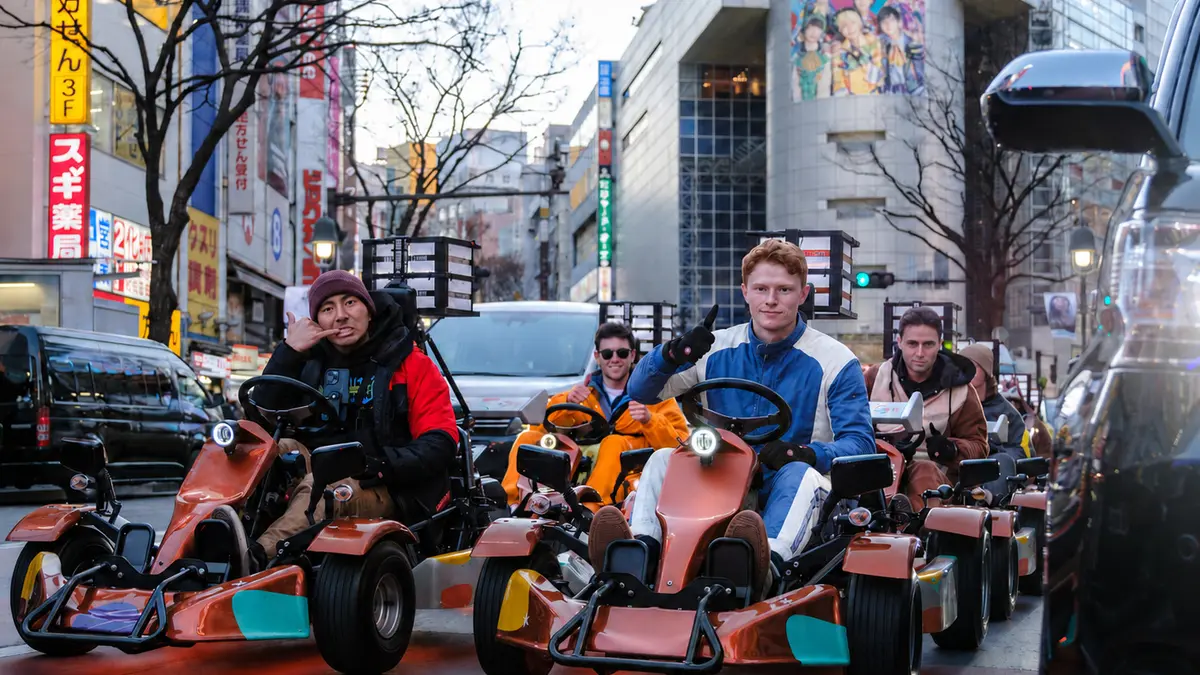
Each participant operates a low, single-seat kart in ordinary traffic. JAPANKART uses a lead vehicle and rear support vehicle, but the formation does not remove the driver’s responsibility to obey lights, lanes, pedestrians and Japanese road law.
Japan drives on the left. The low, open vehicle makes buses, road spray, surface changes, wind and temperature more immediate than they are in a car. Do not use this activity to discover whether you can remain calm in unfamiliar dense traffic.
Never join after alcohol, impairing medication or inadequate sleep. Keep a buffer before any non-changeable train, flight, restaurant or show because traffic can alter the return time.
What to know
Dress for control, weather and the low seating position
JAPANKART requires drivers to be at least 18 and recommends secure shoes and practical clothing. Avoid heels, sandals, skirts and loose garments that could obstruct the pedals or steering. Ask before booking if mobility, joint movement or getting into a low seat may be difficult.
The operator does not publish a strict height or weight limit, but its current route guidance warns that drivers above about 190 cm can feel cramped and that kart performance may be reduced above 100 kg. Those are fit warnings, not guaranteed cutoffs; request individual confirmation.
Open-kart weather is part of the product. Summer heat, winter wind and wet roads can materially change comfort and visibility. The operator says it provides seasonal jackets or rain gear in some conditions, but travelers should still dress for the forecast.
What to know
Use the guide’s photographs instead of handling a phone
JAPANKART includes route photographs and lists smartphone or action-camera holders among its equipment. A holder is not permission to touch or watch a device while driving.
Set an operator-approved camera before departure and follow staff instructions throughout. Never hold a phone, adjust a camera in motion or chase a shot by leaving the formation. Traffic safety matters more than footage.
Costume availability is a recreational extra, not a historical or character guarantee. Creators planning sponsored, commercial or equipment-heavy filming should obtain written production permission rather than assuming an ordinary participant ticket covers it.
What to know
Compare the complete package price, not the first USD figure
JAPANKART’s detailed guides published historical direct prices of ¥20,318 for the Kanda route and ¥18,428 for the Shinjuku route, tax included, stated as of August 2025. These are useful only as dated reference points, not current-price promises for a July 2026 booking.
Klook’s displayed amount changes with package, date, participant count, currency and promotion. Complete the package selection before comparing totals, and check whether the final order names Kanda two hours or Shinjuku 90 minutes.
Value depends on the route you want and your ability to participate legally. A discounted non-refundable kart booking is not a saving if the driver arrives at the wrong branch or presents an invalid permit.
What to know
Cancellation and rain rules depend on where you pay
JAPANKART’s direct licence page currently states that direct bookings can receive a full refund when cancelled at least 24 hours before the start, while cancellations inside 24 hours are non-refundable. It also describes refund or rescheduling options when severe weather prevents operation.
A Klook booking follows the reseller conditions shown for the selected package at checkout. Do not transfer the operator’s direct-booking rule to a Klook order. Save the exact cancellation deadline in Japan time and the weather contact process from the final voucher.
Light rain may not cancel the activity. If you do not want to drive on wet roads, resolve that before the deadline rather than assuming personal discomfort produces a refund.
What to know
Final booking sequence
First, obtain written confirmation that every driver’s original licence set is accepted. Second, choose Kanda for the 120-minute central-Tokyo route or Shinjuku for the 90-minute west-Tokyo route. Third, verify the branch, start time, total price and cancellation terms before paying.
On the day, bring the passport, original national licence and the accepted original permit or translation. Wear secure shoes, arrive at least ten minutes early, store large bags where staff directs and follow the full safety briefing.
Routes, schedules, prices and conditions can change after this July 26, 2026 review. Recheck the operator and selected Klook package before completing the order.
Compare a related booking
JAPANKART East Tokyo Guide: Asakusa, Tokyo Bay or Akihabara?
Compare the Shibuya-focused Kanda and Shinjuku routes with JAPANKART’s separate East Tokyo options for Asakusa, Akihabara and Tokyo Bay.
A good fit
Put it on your list if...
- Confident licensed drivers who have verified every original document
- Travelers choosing a specific Tokyo route rather than a generic kart image
- Small groups comfortable driving individually in ordinary city traffic
- Creators satisfied with operator photographs or a pre-approved hands-free camera
Think twice
Skip or reconsider if...
- Anyone with an unverified, digital-only or Vienna Convention permit
- Nervous drivers or visitors uncomfortable with left-side urban traffic
- Travelers expecting stops or independent sightseeing at every landmark
- Anyone who cannot tolerate open-air heat, cold, rain or a low seat
- Tight itineraries with no buffer for check-in or traffic delays
Booking option
Check the current ticket before paying.
The paid link opens Klook’s English activity 109089 page with USD selected and no fixed date. Verify your driving documents with JAPANKART before choosing the Kanda or Shinjuku package.
- Kanda and Shinjuku are separate meeting points with different routes and durations.
- Every driver must bring the accepted original licence set and passport.
- The selected Klook package’s cancellation and weather terms control the reseller order.
- Arrive at least ten minutes early; late or document-refused guests may be unable to join.
- Traffic and operations can alter the route, landmark views and return time.
Evidence and commercial terms
Sources checked
Government and operator or venue pages establish rules and practical details. Booking-service pages are commercial sources for the package and checkout terms only. Open the relevant sources again before travel.