Before you book
Make these decisions in order.
- 01
Send your issuing country and exact licence or permit type to JAPANKART for confirmation before paying.
- 02
Select the one- or two-hour package by its route and shop; the sales-page headline does not describe both options equally.
- 03
Save the meeting point from the final voucher and reconfirm it with the operator because published branch information is not fully consistent.
- 04
Read the Klook package’s cancellation, late-arrival, weather and document-refusal terms before accepting the booking.
What to know
The Klook headline combines two different East Tokyo experiences
Klook currently presents this activity under one Tokyo Bay, Ginza and Akihabara headline, but the live package selector has two distinct choices: a two-hour tour from the Asakusa branch and a one-hour tour from the Skytree branch.
Do not assume the shorter package reaches Tokyo Bay or Ginza. JAPANKART’s official route pages describe the one-hour option as an Akihabara, Ueno, Kappabashi, Asakusa and Tokyo Skytree loop. The wider waterfront and Ginza route belongs to the two-hour option.
Both are driving tours rather than hop-on sightseeing trips. Routes, timing and photo stops can change with traffic, road restrictions, safety and operations.
What to know
Choose the two-hour Asakusa and Tokyo Bay route for variety
The operator’s two-hour plan starts at Azumabashi near Asakusa, heads toward Toyosu and Tokyo Bay, continues through Ginza and Nihombashi, then passes Akihabara, Ueno and Asakusa before returning with Tokyo Skytree in view.
JAPANKART estimates about 120 minutes of driving and roughly 150 minutes on site after the safety briefing and photo sharing. It describes a break around Toyosu Gururi Park, where the waterfront and Rainbow Bridge form the main photo setting.
This is the stronger choice if you want the contrast between waterfront, luxury retail, electric-town neon and old Tokyo in one drive. It also means twice as long in an open vehicle, more junctions and more exposure to weather and traffic.
What to know
Choose the one-hour Skytree route for a tighter first experience
The one-hour route begins near Tokyo Skytree and focuses on Akihabara Electric Town, Ueno, Kappabashi, the Kaminarimon side of Asakusa and the Sumida River. The operator estimates about 60 minutes of driving and roughly 90 minutes on site.
There is no scheduled restroom break on this course. Use the facilities before check-in and store large bags at the shop or where staff directs. The route is easier to combine with Senso-ji or Tokyo Skytree on the same day because it begins and ends in the same area.
Shorter does not mean closed-course or risk-free. It is still a public-road drive in left-side traffic, with the same legal-document requirement as the longer tour.
What to know
For most US, UK, Canadian and Australian visitors, the IDP must be the 1949 type
Tokyo Metropolitan Police says Japan recognizes only international driving permits issued in conformity with the 1949 Geneva Convention. A 1968 Vienna Convention permit is not valid in Japan, even when the issuing country is also a party to the 1949 convention.
For most visitors from the United States, United Kingdom, Canada and Australia, the usual set is the original national driver’s licence, an original 1949 Geneva Convention IDP issued by an authorized body in the licence country, and the driver’s passport. An online document marketed as an “international driver’s licence” is not automatically legal.
The driving period is subject to both the permit’s validity and the time since entry into Japan. Copies, screenshots and digital-only permits do not replace the originals. A Klook confirmation also does not validate your documents.
What to know
Some foreign licences use an official Japanese translation instead
Japan has a separate foreign-licence route for certain jurisdictions. Tokyo police currently identifies Belgium, Estonia, France, Germany, Monaco, Slovenia, Switzerland and Taiwan, subject to an authorized Japanese translation and the other legal conditions.
JAPANKART’s own pages do not display the country list consistently: its detailed licence page includes Slovenia, while two current route articles omit it, and the operator material does not consistently list Estonia. Treat the police rule as the legal source, then have JAPANKART confirm that it will accept your complete paper document set at check-in.
JAF’s current visitor page explains its translation service and warns that paper originals are required. Do not leave a translation application until the tour morning; processing and printing take time.
What to know
The two packages use different meeting points
The two-hour route page lists 2-18-15 Azumabashi, Sumida City, about three minutes from Honjo-azumabashi Station or seven minutes from Asakusa Station. It asks guests to arrive at least ten minutes before departure.
The one-hour route page lists the Skytree branch at 1F, 1-25-2 Mukojima, Sumida City, about five minutes from Tokyo Skytree Station. However, JAPANKART’s general contact section currently displays the Azumabashi address for both East Tokyo tour labels.
Because those official pages conflict, use the exact address in your Klook voucher and ask JAPANKART to resolve any mismatch before travel. Do not search only for “JAPANKART Asakusa” on the morning of the tour.
What to know
This is public-road driving, not an amusement-park ride
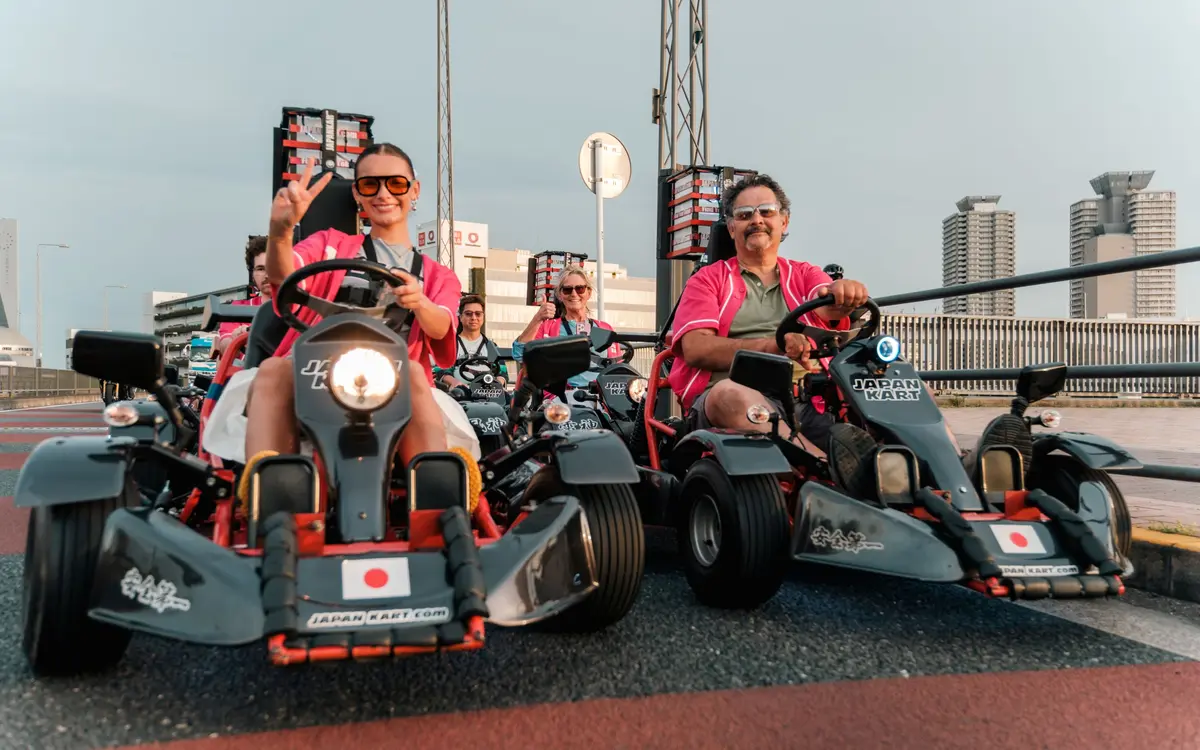
Every guest drives a single-seat road-legal kart through ordinary traffic. A lead vehicle and rear support vehicle organize the group, but they do not remove your obligation to obey signals, road markings, pedestrians, cyclists and surrounding vehicles.
Japan drives on the left. The low seating position makes buses, road spray, heat, cold and surface changes feel more immediate than they do from a car. If you are not already a calm, attentive driver, a Tokyo street is not the place to test whether you enjoy basic vehicle control.
Never participate after drinking alcohol, using impairing medication or becoming too tired to drive. Leave enough time after the tour before any non-changeable train, flight or restaurant booking because traffic can change the return time.
What to know
Fit, clothing and weather change the experience
JAPANKART says the minimum age is 18 and does not publish a strict height or weight ceiling. Its route guidance warns that drivers over 190 cm may feel cramped and that performance may be reduced above 100 kg. Ask the operator before booking if getting into a low kart, joint mobility or body fit may be difficult.
Wear closed, secure shoes and clothing that cannot obstruct the pedals or steering. The operator prohibits sandals, high heels and skirts for driving and advises against loose, flowing items. Winter layers, gloves and sun protection matter because the vehicle is open.
Tours can continue in light rain with ponchos, while severe conditions may cause cancellation or rescheduling. Wet roads reduce comfort and visibility. Do not assume that rain on a non-refundable reseller booking automatically gives you the operator’s direct-booking refund.
What to know
Use the guide’s photo service instead of touching your phone
The operator includes route photos and says hands-free action cameras can be used. Its tour-flow guidance explicitly says guests may not use smartphones while operating the kart because doing so violates Japanese law.
Set any approved action camera before departure and do not touch, watch or adjust it in motion. Although some package descriptions mention smartphone holders, that wording is not permission to operate a phone while driving. Ask the operator what fixed setup is allowed.
Costume rental is included, but JAPANKART says it does not provide Nintendo or Mario Kart costumes because of copyright restrictions. Creators planning sponsored or commercial content should arrange permission through the operator’s collaboration channel rather than assuming an ordinary tour purchase covers production.
What to know
Insurance is included, but it does not erase driver liability
JAPANKART’s route pages publish coverage ceilings of up to ¥80 million for bodily injury, ¥2 million for property damage and ¥5 million for passenger accidents. Its one-hour page also uses both “optional insurance” and “insurance coverage” in different sections, so confirm the exact cover attached to your Klook package rather than relying on one summary line.
The operator’s current insurance FAQ says use of the policy carries a participant deductible of at least ¥50,000 and that kart damage starts at ¥25,000, with higher charges possible depending on the damage. Those are operator-stated terms and limits, not a promise that every event or cost is covered.
Ask about exclusions, rule violations, loss-of-use charges and the procedure after an incident. Your own travel policy may exclude motorized public-road activities. The guide’s presence and an insurance line item do not transfer legal responsibility for your driving decisions.
What to know
Missing documents and late arrival can make the full booking worthless
JAPANKART’s direct terms say guests refused for missing or invalid driving documents do not receive a refund. Its route pages also warn that late arrivals may not be able to participate. Build extra time for the station exit, shop search, document check, briefing and changing clothes.
The operator’s direct cancellation policy currently offers a full refund up to 24 hours before departure, no refund inside 24 hours, and a refund or possible reschedule if the operator cancels for bad weather. A Klook booking can attach different reseller terms, and the package shown at checkout controls that transaction.
If a document, branch or weather decision is still unresolved, contact the operator and Klook before the cancellation deadline. Do not wait for a gate refusal to discover that a permit is the wrong convention.
What to know
How to book the Klook option safely
Select the package first, then compare the displayed price and terms. The current one-hour option is labelled Sky Tree Branch; the two-hour option is labelled Asakusa Branch. Save the exact duration, start time, address, cancellation deadline and participant count from the final confirmation.
Each participant who drives needs an accepted original document set. A non-driving companion or escort-vehicle seat should never be assumed from an old review or photo; ask the operator about current availability before paying.
The best purchase sequence is licence confirmation, route choice, branch confirmation, weather tolerance and only then checkout. The affiliate button below is intentionally placed after those checks because a discounted ticket has no value if the driver cannot legally join.
A good fit
Put it on your list if...
- Confident licensed drivers seeking an active East Tokyo experience
- Travelers choosing a route for specific districts rather than a generic kart ride
- Small groups who have confirmed every driver’s original documents
- Creators using an approved hands-free setup and operator photo service
Think twice
Skip or reconsider if...
- Anyone with an unverified, digital-only or Vienna Convention permit
- Nervous drivers or travelers uncomfortable in dense city traffic
- Visitors expecting the one-hour tour to include Tokyo Bay and Ginza
- Anyone needing a perfectly timed return or weather-proof activity
Booking option
Check the current ticket before paying.
The link opens Klook’s English listing with USD selected. Confirm the driver documents and exact shop with JAPANKART before choosing the one- or two-hour package.
- The one-hour Skytree option does not include the full Tokyo Bay and Ginza route.
- Bring the accepted original licence set and passport; booking confirmation is not legal validation.
- Confirm the final meeting address because JAPANKART’s published branch pages currently conflict.
- Read Klook’s package-specific refund and weather terms before payment.
Evidence and commercial terms
Sources checked
Government and operator or venue pages establish rules and practical details. Booking-service pages are commercial sources for the package and checkout terms only. Open the relevant sources again before travel.