
Before you book
Make these decisions in order.
- 01
Confirm the exact Nagoya meeting point, check-in time, vehicle, escort role and estimated return on the final Klook voucher.
- 02
Choose a walking plan for Daimonzaka, the shrine-temple complex and waterfall before arrival rather than improvising on the steps.
- 03
Wear broken-in walking shoes and carry rainwear, water, sun protection and cash for optional paid areas and food.
- 04
Check official Kumano trail closures and Japan Meteorological Agency warnings on the morning of departure.
- 05
Do not schedule a Shinkansen, flight or non-refundable dinner immediately after the estimated Nagoya return.
What to know
This is a long transfer for a rare Nagoya day trip
Klook presents activity 80054 as an 11-hour join-in tour departing from Nagoya. Its main advantage is reaching the remote Nachisan area without coordinating several trains and local buses or changing hotels.
That convenience comes from compressing a Kii Peninsula journey into one day. A meaningful portion of the schedule is inside the vehicle, and congestion, weather or service-area stops can change both walking time and the return to Nagoya.
Book it when avoiding an overnight stay is more important than a slow pilgrimage. Travelers who want silence, local interpretation, sunrise, multiple Kumano Sanzan shrines or a longer trail should stay in the region instead.
What to know
The World Heritage status covers a living cultural landscape
UNESCO’s “Sacred Sites and Pilgrimage Routes in the Kii Mountain Range” includes Kumano Sanzan, Koyasan, Yoshino and Omine, their connecting routes and surrounding forest landscape. It was inscribed in 2004.
The significance is not that every stone staircase is an isolated monument. UNESCO describes more than 1,200 years of interaction between Shinto nature worship, Buddhism, pilgrimage routes and sacred mountains.
Treat Daimonzaka, the shrine, temple and waterfall as active religious places. Stay on the path, keep voices controlled around worship, carry out rubbish and avoid blocking steps for staged photographs.
What to know
Daimonzaka is short in distance and real in effort
The official Kumano tourism guide describes Daimonzaka as about 600 metres of stone staircase with 267 steps, lined with old cedar, cypress and camphor trees. Its route data gives about one kilometre and 30 minutes for the slope section under good conditions.
That time excludes stops and the additional climb to Kumano Nachi Taisha and Seigantoji. The same official guide suggests another roughly 20 minutes of stairs from the top of the slope to the shrine complex.
The route is not technical hiking, but wet cobbles and roots are slippery. A traveler with knee, balance, heat or mobility limitations should confirm whether the vehicle allows a shorter start near Nachisan or the falls rather than assuming the full ascent is mandatory.
What to know
Walk uphill first and finish toward the waterfall
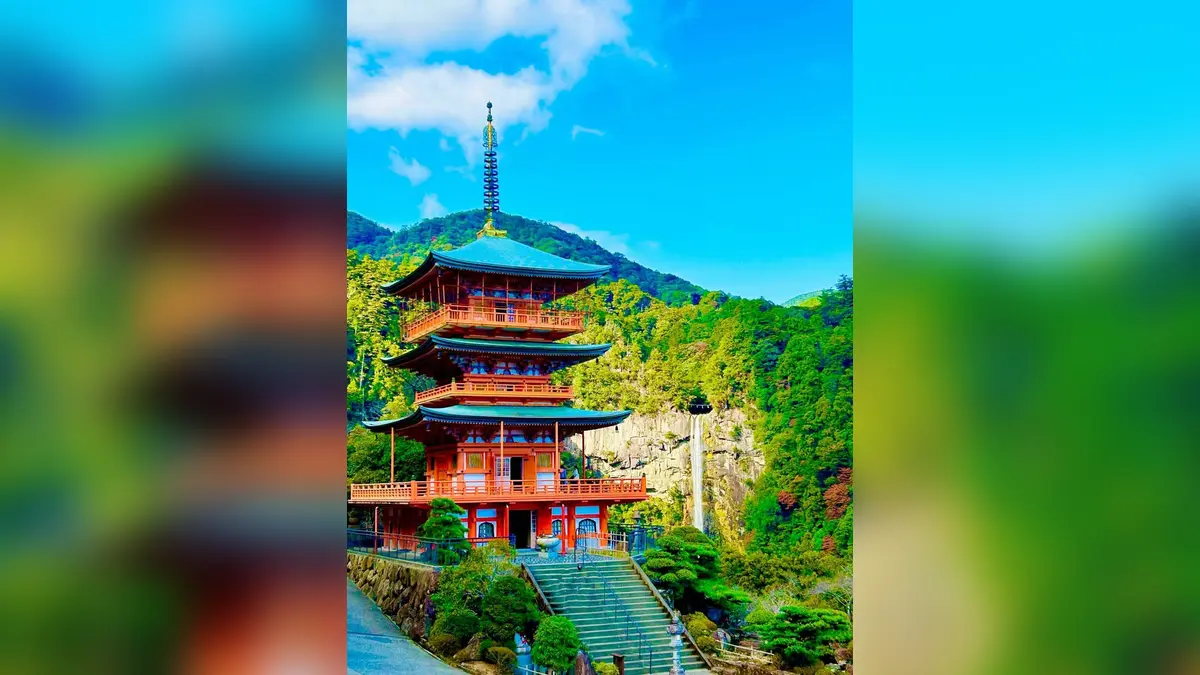
The local tourism bureau’s practical sequence is to climb Daimonzaka toward the shrine grounds, visit Kumano Nachi Taisha and Seigantoji, then descend beside the pagoda toward Nachi Falls.
This produces the classic relationship between the red pagoda, forest and waterfall without repeatedly climbing the same stone slope. It also places the falls later in the route, which may match a downstream vehicle pickup only if the voucher confirms it.
Do not copy another traveler’s meeting arrangement from a review. Use the exact drop-off, pickup point and meeting time issued for your departure, and reverse or shorten the walk when the operator instructs.
What to know
Kumano Nachi Taisha and Seigantoji are two traditions side by side
Kumano Nachi Taisha is one of the three Kumano Sanzan grand shrines and has its religious origin in worship of Nachi Falls. The shrine sits around 350 metres above sea level and the main grounds are free under the current official visitor information.
Neighboring Seigantoji is a Buddhist temple. The shrine and temple demonstrate the long interaction of Shinto and Buddhism that gives the World Heritage landscape its meaning; they should not be reduced to one pagoda photo stop.
Optional interiors and viewing areas can charge separate fees. The local guide currently lists ¥300 for the shrine treasure hall and ¥300 for the falls viewpoint, while Seigantoji’s pagoda also requires a small separate fee. Bring yen and verify the current opening time on arrival.
What to know
Nachi Falls is sacred as well as spectacular
The official Kumano guide gives Nachi-no-Otaki a height of 133 metres and width of 13 metres and identifies it as Japan’s tallest waterfall. Its water source is the protected broad-leaf evergreen forest above.
The waterfall is a sanctuary of Kumano Nachi Taisha, not an adventure-swimming site. Follow the shrine path and viewpoint rules, keep clear of restricted ground and do not use ordinary tour admission as permission for commercial filming.
Rain can increase water volume while simultaneously making the trail and roads unsafe. A stronger-looking waterfall is never a reason to ignore a weather warning or an operator’s shortened itinerary.
What to know
The public Klook page leaves important itinerary details unresolved
The current page advertises an 11-hour join-in trip, Chinese, English and Japanese service, roughly four hours around the Kumano trail, and views of Lion Rock and Kumano Beach from the vehicle.
It does not establish in the public summary whether each departure has a licensed cultural guide, a multilingual tour leader or primarily transport coordination. Customer reviews describe different experiences and are not package guarantees.
Before payment, open the selected package details or contact Klook to confirm the operator, meeting landmark, check-in time, minimum group, commentary, meal inclusion, exact walking window, coastal stops, child rules and late-return procedure.
Compare the selected package
Check live packages and the total price for your date.
Use the same date, meeting point, route, language, admissions, meals and add-ons when comparing Klook with another seller or a self-planned day. Choose the better complete cost, control and cancellation terms.
Check the Kumano Kodo and Nachi Falls tour from Nagoya on Klook↗Read the official Daimonzaka route and safety guidance ↗Non-affiliate link
Paid link. Commercial details checked July 27, 2026; availability and terms can change.What to know
Weather can change both the walk and the highway
The Kii Peninsula is one of Japan’s wettest regions. The official trail-safety guide warns that heavy rain and typhoons can cause flash flooding, landslides, road damage and sudden transport disruption.
Daimonzaka’s old stones and roots become especially slippery when wet. In summer, heat and humidity add heat-exhaustion risk; the local bureau recommends water, a hat, sunscreen, breathable clothing, breaks and sturdy walking shoes.
Check the official trail closure page and weather warnings on the day. A closure elsewhere on the wider Kumano Kodo does not automatically close Daimonzaka, so read the exact route name and follow the operator’s local decision.
What to know
Pack for a trail, bus and sacred site in one day
Wear broken-in walking or hiking shoes with grip. Carry light rainwear, water, sun protection, insect protection, a small towel, portable battery and a warm layer for the long air-conditioned ride.
Use a small day pack rather than a rolling suitcase. The product page does not guarantee large-luggage storage, and a full coach or small vehicle may have restricted space.
Bring cash for food, offerings and optional entry. Confirm whether lunch is included; if it is not, the independent walking window must cover eating as well as the shrine, temple and falls.
What to know
Protect the return evening in Nagoya
An 11-hour advertised duration is an estimate, not an arrival guarantee. Highway congestion, weather, comfort stops and group timing can push the return later.
Do not book a same-evening flight, last train, expensive restaurant or non-refundable event immediately after the scheduled return. Keep access to your hotel and enough battery for a late arrival.
If you must make a fixed connection, visit Kumano with an overnight stay and rail or local transport that you can control more directly. A long join-in day tour is valuable only when the final hours remain flexible.
What to know
Final booking checklist
Confirm date, Nagoya meeting point, check-in time, vehicle, operator, escort language, commentary, minimum group, meal, independent walking time, coastal stops and return estimate.
Decide whether every traveler can manage at least the 267 Daimonzaka steps plus the shrine and waterfall route. Ask about the shorter-access alternative before the cancellation deadline if needed.
Save the voucher, map, operator contact, weather warning page and trail-closure page offline. Pack walking shoes, water, rain and heat protection, cash and a battery, then leave the Nagoya evening open.
A good fit
Put it on your list if...
- Nagoya-based travelers who cannot add a Kumano overnight stay
- Visitors comfortable with a long road journey for a major sacred landscape
- Active travelers able to climb and descend stone steps
- Photographers interested in the pagoda, forest and waterfall relationship
- Travelers who can keep the return evening flexible
Think twice
Skip or reconsider if...
- Visitors expecting a relaxed multi-day pilgrimage
- Travelers who need guaranteed detailed English cultural commentary
- Guests with unconfirmed mobility, balance or knee limitations
- Anyone wearing sandals or smooth-soled city shoes in wet weather
- Travelers with a fixed flight, last train or timed event after the tour
- Visitors treating customer-review itineraries as current package promises
Booking option
Check the current tour terms before paying.
The paid link opens Klook activity 80054 in English and USD without fixing a date or party. Open the selected package details to confirm the current meeting, escort, walking and cancellation conditions.
- The product currently advertises 11 hours, but traffic can delay the return.
- Confirm what Chinese, English and Japanese service means for the selected departure.
- Verify the Nagoya meeting point and final pickup route on the voucher.
- Check whether lunch, optional admissions and coastal stops are included.
- Review weather, trail-closure, cancellation and minimum-group rules.
Evidence and commercial terms
Sources checked
Government, destination and transport pages establish safety, access and current operating facts. Booking-service and seller pages are commercial sources whose terms apply only to their own channel. Open the relevant sources again before travel.