Do this now
Follow these steps in order.
- 01
Check the exact branch for an eat-in sign or locator icon, then confirm any posted opening hours or temporary closure.
- 02
Look for a free permitted seat without leaving luggage or valuables to reserve it.
- 03
Tell the cashier “Īto-in de tabemasu” before payment, or choose the eat-in option shown by the register.
- 04
Identify which food or drink you will consume there if the rest of the basket is takeaway.
- 05
Pay before opening or eating ordinary shelf products; follow the store’s stated checkout and preparation process for coffee, heating and other equipment.
- 06
Use only the designated table or counter and only the products the sign or staff permits.
- 07
Keep bags, suitcases, strollers and chairs out of aisles, doors and accessible routes.
- 08
Finish without turning a small shared seat into an unapproved office, charging station or group meeting place.
- 09
Wipe ordinary crumbs, report spills or breakage, and sort only accepted waste at the marked return point or bin.
- 010
Ask staff when your plan changes, the seat closes or any rule is unclear.
What to know
Not every convenience store has an eat-in area
The brand sign outside does not promise seating inside. Eat-in facilities are installed branch by branch, and an individual store can remove seats, close them temporarily, restrict them to certain hours or limit the available places without closing the retail floor.
FamilyMart’s official locator uses a fork-and-spoon icon for listed eat-in stores. Its FAQ also warns that outside benches and shared eating spaces in office buildings are not shown, so even a locator result is not a complete description of the actual site. Natural Lawson likewise states that some stores do not have an eat-in area.
Use the locator as a lead, not a reservation. At the door, look for イートイン, 利用時間, 使用中止, 飲食禁止 or another current notice. If the seats are blocked, stacked, roped off or being cleaned, treat them as closed and ask before moving anything.
What to know
Identify the exact space before opening food
A real eat-in area is normally marked as customer dining space with a counter, table or seats. A packing shelf, window ledge, ATM waiting area, magazine corner, toilet approach, stair landing or employee break space is not a substitute.
In a station, hospital, office tower or shopping complex, nearby seating may belong to the building rather than the convenience store. Its operating hours, eligible shops and waste route can be different. Ask “Kono seki wa konbini no īto-in desu ka?”—“Is this seating the convenience store’s eat-in area?”
An outdoor bench is equally ambiguous. Use it only when the store identifies it as an eating place or staff confirms it. The separate guide on eating outside a convenience store covers entrances, pavements, parking areas and local outdoor rules.
What to know
Check for a seat, but do not reserve one with belongings
A quick look before shopping can prevent buying a hot meal for a closed or full area. However, do not leave a phone, wallet, bag, coat or suitcase on a chair while you browse. The seat is shared, valuables can be lost, and unattended luggage can block the limited space.
If the store uses a reservation card, numbered place or another explicit system, follow that instruction. Otherwise, buy the food and take an actually free seat after checkout. One person should not occupy extra chairs for shopping bags when another customer needs them.
A queue for the seats is separate from the register queue unless the shop marks a combined process. Do not stand across the entrance or reach over seated customers to claim the next place.
What to know
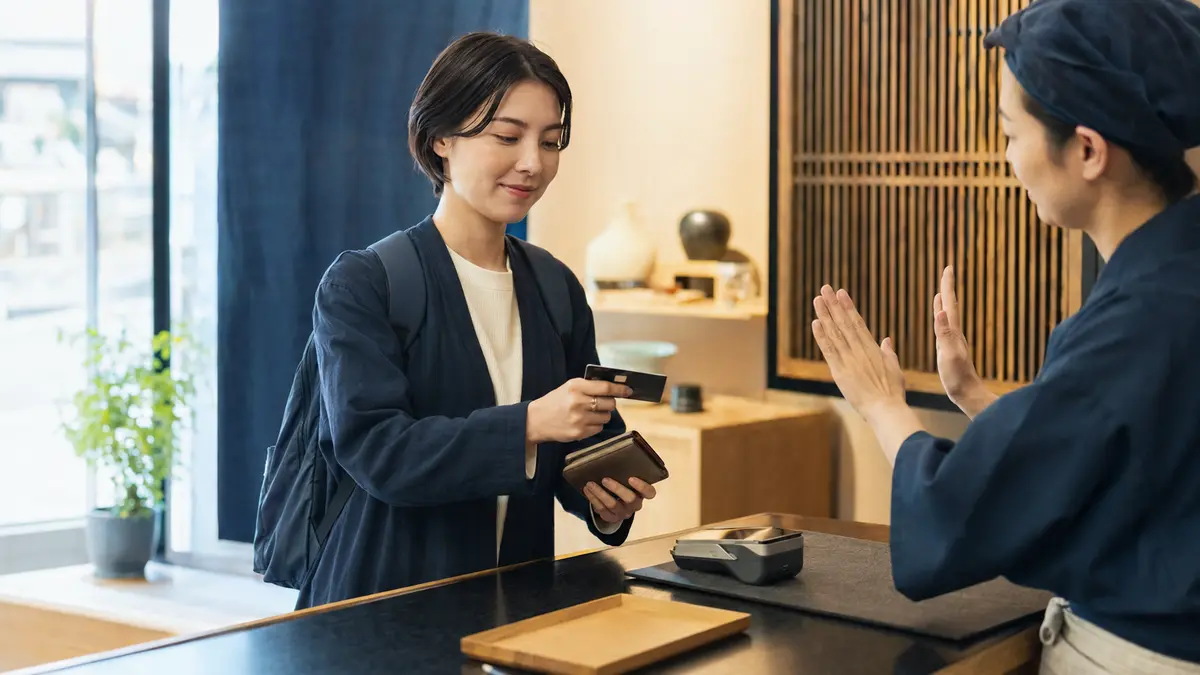
Tell the cashier before paying
When you intend to eat in the designated area, say “Īto-in de tabemasu”—“I will eat in”—before the transaction is completed. A self-checkout or mobile checkout can instead show an eat-in or takeaway choice; follow that prompt and ask staff if the option is unclear.
Do not wait for every cashier to ask. The National Tax Agency expressly allows a convenience store to use a sign such as “Please tell us if you will use the eat-in corner” instead of questioning every customer where the store operates on the premise that most food is takeaway.
Point to the applicable items when the basket is mixed: “Kore wa īto-in de, kore wa mochikaeri desu”—“This is eat-in; this is takeaway.” Let the register apply the store’s treatment rather than trying to calculate a tax adjustment yourself.
What to know
Takeaway food is usually 8%; eat-in food service is 10%
Japan’s reduced consumption-tax system began on October 1, 2019. Qualifying food and non-alcoholic drink sold for takeaway normally use the reduced 8% rate. Food supplied for consumption using the seller’s designated table, seat or counter is treated as food service and uses the standard 10% rate.
The container does not decide the rate by itself. A bento, sandwich, hot snack or qualifying non-alcoholic bottled drink can be handed over in the same takeaway packaging in either case; the store classifies the supply from the customer’s stated plan and its actual facility arrangement when the food is provided.
A shelf label can show a tax-inclusive takeaway price, so the register total may be slightly higher for eat-in. The difference is consumption tax, not a cover charge, tip or fee for reserving the seat.
What to know
Alcohol is not an 8% takeaway item
Alcoholic drink is excluded from the reduced food-and-drink rate, so it is generally subject to the standard 10% consumption-tax rate whether it is taken away or consumed in a permitted location. Do not describe an alcohol purchase as changing from 8% to 10% merely because of the seat.
The tax rate does not grant permission to drink in the eat-in area. The store, building and municipality can restrict alcohol by product, place or time, and staff must not sell alcohol to anyone under 20. Ask before opening it and carry identification when an age check is required.
Never drive or cycle after drinking. If the store does not clearly permit alcohol at the table, keep the container closed and choose a lawful setting.
What to know
A mixed purchase can need item-by-item clarification
If you will eat one individually sold item now and carry the others away, identify them before payment. The register can treat separate supplies according to the declared plan. Do not simply announce “takeaway” for the whole basket while intending to open part of it at the table.
If the store sells the meal as one set product, declaring any part for eat-in makes the whole set food service at 10%. Separately priced items can be treated separately; ask staff how the product is sold and let the register apply that treatment.
Coupons and free-item promotions can also calculate differently when an eat-in item uses the standard rate. Show the coupon before payment and accept the amount produced by the valid offer and register.
What to know
If your genuine plan changes, ask before sitting
Tax guidance determines eat-in or takeaway from the intention confirmed when the food is supplied. A later change caused by rain, a delayed train or another practical event is not a reason to hide what happened or argue with another customer.
Keep the receipt and ask staff before using the area: “Mochikaeri de kaimashita ga, koko de tabete mo ii desu ka?”—“I bought this to take away, but may I eat here?” Follow the store’s operational instruction. This guide does not promise that every register can reopen a completed transaction in the same way.
If you declared eat-in but then need to leave, take unopened or safely portable food with you unless the store used returnable tableware or gives a different instruction. The original classification was made when it was supplied; do not demand a tax refund because you left early.
What to know
Pay before opening or eating; follow the preparation process
Ordinary shelf food remains sale stock until the purchase is completed. Bring it to the staffed register, self-checkout or authorized mobile-checkout process, resolve any age or barcode prompt and confirm successful payment before opening it.
Microwaves, hot-water dispensers, coffee machines, condiment stations and utensils follow the exact store’s process. Some equipment is customer-operated and some is staff-operated. Ask before using it, follow the package heating time and never heat metal, sealed eggs, unsuitable containers or food from another business without permission.
Do not carry an open soup, uncovered hot food or filled cup around the sales floor. Complete preparation in the marked area and move carefully to the seat.
What to know
Treat the space as being for that store’s permitted products
Official FamilyMart locator wording describes eat-in as a place to consume purchased products, and Natural Lawson similarly describes enjoying products bought at the store. The safest default is therefore to use a branch’s seats for products purchased there during that visit.
There is no reliable nationwide chain rule that makes all outside food either allowed or forbidden. A shared building lounge can use a different policy from a store-controlled counter. Ask before bringing restaurant takeaway, another chain’s coffee, hotel breakfast, a packed lunch or delivery food.
A store can also limit which of its own products may be consumed in a particular area. Follow signs that specify drinks and bread only, prohibit alcohol, or direct strong-smelling or messy food elsewhere.
What to know
Keep aisles and accessible places clear
Place bags under control without extending straps, suitcases, strollers or shopping baskets into the aisle. Keep wheelchair turning space, the path to the register and toilet, emergency access and the route used by staff completely open.
Do not move fixed furniture or borrow another table’s chair without permission. High counters, narrow gaps and fixed stools are not accessible to everyone; ask whether another permitted place is available instead of blocking the route while improvising one.
Facilities such as a customer toilet, accessible toilet, child seat or step-free route vary by branch and building. An eat-in icon alone does not promise any of them.
What to know
Keep the visit short, quiet and purchase-focused
An eat-in counter is a small shared dining facility, not automatically a coworking lounge. Finish the purchased food, keep calls and videos quiet, use headphones without sound leakage and leave the place available for the next customer.
Time limits, laptop use, studying and group meetings are store policies, not one national rule. Follow a posted limit and a staff request even when seats remain empty. Do not spread notebooks, cosmetics, parcels or merchandise across the eating surface.
Electrical outlets and USB ports are not invitations unless a sign clearly authorizes customer charging. Wi-Fi availability, login terms and signal coverage also vary. Never unplug store equipment or run a cable across a route.
What to know
Leave the table ready for the next person
Collect wrappers, lids, chopsticks, napkins and small tabs before standing. Wipe ordinary crumbs or droplets with the material provided, but tell staff immediately about a large spill, broken glass, a sharp object or a hot-food accident so they can make the area safe.
Return reusable trays, baskets or tableware to the labelled point. Do not stack liquid-filled cups where they can tip, leave food in a return tray or place waste on a clean utensil shelf.
Pushing two tables together, moving a sign or leaving a used surface for staff to discover creates work and can reduce the number of available seats. Restore any movable item only as the store directs.
What to know
Sort waste only where the labels accept it
Use the store’s labelled openings for accepted waste from the visit. Cups, leftover liquid, burnable waste, cans and PET bottles can have different routes, and a specialised bottle-recovery machine is not a general rubbish bin.
Do not bring household waste, hotel rubbish or another business’s packaging to the store. If a suitable bin is absent, closed or full, seal the waste and carry it away. Ask “Gomi wa doko desu ka?”—“Where is the waste point?” instead of leaving items beside a bin.
Empty a drink, ice or soup only into a receptacle explicitly provided for liquids. Never use a hand basin, toilet, planter, rain drain or recycling opening as an improvised disposal point.
What to know
Smoking requires a separate marked facility
Do not smoke or vape at an eat-in table. Japan’s passive-smoking framework requires smoking places to be identified, and a smoking-only room cannot be used for eating or drinking. A historic ashtray or a cigarette sale is not permission.
Use only a currently marked smoking facility if the store or building provides one. People under 20 are not allowed to enter a smoking area, even to accompany someone else or to work there.
Eating, drinking, smoking and outdoor public-space rules are separate questions. A permitted meal does not override a local street-smoking restriction, and a smoking facility does not expand the eat-in area.
What to know
When the area is unavailable, switch plans cleanly
If the area closes, fills or does not accept the product, keep unopened food packaged and use a clearly permitted alternative. Your accommodation, a designated food court or a park rest area that permits eating can be better than standing beside the store entrance.
Do not move to the doorway, curb, car park, neighboring steps or another tenant’s furniture merely because you paid at the store. Those places have separate access, property and local rules.
If you need a seat for a disability, pregnancy, illness or heat safety, explain the immediate need to staff. They may identify an accessible option or another nearby facility, but the presence of retail space alone does not guarantee customer seating.
If that does not work
Use the fallback.
- No eat-in sign or open seat: keep the food closed and choose another permitted place.
- The cashier did not ask: state your eat-in plan before payment.
- A mixed basket is confusing: point out which individual items are eat-in and which are takeaway.
- Your plan changed after checkout: keep the receipt and ask staff before sitting.
- Outside food, charging or laptop use is unclear: do not assume; ask first.
- The bin is missing or full: seal and carry the waste away.
- Staff closes the area: collect everything and comply promptly.
Before you need it
Save this offline.
- イートイン · īto-in = designated eat-in / dine-in area
- 持ち帰り · mochikaeri = takeaway
- 店内飲食 · tennai inshoku = eating or drinking on the premises
- Īto-in wa tsukaemasu ka? = May I use the eat-in area?
- Īto-in de tabemasu. = I will eat in.
- Kore wa īto-in de, kore wa mochikaeri desu. = This is eat-in; this is takeaway.
- Kono seki wa tsukaemasu ka? = May I use this seat?
- Denshi renji o tsukaemasu ka? = May I use the microwave?
- Gomi wa doko desu ka? = Where is the waste point?
- Koko de tabete mo ii desu ka? = May I eat here?
Primary evidence
Official sources used
Open these pages again before travel. External links lead to the responsible Japanese authority or transport organization.